
LSA-1193
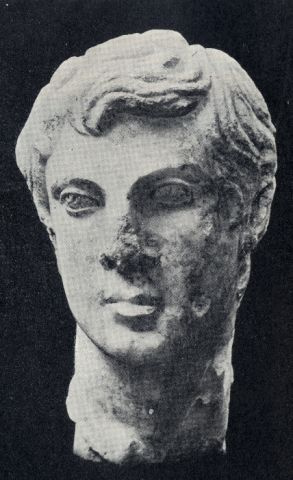
Head for insertion of Menander. Rome. Fourth to fifth century.
Record details
Photographs
Bibliography
- Fittschen, K.'Zur Rekonstruktion griechischer Dichterstatuen. 1. Die Statue des Menander', Mitteilungen des Deutschen Archäologischen Instituts, Athenische Abteilung 106, Berlin 1991, 269, no. 40
- Mustilli, D. 'Di alcune sculture, trovate tra il Foro della Pace e l'Anfiteatro', Bullettino della Commissione archeologica comunale di Roma 61, Rome 1933, 101-104, no. 9, fig. 8 (Menander, 4th c.)
Discussion
DESCRIPTION (Object)
Over life-size head. H: 34, H (chin to hair on brow): 19.5 cm. Greek marble with large and shiny crystals.
The nose and ear lobes are chipped. The irises and pupils appear to be indicated by parallel engraved arcs. The head was worked separately and inserted into a statue but seemingly without a significant tenon. The turn of the head is faithful to the original seated statue and perhaps it was mounted on a seated figure.
PROVENANCE
The statue was found during the excavation of the Via dei Fori Imperiali between the Forum of Peace and the Colosseum.
DESCRIPTION (Subject)
The portrait head shows a clean-shaven man who turns significantly to his right. It is a version of the portrait of Menander, the Greek playwright of the new comedy who was immensely popular in the Roman world. There are c. 75 extant copies of this type.
Here the large curving lock over the centre of the brow combined with the long face and clean-shaven cheeks make it readily recognizable. However, the physiognomy has been greatly simplified; the cheeks are immobile and without signs of age; the mouth is small and regular; and the chin without its defining line beneath the lower lip.
DATE
This is a youthful and simplified rendition of the well-known model. The rendering of the pupils and the heavy outline of the eyeballs seem to correspond to techniques visible on fourth-century portraits in Rome; see for example images of Constantine and his family at LSA-554, LSA-556, and LSA-381.
HONORAND
The portrait of Menander is the most popular Roman period image of a cultural figure. It is probably not surprising that this continues into late antiquity. There are six other late-antique versions of the portrait recorded in LSA; LSA-238, LSA-680, , LSA-2106 , LSA-2109, LSA-2110, LSA-2111. Three of these come from Asia Minor and the other three from Rome, areas where traditional classical culture continued to flourish.
Cite: Last Statues of Antiquity, LSA-1193 (J. Lenaghan).