
LSA-1196
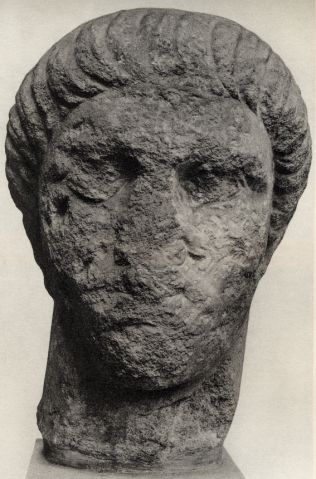
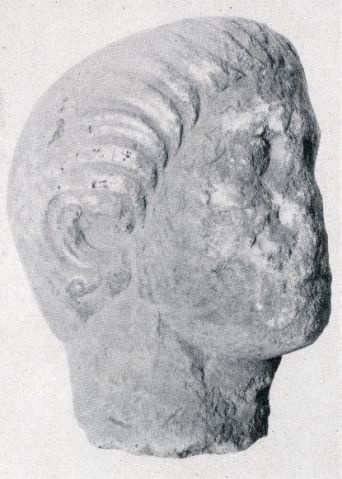
Colossal portrait of Emperor with lank hair brushed forward. From Thessalonica. Fourth century.
Record details
Photographs
Bibliography
- Gardner, E.A. and S. Casson. 'Macedonia. II. Antiquities found in the British zone 1915-1919', The Annual of the British School at Athens 23, London 1918-1919, 39, pl. 10.2
- Gross, W.H., Bildnisse Traians. Römische Herrscherbild. II. Abteilung, vol. 2., Berlin 1940, 130, no. 55, pl. 25b (Trajan)
- L'Orange, H. P., Das spätantike Herrscherbild von Diokletian bis zu den Konstantin-Söhnen, 284-361 n. Chr. Das Römische Herrscherbild. III. Abteilung ; Bd. 4 , Berlin 1984, 132 (son of Constantine)
Discussion
DESCRIPTION (Object)
Colossal portrait head. H: 45.5 cm. 'Greek' coarse-grained marble.
The head is broken through the neck, near its base. It is badly worn. The face is battered, making the physiognomy almost illegible. The back of the head is preserved and appears to have no representational detail.
PROVENANCE
The head was found in 1918 in proximity to a milestone which was found at the end of 1917 at the 6th kilometre of the Salonika-Serres road. The milestone (H: 4 feet, D: 1 foot) has an inscription datable to the reign of Trajan which refers to the repair of the Via Egnatia between Durazzo and Kavala.
DESCRIPTION (Subject)
The portrait depicts a clean-shaven man with lank straight hair that is brushed regularly forward on to the brow. The c-shaped locks all curve gently to the honorand's left. The chin is deep and full. The eyes appear to have been large with sagging skin under the lower lids. The corners of the mouth seem up-turned, indicating a possible smile. There is no extant trace of naso-labial folds.
HONORAND
The size of the portrait indicates that it is an Emperor. At this large-scale, portrait images often featured more ideal physiognomies. This fact combined with the battered condition of the head make it difficult to identify securely.
Because of its find proximity to a Trajanic milestone, the head was immediately identified as Trajan. Gross accepted this identication and placed it in his list of Type V Trajans. Jucker in his 1957 review (in the American Journal of Archaeology) of Gross' volume in the Herrscherbild series argued that the head was an unidentifiable portrait of the fifth century.
Unlike most versions of the Emperor Trajan, the hair at the sides of the head is brushed forward. Also the eyes appear to have arching lower lids (not generally a characteristic of the narrow-eyed Trajan), and there are no naso-labial folds nor a short rounded chin (both distinctive characteristics of Trajan). These specific details may of course have been regularized in a large provincial version.
Unlike standard portraits of late antique Emperors, the head lacks a diadem. In this case the head might however have had a diadem in another material. Only the locks of hair from the ears forward appear to be rendered which could potentially be the result of a diadem. Moreover, as L'Orange has suggested, the head might represent a son of Constantine in which case a diadem would not be necessary. It merits note that portraits of Trajan or of the Trajanic era were often re-used for portraits of Constantine and his sons. The head of Constantine, now in Madrid, LSA 599, if faceless, would look much like this head from Thessalonica.
Thus both a Trajanic and a fourth to early fifth century date remain possible.
Discussion references
- Jucker, H. 'IV. Nachtrag zu W.H. Gross Bildnisse Traians, Berlin 1940', American Journal of Archaeology 61, New York 1957, 251, no. 22
Cite: Last Statues of Antiquity, LSA-1196 (J. Lenaghan).