
LSA-12
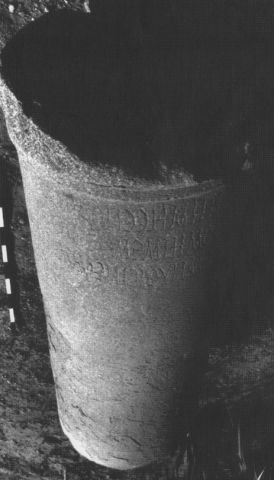
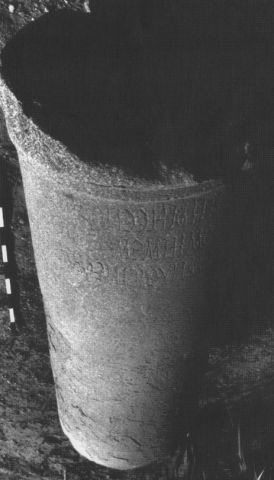
Columnar base for gilded bronze statue of Nomus, possibly governor of Palaestina. Caesarea Maritima (Palaestina I). Earlier fourth century
Record details
Photographs
Inscription
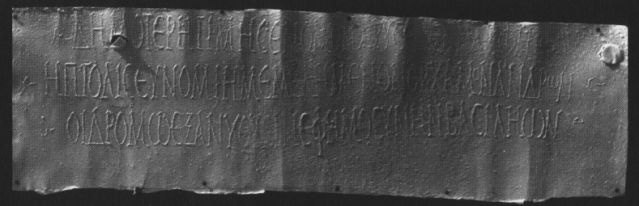
δημοτέρῃ τίμησε Νόμον χρυσέῃ ἐνὶ μορφῇ / ἡ πτόλις εὐνομίῃ μεμελημένον ὄρχαμον ἀνδρῶν / οἱ δρόμῳ ἐξανύουσιν ἐφημοσύνην βασιλήων
Inscription translation
Publicly with a golden statue the city honoured Nomus who is mindful of justice and a leader of men who hasten to accomplish the commandments of (the) emperors (trans. Lehmann & Holum)
Bibliography
- Lehmann, C. M. and K. G. Holum, The Greek and Latin inscriptions of Caesarea Maritima, Boston 2000, no. 25 pl. XXVI
Discussion
INSCRIPTION
Verse inscription of three hexameters laid out in three lines:
δημοτέρῃ τίμησε Νόμον χρυσέῃ ἐνὶ μορφῇ /
ἡ πτόλις εὐνομίῃ μεμελημένον ὄρχαμον ἀνδρῶν/
οἱ δρόμῳ ἐξανύουσιν ἐφημοσύνην βασιλήων
'Publicly with a golden statue the city honoured Nomus who is mindful of justice and a leader of men who hasten to accomplish the commandments of [the] emperors' (trans. Lehmann & Holum).
Letter height 7.5 - 8 cm. 'At the beginning of line 1 is a hooked stroke, and at the beginning of lines 2 and 3 and at the end of each line there are S-shaped signs and dashes. These marks seem decorative' (Lehmann-Holum).
DESCRIPTION (from Lehmann-Holum)
Section of the top of a grey granite column broken at the bottom: H 189 cm, diameter 63 cm at bottom and 69 at top moulding. On the top are eight holes varying from 2.5 cm to 5 cm in diameter and 1.8 - 2.8 cm deep. On opposite sides, 20 cm below the top, there are holes 3.5 and 5 cm in diameter, 2.8 and 3.2 cm deep respectively. These holes (which may have been for clamps, securing the statue-base above) intrude on line 1 near the beginning and the end.
PROVENANCE AND CURRENT LOCATION
Provenance is unknown (Lehmann - Holum, 56 no. 25). Now located in the Old City on the western side of the Inner Harbour.
HONORAND AND DATE
The exact position of the honorand Nomus is not explicit in the inscription, and he cannot be identified with a known figure. The good order (eunomia) of the community is the result of his justice, the principal virtue of late antique imperial officials, as glorified in verse inscriptions in the Greek East from the 4th century onwards. The majority of the monuments that use the term were dedicated to provincial governors, but higher ranking officials (like vicars and praetorian prefects) are also possible. The 'men who hasten to accomplish the commandments of the emperors' could refer to subordinate magistrates of a vicar or praetorian prefect, but they might refer to the lesser staff (the officium) of a governor. As Lehmann and Holum point out, the term orchamos can be used to refer to a governor (for example in the epigram for the governor Nonnus in Ephesus, LSA-731).
Lehmann - Holum suggest a date between 300 and 650, in other words the entire period of poetic late antique honorific inscriptions. However, our base should certainly be dated before 500, because after that date (if not before) non-imperial statues are extraordinarily rare. The plural 'basileon, of the emperors' should also be taken seriously, since the long syllable is not required by the metre of the verse - this suggests a dating not later than the middle of the fifth century, when the eastern emperors were still recognising a western colleague.
Imperial permission became obligatory for the dedication of a metal statue after the mid 4th century (Feissel 1984, Prmerstein 1912). Our text does not refer to it; this narrows the date further to the earlier 4th century.
FURTHER DISCUSSION
It is a striking feature of the honorific inscriptions in Caesarea that virually all of them were carved on free standing columns (our inscription, LSA-11, LSA-1090,LSA-1100, LSA-1105, LSA-1106, LSA-1107). There is no reason to doubt that these were statue bases, with statues set on top of the columns.
Discussion references
- Feissel, D. 'Notes d' Épigraphie chrétienne', Bulletin de Correspondance Hellénique 108, 545-579, Paris 1984
- Merkelbach, R. and J. Stauber (eds.), Steinepigramme aus dem griechischen Osten. Bd. 4. Die Südküste Kleinasiens, Syrien und Palaestina, Munich 2002, p. 316-7 no. 21/ 03/ 02
- Premerstein, A. v., 'Griechisch-Römisches aus Arkadien', Jahreshefte des Österreichischen Archäologischen Instituts 15, 197 - 218, Wien 1912
Cite: Last Statues of Antiquity, LSA-12 (Ulrich Gehn).