
LSA-120
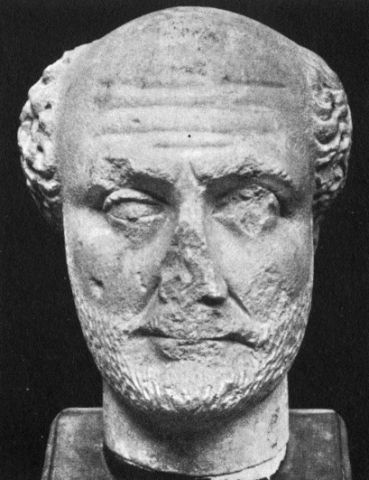
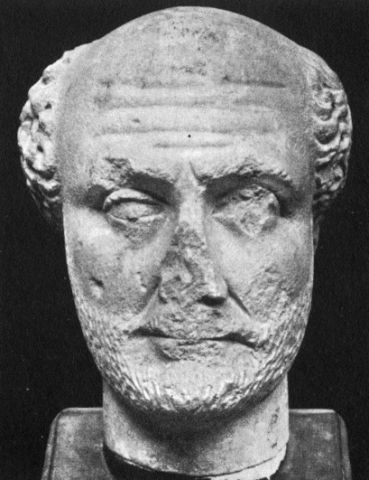
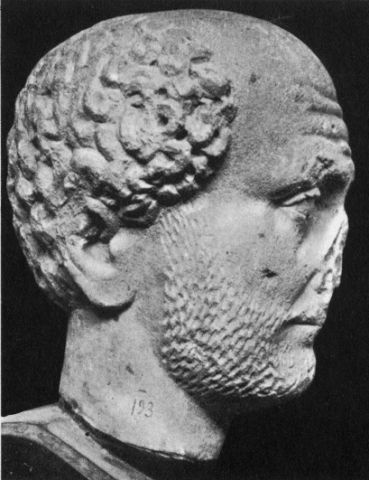
Portrait head of bearded man. Athens. Late third to earlier fourth century
Record details
Photographs
Bibliography
- L'Orange, H. P., Studien zur Geschichte des spätantiken Porträts, Oslo 1933, pp. 82-4, 145 no. 111 figs. 210-11
Discussion
DESCRIPTION (Object)
Marble portrait head of a bolding bearded male, neck horizontally cut under the adam's apple. The only measurement recorded by L'Orange 1933, 145 no. 111, is the distance moutline-uppermost furrow on the forehead (13 cm). Nose, lips, part of right eyebrow and of left eye are chipped off; further chips on cheeks and earshells.
The hair is divided into irregular round curls by chiselwork with some irregular drillpoints at the temples. The beard is marked by short chisel strokes.
The eyes are almond-shaped, the hair of the low arching brows is indicated by short vertical chisel-strokes, the beard in the same way. The heavy upper lid is separated from the orbital by a thin drill line. The lids don't meet at the inner side of the eyes; at the outer side the upper lid overlaps the lower. There is no marking of iris and pupil.
The modelling of the face is restricted to few and marked elements. The bold forehead is furrowed by five horizontal folds, deeply cut naso-labial folds run from the nostrils to the angles of the mouth. The lips are pressed together, separated by a thin drilled line.
PROVENANCE/ LOCATION
There is no published record on the provenance of the head. The stone, according to L'Orange 1933, is large-cristalled island marble; this does not necessarily, however, point to a non-Athenian production. Today the head is in the National Museum in Athens (without published inv. no.).
DESCRIPTION (Subject)
The portrayed is a mature man, as is indicated by the markedly bolding head, the trimmed beard, and the deep folds around the mouth and on the forehead; no further wrinkles, however, disturb the smoothness of the flesh, notably around the eyes. Despite the boldness of the calvary, the hair is rich around the temples and on the back.
The iconographic features - the trimmed hair and short beard – are appropriate for a ‘good citizen’ or a state official alike.
DATE
The head was discussed by L'Orange 1933, 82-3 together with the so called 'Elder Magistrate' from Aphrodisias the stylistic and typological characteristics of which - reduction of plastic values to few but marked caesuras and the severe expression of the face aroused by the firmly-pressed lips - he saw resembled in our head. The head in Aphrodisias had been dated to the 2nd quarter of the 5th century by the Norwegian scholar by comparison with the diptych in the Novara-cathedral, the so-called 'Novara-Patricius' (Delbrueck, 1929 pp. 248-50 N 6) and with the diptych of the consul of 428 Felix (Delbrueck 1929 pp. 93-5 N 3). L'Orange considered the Aphrodisian head as a main testimony for the reduction in plastic values that went beyond the subtle modelling of the 'subtle style' ('subtiler Stil') in the beginning of the 5th century (L'Orange 1961).
The Aphrodisias head, however, displays the ‘wreath-hairstyle’ for 5th-century magistrates’ portraits. This hairstyle is a reliable dating criterion for the 5th century, and it was empire wide fashionable. In Athens it is displayed by the heads LSA-117 and LSA-119. Its absence at our head indicates a pre-theodosian date.
Discussion references
- Delbrueck, R., Die Consulardiptychen und verwandte Denkmäler, Berlin & Leipzig 1929
- L'Orange, H. P., 'Der subtile Stil. Eine Kunstströmung aus der Zeit um 400 n. Chr.', Antike Kunst , 4 (1961) 68-75
Cite: Last Statues of Antiquity, LSA-120 (Ulrich Gehn).