
LSA-1200
Base for statue of Maximus, local benefactor. Stratonicea (Caria). Fifth century.
Record details
Photographs
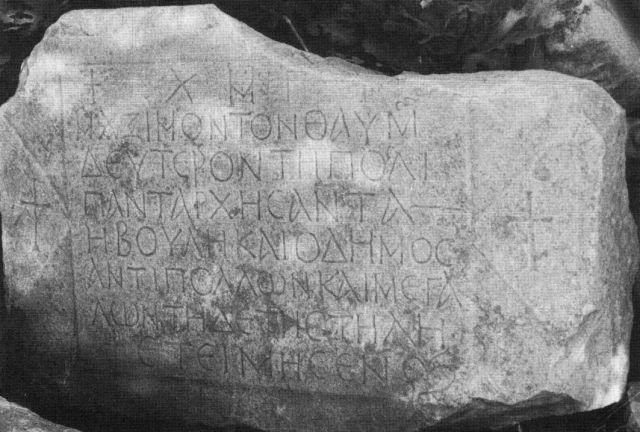
Inscription
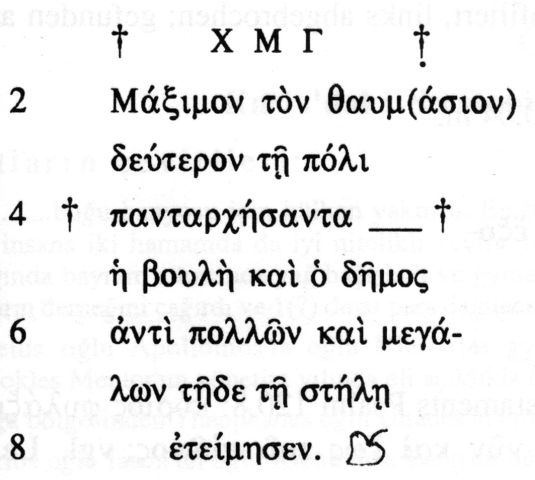
(cross) Χ(ριστὸν) Μ(αρία) Γ(εννᾷ) (cross) / Μάξιμον τὸν θαυμ(άσιον), / δεύτερον τῇ πόλι / (cross) πανταρχήσαντα, (cross) /(5) ἡ βουλὴ καὶ ὁ δῆμος, / ἀντὶ πολλῶν καὶ μεγά/λων, τῇδε τῇ στήλῃ / (cross) ἐτείμησεν. (ivy leaf)
Inscription translation
Christ was born to Mary. [You see] Maximus the admirable, who for the second time held all the offices of the city. The council (boule) and the people (demos) honoured him, for his many and great deeds, with this statue.
Bibliography
- Çetin Şahin, M. (ed.)
, Die Inschriften von Stratonikeia. Teil II, 2: Neue Inschriften und Indices (= Inschriften griechischer Städte aus Kleinasien (IK) 22,2), Bonn 1990, 30 no. 1387 - Varinlioğlu, E. Inschriften von Stratonikeia in Karien, Epigraphica Anatolica 12, 1988, 79-128, pp. 123-4 no. 87 pl. 3
Discussion
INSCRIPTION
In eight lines:
(cross) Χ(ριστὸν) Μ(αρία) Γ(εννᾷ) (cross) / Μάξιμον τὸν θαυμ(άσιον), / δεύτερον τῇ πόλι / (cross) πανταρχήσαντα, (cross) /(5) ἡ βουλὴ καὶ ὁ δῆμος, / ἀντὶ πολλῶν καὶ μεγά/λων, τῇδε τῇ στήλῃ / (cross) ἐτείμησεν. (ivy leaf)
'Christ was born to Mary. [You see] Maximus the admirable, who for the second time held all the offices of the city. The council (boule) and the people (demos) honoured him, for his many and great deeds, with this statue.'
Letter height 4 – 4.5 cm.
The inscription is set within a tabula ansata, with crosses in both ansae.
In line 2, both Jones and Staab (following a suggestion by Feissel) have θαυμ(ασιώτατον) ('the most admirable') instead of θαυμ(άσιον) ('the admirable') (see below, 'Honorand, Awarder and Date').
DESCRIPTION (from Varinlioğlu 1988 and the published images)
Rectangular block of marble broken and lost at both top corners, and at bottom right: H 66, W 103, D 38 cm.
This low but wide block is an unusual shape for a statue base; but the wording of the inscription, and the other dedications to Maximus (see below, 'Honorand, Awarder and Date'), make it quite clear that it once supported a statue.
PROVENANCE AND CURRENT LOCATION
First recorded by Varinlioğlu 1988 in the gymnasium of Stratonicea. There is no published record of its present location.
HONORAND, AWARDER AND DATE
Maximus, the honorand, was a citizen of Stratonicea, and received four dedications within the city (this one, LSA-657, LSA-1201, and LSA-1202). Here he is honoured because he had held civic office, and accomplished all civic duties, for the second time (lines 2-3), as well as for his many unspecified good deeds (lines 6-7). As Jones 2009 points out, the rank title of Θαυμ(ασιώτατον) is widespread in the 5th century for functionaries below the rank of illustris and is attached to the civic office of defensor civitatis in some inscriptions of the period.
The base was set up by the council and people (boule kai demos) of Stratonicea.
The initial invocation, and no less than five crosses, lend a decidedly Christian character to this inscription, which, unlike the other dedications to Maximus, is otherwise conservative and ‘civic’ in tone. The prominent Christian sentiments expressed in all the dedications to Maximus, are unlikely before the fifth century, providing us with an approximate terminus post quem. In one of the other inscriptions to Maximus (LSA-1201) he is praised for having paid, on behalf of his poorer fellow citizens, the tetraeterikon, a tax demanded every fourth year. This tax was abolished by Anastasius in 498, thereby providing a reliable terminus ante quem for him and his honours.
Discussion references
- Jones, C. P., New Late Antique Epigrams from Stratonicea in Caria, , 149-50 no. 3
- Staab, G., Zu zwei neuen Epigrammen aus Stratonikeia in Karien, Zeitschrift für Epigraphik 170, 35-42, 2009, 35-8
Cite: Last Statues of Antiquity, LSA-1200 (Ulrich Gehn).