
LSA-1201
Base for statue of Maximus, local benefactor. Stratonicea (Caria). Fifth century
Record details
Photographs
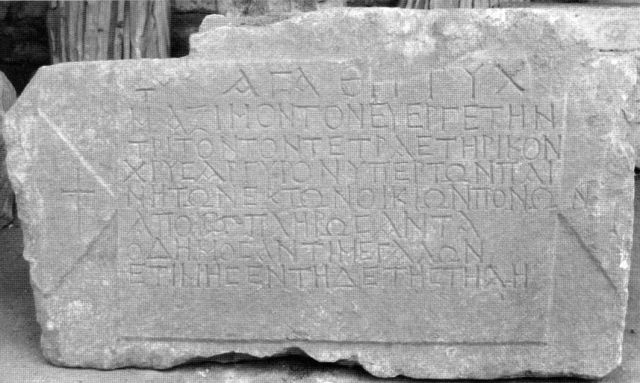
Inscription
Ἀγαθῇ τύχ[ῃ]. / Τ Μάξιμον τὸν εὐεργέτην, / τρίτον τὸν τετραετηρικὸν /(4) χρυσάργυρον ὑπὲρ τῶν παι/νήτων ἐκ τῶν οἰκίων πόνων / ἀπο(ivy leaf)πληρώσαντα, / ὁ δῆμος ἀντὶ μεγάλων /(8) ἐτίμησεν τῇδε τῇ στήλῃ.
Inscription translation
To Good Fortune. T. [You see] Maximus the benefactor, who three times paid the tax in cash which is raised every fourth year, on behalf of the poor from his own resources; the people (demos) honoured him for his great deeds with this statue.
Bibliography
- Şahin, M. Ç. (ed.), The Inscriptions of Stratonikeia, Part III. (Inschriften griechischer Städte aus Kleinasien, bd. 68), Bonn 2010, pp. 61-2 no. 1521
- Şahin, M. Ç., New Inscriptions from Stratonikeia and its Territory, Epigraphica Anatolica 41, 2008, 53-81, p. 59 no. 9
Discussion
INSCRIPTION
In eight lines:
Ἀγαθῇ τύχ[ῃ]. / Τ Μάξιμον τὸν εὐεργέτην, / τρίτον τὸν τετραετηρικὸν /(4) χρυσάργυρον ὑπὲρ τῶν παι/νήτων ἐκ τῶν οἰκίων πόνων / ἀπο(ivy leaf)πληρώσαντα, / ὁ δῆμος ἀντὶ μεγάλων /(8) ἐτίμησεν τῇδε τῇ στήλῃ.
'To Good Fortune. T [You see] Maximus the benefactor, who three times paid the tax in cash which is raised every fourth year, on behalf of the poor from his own resources; the people (demos) honoured him for his great deeds with this statue.'
Letter height 2.7 – 5.3 cm.
The inscription is set within a tabula ansata standing slightly proud of the face of the block; in the left ansa there is a cross, in the right one a letter (N?).
Şahin, the first editor of the inscription, read the 'T', which is set above the M of Μάξιμον at the beginning of line 2, as an abbreviation of the Roman name Titus; however, as Feissel 2011 points out, a Latin praenomen would require also a nomen gentilicium, missing in our inscription. We have followed Feissel 2011 who suggests that the 'T' is a Christian symbol, not a name. This is supported by the fact that three other inscriptions to the same man from Stratonicea all style him simply 'Maximos' (without the 'T') (LSA-657, LSA-1200, LSA-1202).
DESCRIPTION (from Şahin 2008 and the published photo)
Rectangular block of marble, broken and lost at top left and top right corner. All the edges are chipped, but the full height is preserved: H 60, W 101, D 40 cm.
This low but wide block is an unusual shape for a statue base; but the wording of the inscription, and the other dedications to Maximus (see below, 'Honorand, Date and Awarder'), make it quite clear that it once supported a statue.
PROVENANCE AND CURRENT LOCATION
The inscription was first recorded in 2006 in Stratonicea, south of the eastern city gate (for location see Şahin 2008, 53). It is today in the storerooms of the Stratonicea museum (without published inv. no.).
HONORAND, DATE AND AWARDER
Maximus, the honorand, was a citizen of Stratonicea (lines 2-3), lauded in several inscriptions in the city (this one, LSA-657, LSA-1200, and LSA-1202), from which we learn that he was a wealthy member of the curial class of the city. Here is praised for a benefaction which is specified with unusual precision: he paid from his own resources, on behalf of the poor of Stratonicea, the imperial tax in cash (tetraeterikon) that was raised every fourth year. This tax is the χρυσάργυρον (chrysargyron, Latin collatio lustralis) which, by the 5th century, was collected every fourth year (Jones 1964, 431-2). It was abolished in the East by Anastasius in 498 (Cameron, Ward-Perkins & Whitby 2000, 53-4), which provides a terminus ante quem for our inscription, and for all the other dedications to Maximus (Şahin 2010, 62). The prominent Christian sentiments expressed in all the inscriptions to Maximus are unlikely before the fifth century, providing an approximate terminus post quem.
This dedication was set up by the people (demos) of Stratonicea (line 7).
Discussion references
- Cameron, A., Ward-Perkins, B. & M. Whitby, Late Antiquity: Empire and Successors, A.D. 425-600 (The Cambridge Ancient History Volume XIV), Cambridge 2000
- Feissel, D., Bulletin Épigraphique, Revue des Études Grecques 124, Juillet-Décembre 2011, 526
- Jones, A. H. M., The Later Roman Empire, 2 vols., Oxford 1964
- Jones, C. P., New Late Antique Epigrams from Stratonicea in Caria, Epigraphica Anatolica 42, 145-51, 2009, 150 no. 4
- Staab, G., Zu zwei neuen Epigrammen aus Stratonikeia in Karien, Zeitschrift für Epigraphik 170, 35-42, 2009, 35-8
Cite: Last Statues of Antiquity, LSA-1201 (Ulrich Gehn).