
LSA-1204
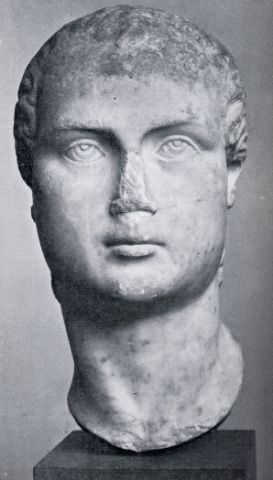
Portrait head for insertion wearing helmet? Unknown provenance. Fourth century.
Record details
Photographs
Bibliography
- Johansen, F. 'Ritratto di un imperatore della tarda antichità a Copenhagen', Archeologia Classica 21, Rome 1969, 258-61, pls. 88-92
Discussion
DESCRIPTION (Object)
Over life-size head for insertion. H: 40, H (chin to hair): 23 cm. Fine-grained white marble.
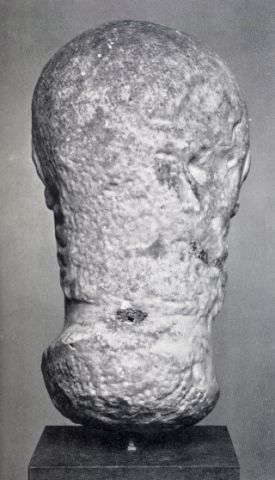
The head is missing the tip of the nose. The head and neck have been cleaned with acid so as to remove calcareous accretions of which traces remain on the brow. At the nape of the neck, touching the hairline, is an iron pin encased in lead.
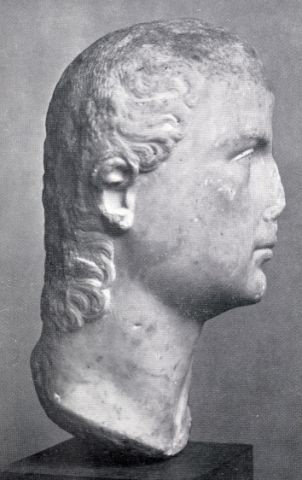
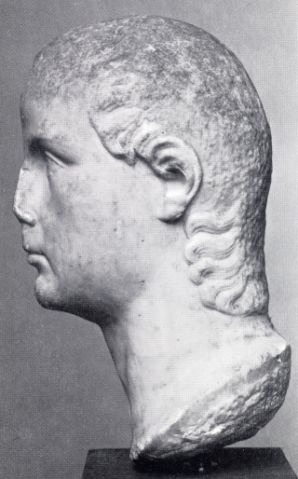
The hair and eyes have been re-cut. The original hair is worked in large locks with individual strands denoted by fine engraved lines. It has been systematically removed along the top and back of the head. The removed area begins directly over the brow and contnues to the nape of the neck leaving only the hair in front and behind the ears. The surface shows traces of a point chisel at the back and a claw chisel around the top of the head. The iris and the pupil are marked by concentric half circles made with a broad chisel.
PROVENANCE
The head was published by Flemming Johansen who notes only that it came from the collection of the deceased Gunnar Sadolin at Dragor (Copenhagen). Sadolin is the co-founder of a successful paint company who was allegedly inspired by antiquities.
DESCRIPTION (Subject)
The head, separately worked for insertion, depicts a full-faced young man with long hair who turns to his left. The head has clearly been reworked from an earlier portrait; this is abundantly visible in the eyes and hair.
The result is a man with a specific physiognomy. The eyebrows are even and straight; the nose fine; the mouth small; and the chin small but projecting close under the lower lip. There are no signs of age; for example, the modulation below the eyes in minimal, and there are no naso-labial folds or interruptions to the smooth brow. The eyes have been rendered expressive by secondary chisel work that denotes the iris and pupil.
Long locks of hair remain above and below the ears. One lock even curls into the shell of the right ear. Over the brow these locks seem to recede; only one lock is extant at the center of the brow. The hair at the back and top of the head as well as that immediately around the ears has been removed. Some object was surely fitted over the head. The hole at the centre of the nape, now filled with iron and lead, would have fixed this headgear to the marble head. The shape of the working led Johansen to suggest a helmet which does in fact seem likely. This attribute however is highly unusual for a fourth century portrait head.
HONORAND
The original portrait seems plausibly identified with an honorand of the third-quarter of the first century. The form and shape of the hair is in keeping with the fourth portrait type of Nero as is the general shape of the face. Even the small mouth and fine nose might be associated with Nero.
The second use of the head seems to date to the fourth century AD on account of the rendering of the pupil and iris. An honorand wearing a helmet in this period is unusual but might have been intended to be a heroic figure, for example Alexander. If it were wearing a complicated diadem rather than a helmet, one would identify the honorand of the second use as an Emperor.
Cite: Last Statues of Antiquity, LSA-1204 (J. Lenaghan).