
LSA-1207
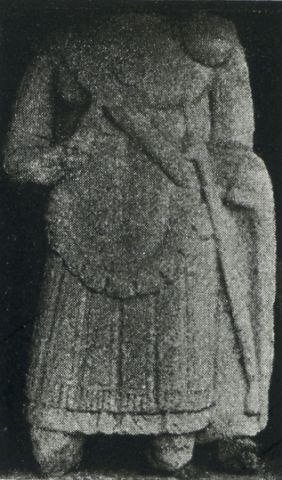
Portrait statue in armour. From modern Aichdorf (Noricum Mediterraneum). Late third to fourth century?
Record details
Photographs
Bibliography
- Egger, R., Führer durch die Antikensammlung des Landesmuseums in Klagenfurt, Vienna 1921, 54-5, no. 71, fig. 30
Discussion
DESCRIPTION (Object)
Torso of a white marble statue, broken at the knees. The head is missing; H 116, W 56 cm. The left forearm is broken; a portion of the left forearm and hand is chipped off. The back face is only summarily finished. The surface is heavily washed.
PROVENANCE AND MOST RECENTLY RECORDED LOCATION
The statue was found in the river Mies near Aichdorf ('im Miesflusse bei Aichdorf') according to Egger 1921. Egger recorded it in the Landesmuseum in Klagenfurt, inv. no. 275.
DESCRIPTION (Subject)
The portrayed stands over his left leg; the right arm is bent and held in front of the body, the left arm is bent at the side. The man is wearing an artless cuirass over a tunic. On the breast he is displaying a military decoration (phalera). A sword is hanging at his left hip; it is held by a belt (balteus) laid over the right shoulder. On the left shoulder, a cloak is fixed; it hangs down into the back and is held by the left forearm at the hip.
HONORAND AND DATE
The depicted is a subaltern as is indicated by the decoration (phalera) as well as by the lack of the bandage of higher officers (cinctorium).
The statue has been dated to the late 3rd century by Egger 1921 by comparison with the more famous statue from Celeia (LSA-1785).
FURTHER DISCUSSION
The portrayed probably was, as Egger 1921 pointed out, a centurion who settled down in the province of Noricum. Egger (l. c.) assumes that this was a funerary statue; probably justly, since the depicted was not of the elevated status of the persons who still received honorific statues in the provinces in late antiquity.
Cite: Last Statues of Antiquity, LSA-1207 (Ulrich Gehn).