
LSA-1208
Fragment, probably from base for statue of Maximian, emperor. Pola (Venetia et Histria). 286-305
Record details
Photographs
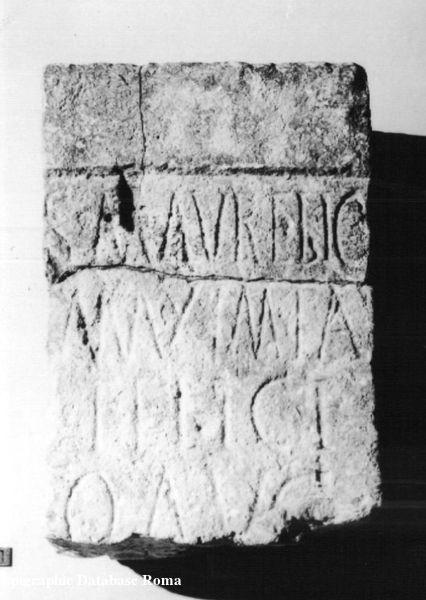
Inscription
[Imp(eratori) Cae]s(ari) M(arco) Aurelio / [Val(erio)] Maximia/[no, pio], felici, / [invict]o Aug(usto) / [---].
Inscription translation
To the emperor Caesar Marcus Aurelius Valerius Maximianus, pious, fortunate, unconquered Augustus ...
Bibliography
- Corpus Inscriptionum Latinarum; , V, no. 30
- Forlati Tamaro, B. (ed.), Inscriptiones Italiae Academiae Italicae Consociatae ediderunt. Volumen X, Regio X, Fasciculus I, Pola et Nesactium, Rome 1947, no. 44
Discussion
INSCRIPTION
Partly preserved in four lines:
[Imp(eratori) Cae]s(ari) M(arco) Aurelio / [Val(erio)] Maximia/[no, pio], felici, / [invict]o Aug(usto) / [---].
'To the emperor Caesar Marcus Aurelius Valerius Maximianus, pious, fortunate, unconquered Augustus ...'.
Letter height not recorded.
We reproduce the inscription with the completions suggested by CIL V. The surviving part of the inscription has the imperial name and titles in the dative; this, and the shape of the block, suggest that the inscription was for a statue (see also below, 'Description').
DESCRIPTION (from Forlati Tamaro 1947 and the published image)
Rectangular fragment of a limestone block, H 50.5, W 34, D 26 cm. The fragment apparently preserves the right margin and the top of the inscription. The epigraphic field is slightly cut back against a flat band at the upper rim.
PROVENANCE AND CURRENT LOCATION
The provenance of the inscription is unknown, but it is probably from ancient Pola (http://www.trismegistos.org/place/12233). It is now in the Pula museum, inv. no. 325.
HONORAND, AWARDER AND DATE
Maximian, the honorand, was Augustus from 286 until his abdication in 305.
The name of the awarder is lost.
Cite: Last Statues of Antiquity, LSA-1208 (Carlos Machado & Ulrich Gehn).