
LSA-121
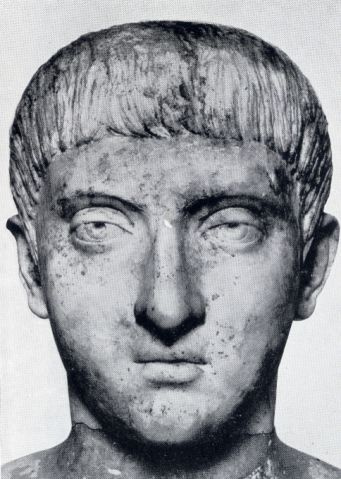
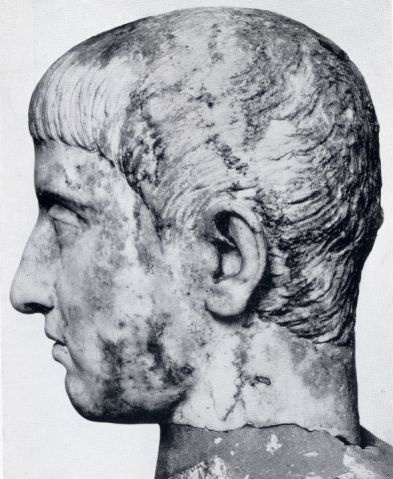
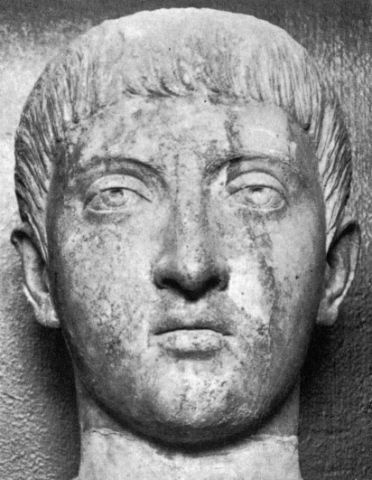
Portrait head of young man, re-worked from earlier portrait. Athens. Third century
Record details
Photographs
Bibliography
- Datsoule-Satvride, A., Romaika Portraita sto Ethniko Archaiologiko Mouseio tes Athenas, Athens 1985, pp. 106-7 pl. 162-3
- L'Orange, H. P., Studien zur Geschichte des spätantiken Porträts, Oslo 1933, pp. 137 no. 85 figs. 161, 162
- Lattanzi, E., I ritratti dei Cosmeti nel Museo Nazionale di Atene, Rome 1968, 64, no. 33, pl. 33
- Lattanzi, E., I ritratti dei Cosmeti nel Museo Nazionale di Atene, Rome 1968, 64, no. 33, pl. 33
Discussion
DESCRIPTION (Object)
Marble head with its neck broken in an irregular plain below the chin. The marble is Parian according to Datsoule-Stavride 1985, Pentelic according to Kavvadias 1892; H 28 cm, W 20 cm (measurements from Datsoule-Stavride 1985, 107; the measurements given by Graindor 1915, 378 (H 24 cm, W 12.5 cm) and by Lattanzi 1968, 64 (H 22 cm) are considerably different). The head is covered with traces of sinter and roots and a piece of the right earlobe is chipped off; otherwise it is in an excellent state of preservation.
The hair is worked in two different ways around the face and in the back. Around the face it is lank, arranged in long forward-brushed strands articulated by thin lines shallowly incised with a chisel. Although the strands follow basically the same direction, the sculptor avoided strict uniformity in their alignment; there is no solid line separating the hair from the flesh. Above the ears, singular strands are overlapping thus forming a second and even third layer of hair. In the back, the hair is arranged in 'flamelets', likeweise articulated by chisel-work. The hair in the back is a remnant of the early-imperial (julio-claudian) original from which the head was re-cut (see below).
The eyebrows are symmetrically arching high above the eyes, echoing the equable arch of the hairline; they are plastically rendered and articulated by short vertical chisel strokes. The iris is circumscribed by an incised circular line; the upper third of it is covered by the heavy upper lid. The pupil is a round drill hole boardered by the upper lid. The outer lid overlaps in the outer angles.
The lips are separated by a drilled line. They are embedded in the flesh without sharp delineations. The flesh is smooth, without folds or wrinkles and softly modelled without hard caesuras.
The head in its present state is the result of a late-antique re-work as is testified to by the original hairstyle still visible at the back of the head.
PROVENANCE AND CURRENT LOCATION
The head was found in 1861 in the fillings of the so-called 'Post-Herulian wall', about 250 m east of the 'tower of the winds', northeast of the acropolis and east of the Roman agora (Lattanzi 1968, 64; for the excavations of 1861 see Lattanzi 1968, 15 n. 1; Kavvadias 1892, 256-65 nos. 384-416, our head is p. 262-3 no. 399). Spolia of different kinds were built into the wall at this spot among which there were numerous headless herms, statue bases of ephebes and cosmetes, and ephebic lists (Graindor 1915, 241 n. 5-6, 242 n. 1); together with this, 33 portrait heads were found, four of which go together with herms of cosmetes and therefore securely represent holders of this office (Graindor 1915, 245 n. 3; see also below, 'Description (Subject)'). One of the stelai bequeathes the instruction that copies of the inscriptions be set up in he gymnasium of Diogenes (Diogeneion) in Athens. It is a widely accepted hypothesis therefore that the Diogeneion was located just outside the post-Herulian wall in exactly the area where the spolia were found (Judeich 1931, 92, 379; Travlos 1971, 281, 576-7 fig. 722, 579; A. Frantz, Hesperia 48, 1979, 201-203; Datsoule-Stavride 1985, 107; Frantz 1988, 61) (see also below, 'Date').
The head is today in the National Archaeological Museum in Athens, inv. no. 399.
DESCRIPTON (Subject)
The portrait depicts a beardless young man, his lank hair brushed towards the face. Oval lines, smoothness, and a symmetrical arrangement are the prevalent features of the face. The hairline forms a regular arch; above the (proper) right eye the hair forms into a small 'fork'. The face is oval, with long cheeks and a long rounded chin.
Of the 33 portrait heads found in the area of the Diogeneion (see above, 'Provenance and current Location'), 30 represent bearded men who ought to be identified as cosmetes (which is secured for four of these heads, Graindor 1915, 245 n. 3; see also above, 'Provenance and current Location') or other officials who under the supervision of the cosmetes were responsible for the education of the ephebes (Graindor 1915, 245 n. 4; Lattanzi 1968, 15, 30). The three unbearded portraits of youths found in the spot, of which our head is one, are portraits of either ephebes from wealthy families who supported the gymnasium, or of individuals who were outstanding in the ephebic contests (Graindor 1915, 245-6).
DATE
Graindor 1915, 378-81 no. 33, assigned a Constantinian date to our head, suggesting that its geometrically exact symmetry was an indicator of a predominantly decorative character at the expense of plastic values, characteristic of a period of transition or decline from antique to Byzantine art. L'Orange 1933, 57-8, correspondingly suggested a date around 320; it has to be noted, however, that after outlining characteristics of 'Constantinian classicism' claimed for the time in question, (simplification of plastic modellings to undetailed plain areas, stereometrical buildup, subordination under symmetrical forms notably also of the hair, see L'Orange 1933, 56) the scholar did note the deviance of our head from these very criteria ('etwas freiere Anordnung der Stirnhaare', 'Weichheit der Modellierung und Flüssigkeit der Übergänge' L'Orange 1933, 58). The 'Constantinian' hairstyle, however, remained the decisive criterium for L'Orange to assign a Constantinian date to our head. A date in the late/ post-Gallienian period was first proposed by Harrison 1953, 66, 91, 99-100. Harrison could refer to the American excavations which had secured that the 'Post-Herulian wall', so far considered to be from the 15th century, was indeed built around 280; the date of the wall is the terminus post quem for our portrait (see above, 'Provenance and Current Location'; for the date of the wall see now Frantz 1988, 6). Harrison, moreover, accepted the stylistic criteria developped by L'Orange 1933 for the Constantinian portraiture, yet pointed out that these criteria are not met by our head. Numerous typological and stylistic analogies in the pre-tetrarchic 3rd century highlighted by the author were to support the assertion that 'a date between 267 and 275 (...) would reconcile the demands of style and those of archaeological probability' (quotation Harrison 1953, 66; typological and stylistic parallels discussed l. c. 99-100); Harrison 1953, 99 explicitly did not exclude, however, a date earlier in the third century. Harrison's suggestions for a late-/post-Gallienian date were adopted by Lattanzi 1968. Bergmann 1977, 88, on contrast, denied any reliable stylistic and typological criterium to date our head which might range earlier in the 3rd century. L'Orange's Constantinian date has surprisingly been readopted by Datsoule-Stavride 1985, without, unfortunately, offering an argument on this dating. Romiopoulou 1997 proposes a date in the 2nd quarter of the 3rd century.
In my own view, Bergmann's scepticism regarding a precise date in the 3rd century is justified. The portraits of the defunct of the so-called 'Brother-sarcophagus' in Naples, quoted as chief witness for her late/post-Gallienian date by Harrison 1953 indeed show similar coiffure-types, they are comparable, moreover - in terms of style - in the surface-bound articulation of the single strands and in the avoidance of strict similarity in the direction of the strands (Reinsberg 2006, pl. 85). In the way in which different layers of hair are formed (particularly on the right side), however, our head resembles the a-penna technique of the late-severan portraiture. In my view, this favours a date in the earlier 3rd century. However, in Athens itself, no convincing and well-dated piece of comparison seems at hand; I therefore assign a broad date in the 3rd century to our head; the terminus ante quem of 282 ca. (Frantz 1988, 6) remains unaffected.
Discussion references
- Bergmann, M., Studien zum römischen Porträt des 3. Jahrhunderts n. Chr., Bonn 1977, p. 88
- Frantz, A., Late Antiquity A. D. 267 - 700: The Athenian Agora XXIV, Princeton 1988
- Graindor, P., Les cosmètes du Musée d'Athènes, Bulletin de Correspondance Hellénique 39, 241-401, Paris 1915, pp. 378-81 no. 33 pl. 26
- Harrison, E. B., Portrait Sculpture: The Athenian Agora I, Princeton, N. J. 1953
- Judeich, W., Topographie von Athen (Handbuch der Altertumswissenschaft. Dritte Abteilung. Zweiter Teil. Zweiter Band), München 1931
- Kavvadias, P, Glypta tou Ethnikou Mouseiou, Perigraphikos Katalogos, Athens 1890-1892
- Lattanzi, E., I ritratti dei Cosmeti nel Museo Nazionale di Atene, Rome 1968, p. 64 no. 33 pl. 3, a-b
- Romiopoulou, K., Ellenoromaika Glypta tou Ethnikou Archaiologikou Mouseiou, Athens 1997, p. 66 no. 64
- Travlos, J., Bildlexikon zur Topographie des antiken Athen, Tübingen 1971
Cite: Last Statues of Antiquity, LSA-121 (Ulrich Gehn).