
LSA-1210
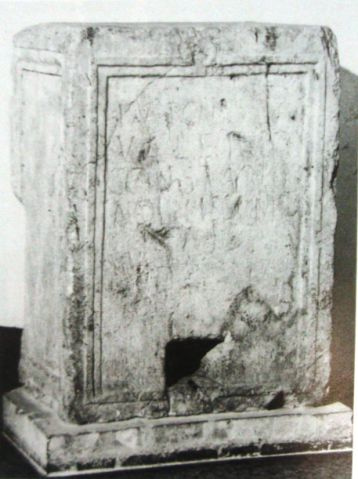
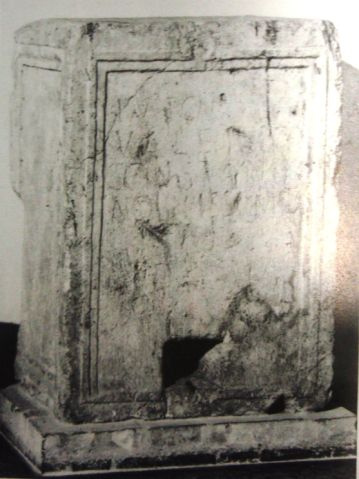
Base for statue of Constantius I, emperor. Bellunum (Venetia et Histria). 293-305
Record details
Photographs
Inscription
Imp(eratori) Caẹ[s(ari)] F̣ḷa(vio) / Valerio / Constantio / nobilissimo / (5) C̣a[es(ari)], / d(ecurionum) d(ecreto).
Inscription translation
To the emperor Caesar Flavius Valerius Constantius, most noble Caesar. [Set up] by decree of the councillors.
Bibliography
- Corpus Inscriptionum Latinarum; , V, no. 82*
- Alföldy, G. , Römische Statuen in Venetia et Histria : epigraphische Quellen, Heidelberg 1984, no. 150
- Lazzaro, L., "Bellunum", Supplementa Italica, n.s. 4, Rome 1988, 325-7 n. 7
Discussion
INSCRIPTION
In six lines:
Imp(eratori) Caẹ[s(ari)] F̣ḷa(vio) / Valerio / Constantio / nobilissimo / (5) C̣a[es(ari)], / d(ecurionum) d(ecreto).
'To the emperor Caesar Flavius Valerius Constantius, most noble Caesar. [Set up] by decree of the councillors.'
Letter height 5.5 – 6 cm.
We reproduce the inscription as read by Lazzaro 1988 (see below, 'Honorand and Date', and 'Further Discussion').
DESCRIPTION (from Alföldy 1984, Lazzaro 1988, and the published image)
Rectangular statue base of grey limestone, H 96, W 75 (Alföldy: 71), D 53.5 cm. The epigraphic field is framed, and there are also moulded frames on both sides of the base. A large rectangular hole pierces the lower part of the epigraphic field.
PROVENANCE AND CURRENT LOCATION
The inscription was first recorded in front of the church of San Pietro in Belluno, in the early 17th century. It was almost certainly once set up in the ancient city of Bellunum (http://www.trismegistos.org/place/12249).
The inscription is now in the local museum (Museo Civico) of Belluno , inv. no. 14.
HONORAND, AWARDER AND DATE
Constantius I, the honorand (full name Flavius Valerius Constantius, as in our inscription) was Caesar 293-305. Alföldy 1984 read Constanti in line 3 and attributed the inscription to Constantine’s youngest son Constans (Caesar 333-7). However, Constans’ full name was Flavius Iulius Constans (LSA-608, LSA-652, LSA-1386, LSA-1549, LSA-1551, LSA-1715, LSA-2223, LSA-2838), and Lazzaro states that the o is clearly visible.
The inscription was set up by decree of the city council.
FURTHER DISCUSSION
The inscription was considered a forgery by CIL. Its genuiness was recognized by Alföldy 1984, based on observations by M. S. Bassignano, and confirmed by Lazzaro 1988.
Cite: Last Statues of Antiquity, LSA-1210 (Ulrich Gehn & Carlos Machado, discussion added 6/2014).