
LSA-1211
Base for statue of emperor. Feltria (Venetia et Histria). Probably late third century.
Record details
Photographs
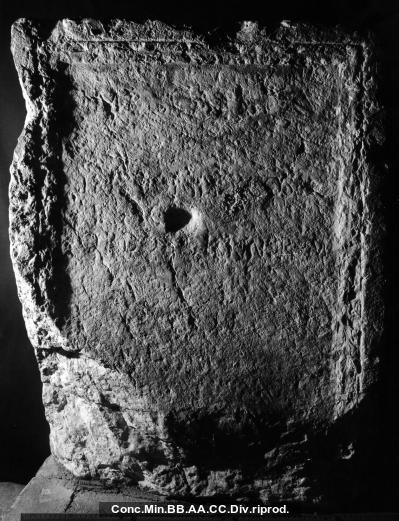
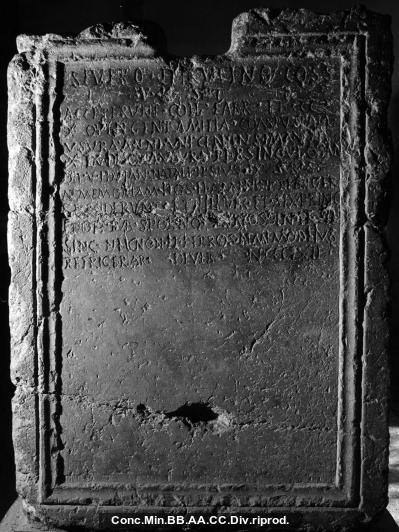
Inscription
Imp(eratori) Caesạ[ri] / [---] / [p(io), f(elici)], Ạụ[g(usto), pontif(ici)] m[ax(imo)], / trib(unicia) pot(estate) II, p(atri) p(atriae), co(n)s(uli) II, /(5) pr[o]c[o(n)s(uli)], / ordo Feltrinorum.
Inscription translation
To the emperor Caesar (...) pious, fortunate, Augustus, highest priest (pontifex maximus), holding tribunician power for the second time, father of the fatherland, consul for the second time, proconsul. The council of the Feltrians [set this up].
Bibliography
- Alföldy, G. , Römische Statuen in Venetia et Histria : epigraphische Quellen, Heidelberg 1984, no. 155
- Lazzaro, L., Regio X. Venetia et Histria: Feltria, Supplementa Italica, nuova serie 5, 241-61, Roma 1989, 251-3 no. 2
Discussion
INSCRIPTION
In six lines:
Imp(eratori) Caesạ[ri] / [---] / [p(io), f(elici)], Ạụ[g(usto), pontif(ici)] m[ax(imo)], / trib(unicia) pot(estate) II, p(atri) p(atriae), co(n)s(uli) II, /(5) pr[o]c[o(n)s(uli)], / ordo Feltrinorum.
'To the emperor Caesar (...) pious, fortunate, Augustus, highest priest (pontifex maximus), holding tribunician power for the second time, father of the fatherland, consul for the second time, proconsul. The council of the Feltrians [set this up].'
Letter height 3.5 – 4.2 cm.
DESCRIPTION (from Alföldy 1984, Lazzaro 1989, and the published images)
Rectangular statue base of grey limestone, H 97, W 68, D 59 (Alföldy: 60) cm. At the front face, the lower margin of the block is broken off. The surface is badly worn and the inscription is difficult to read; line 2 appears to have been deliberately erased.
There are moulded frames on all four sides. There is a small rectangular dowel hole in the left rear corner. A large rectangular cavity on the top face cuts also the upper margin of the back face.
Our inscription is probably on the original front; there is another, probably later, inscription, from 323, on the back face, which was not for a statue (Dessau 9420 = AE 1908, 107 = Luciani 2011, 96-8 no. 38). The surface of this inscription is much better preserved than that of our statue base inscription.
PROVENANCE AND CURRENT LOCATION
The block was first recorded in 1906, in front of the cathedral of Feltre (http://www.trismegistos.org/place/12276). It is now in the local museum (Museo Civico) of the city (inv. no. 292017).
HONORAND, AWARDER AND DATE
The imperial name in line 2 is illegible (probably erased). Alföldy 1984 suggested that the honorand was an emperor of the 3rd century. Of those who held their second consulship in their second year of reign, he considered Carinus in 284 the most likely.
The inscription was set up by the council (ordo) of Feltria.
ACKNOWLEDGMENT (added 5/15)
We are grateful to Dr F. Luciani, Università Ca' Foscari Venezia, for providing us with additional information on this inscription.
Discussion references
- Dessau, H., Inscriptiones latinae selectae, Berlin 3rd ed. 1962, no. 9420
- L'Année épigraphique, , 1908 no. 107
- Luciani, F., Schiavi e liberti municipali nell'epigrafia latina della Gallia Cisalpina (tesi di dottorato, URI: http://hdl.handle.net/10579/1120), Venezia 2011, 96-8 no. 38
Cite: Last Statues of Antiquity, LSA-1211 (Carlos Machado & Ulrich Gehn).