
LSA-1212
Base for statue of Constantine I, emperor. Tergeste (Venetia et Histria). 313-337
Record details
Photographs
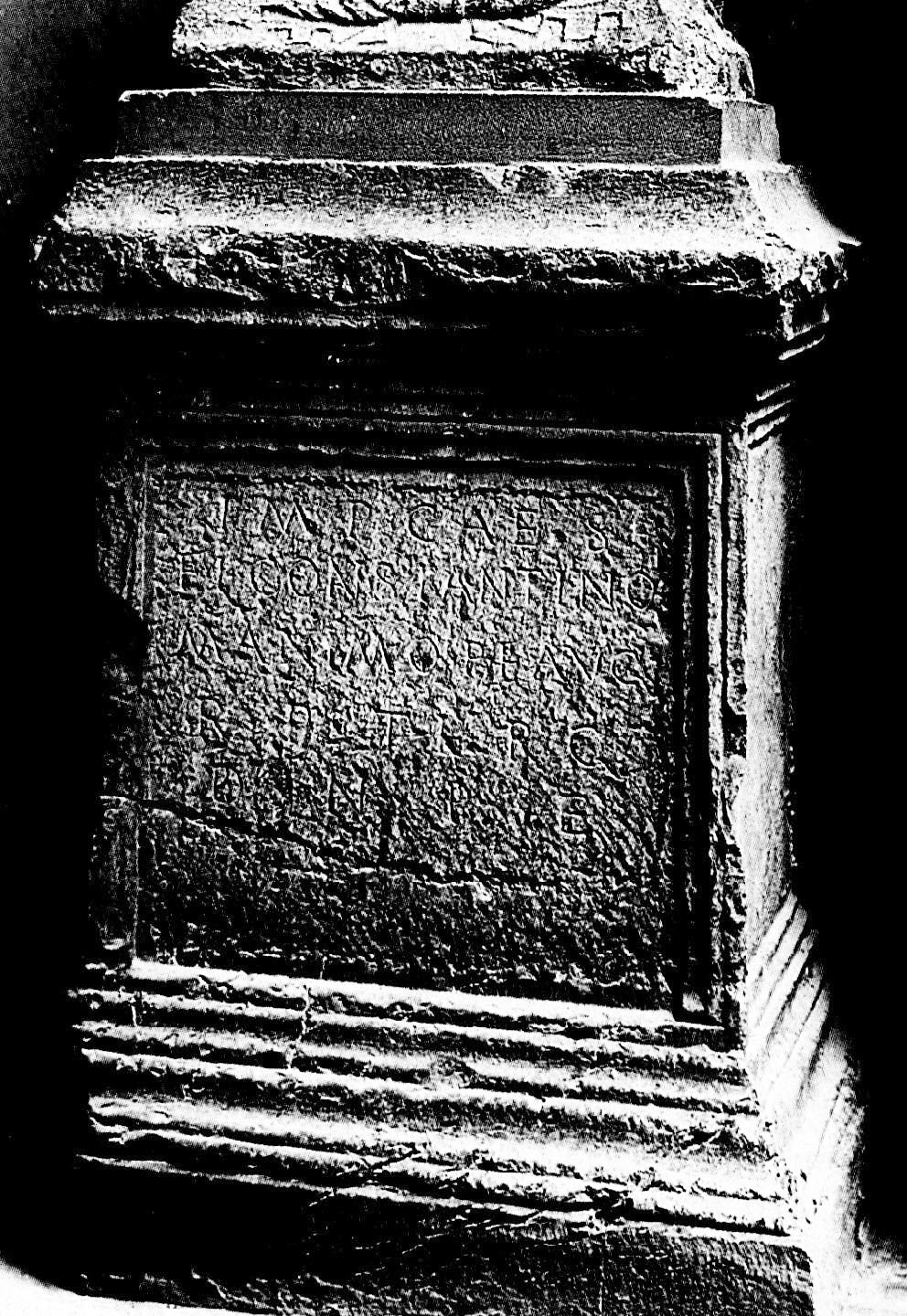

Inscription
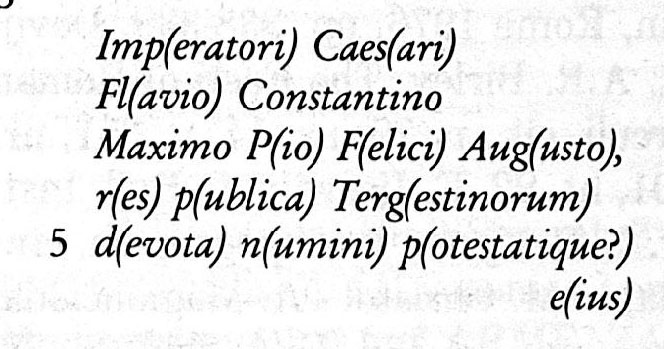
Imp(eratori) Caes(ari) / Fl(avio) Constantino, / maximo, p(io), f(elici) Aug(usto), / r(es) p(ublica) Terg(estinorum) /(5) d(evota) n(umini) p(otestatique?) e(ius).
Inscription translation
To the emperor Caesar Flavius Constantinus, the greatest, pious, fortunate Augustus. The city (res publica) of Tergeste, devoted to his divine spirit (and power?) [set this up].
Bibliography
- Corpus Inscriptionum Latinarum; , V, no. 529
- Alföldy, G. , Römische Statuen in Venetia et Histria : epigraphische Quellen, Heidelberg 1984, no. 28
- Zaccaria, C. "Tergeste - Ager Tergestinus et Tergesti adtributus", Supplementa Italica, N.S. 10, Rome 1992, 248-9 n. 7
Discussion
In five lines:
Imp(eratori) Caes(ari) / Fl(avio) Constantino, / maximo, p(io), f(elici) Aug(usto), / r(es) p(ublica) Terg(estinorum) /(5) d(evota) n(umini) p(otestatique?) e(ius).
‘To the emperor Caesar Flavius Constantinus, the greatest, pious, fortunate Augustus. The city (res publica) of Tergeste, devoted to his divine spirit (and power?) [set this up]’.
Letter height not recorded.
DESCRIPTION (from Alföldy 1984, Zaccaria 1992, and the published image)
Rectangular limestone base moulded at top and bottom, H 147, W 100, D 78 cm. The epigraphic field is framed, and there are also moulded frames on both sides of the base. The left bottom corner is broken; there are chips on the mouldings, and a horizontal crack is running through the lower part of the epigraphic field.
Our inscription is carved over an erased earlier one to a local notable of Tergeste, of the later 2nd century (Alföldy 1984 no. 36; Zaccaria 1992 no. 7 A). Traces of this earlier inscription are visible at the top edge of the epigraphic field, and a C from the original inscription was used for Constantine’s name (line 2).
PROVENANCE AND CURRENT LOCATION
The inscription was first recorded in the tower of the cathedral San Giusto in Trieste in the 17th century (http://www.trismegistos.org/place/12317). It is now in Trieste, in the Civico Museo di Storia e Arte (CMSA), set up in the pronaos of the cenotaph of Winckelmann (inv. no. 13581).
HONORAND, AWARDER AND DATE
Constantine, the honorand, was Augustus 306-37. As Zaccaria points out, the cognomen Maximus (line 3) is not attested for Constantine before 313.
After 314 Constantine assumed the victory titles of Germanicus and Gothicus. Both are missing in our inscription, and Zaccaria therefore suggested a narrow date of 313/14 for our inscription. However, victory titles are not often included in the honorific epigraphy of late Roman emperors, and their absence is no good indicator of date. We therefore prefer to assign broader outer dates of 313/37 to our inscription.
Discussion references
- Sticotti, P. (ed.), Inscriptiones Italiae Academiae Italicae Consociatae ediderunt. Volumen X, Fasciculus IV, Tergeste, Rome 1951, no. 27
Cite: Last Statues of Antiquity, LSA-1212 (Ulrich Gehn & Carlos Machado, discussion added 5/2014).