
LSA-1216
Plaque, probably from base for statue, with dedication to Constantine I and sons, emperors. Aquileia (Venetia et Histria). 326-337.
Record details
Photographs
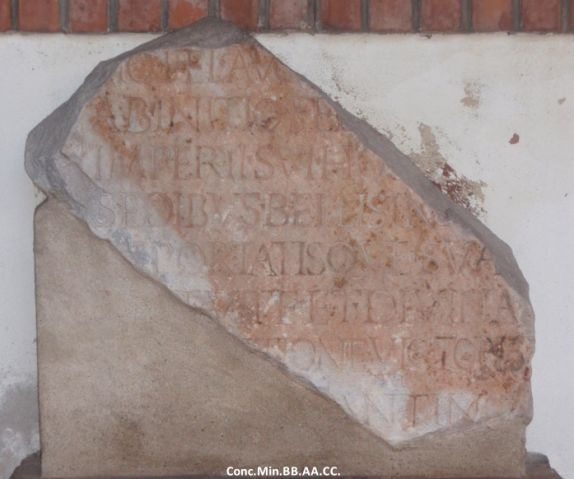
Inscription
[Imp(eratori) Caes(ari) Flavio] / [Constantino max(imo),] / [p]io, fel(ici), Aug(usto), [victori], / ab initio fel[icissimi] / imperii sui hos[tium] / sedibus bellis in[latis], / (5) [r]eportatisque sua / [vir]tute et divina / [dispos]itione victoriis, / [et Fl(avio) Const]antino, / [et Fl(avio) Constantio ---].
Inscription translation
To the emperor Caesar Flavius Constantinus the greatest, pious, fortunate Augustus, victor, because, from the beginning of his most happy reign, wars were taken to the lands of [our] enemies and victories were brought back, through his courage and divine direction; and to Flavius Constantinus, and Flavius Constantius ...
Bibliography
- Corpus Inscriptionum Latinarum; , V, 8269
- Brusin, G., Inscriptiones Aquileiae, vol. I-III, Udine 1991-1993, vol. I no. 448
- L'Année épigraphique, , 1984, 434
Discussion
INSCRIPTION
Partly preserved in eight lines:
[Imp(eratori) Caes(ari) Flavio] / [Constantino max(imo),] / [p]io, fel(ici), Aug(usto), [victori], / ab initio fel[icissimi] / imperii sui hos[tium] / sedibus bellis in[latis], / (5) [r]eportatisque sua / [vir]tute et divina / [dispos]itione victoriis, / [et Fl(avio) Const]antino, / [et Fl(avio) Constantio ---].
To the emperor Caesar Flavius Constantinus the greatest, pious, fortunate Augustus, victor, because, from the beginning of his most happy reign, wars were taken to the lands of [our] enemies and victories were brought back, through his courage and divine direction; and to Flavius Constantinus, and Flavius Constantius ...
Letter height 4 - 4.5 cm.
We reproduce the inscription with the completions suggested by Mommsen for CIL V, and accepted by Brusin 1991.
The dative of the imperial name preserved in line 8 makes it possible that this was a statue base inscription (see also below, ‘Description’).
DESCRIPTION
Fragment of a marble plaque, H 56, W 69, D 15 cm.
This plaque may once have covered the front of a statue base in brick or other material, though this cannot be certain.
PROVENANCE AND CURRENT LOCATION
The inscription was found in a field at Marigname, on the via Annia, immediately west of Aquileia, in 1855.
It is now in the archaeological museum (Museo Archeologico Nazionale) of Aquileia, inv. no. 20.
HONORAND, AWARDER AND DATE
The epigraphic formula, and the panegyric tone, of our inscription make it certain that it addressed an emperor or emperors. The extant remains of the imperial name in line 8 must belong to Constantine’s eldest son Constantine II; his father Constantine I was certainly recorded at the beginning of the inscription (though only a part of his imperial title survives in line 1).
Constantine II was made Caesar in 317, together with his brother Crispus who was executed in 326. However, Crispus was the Caesar proximus and would therefore have been commemorated before his brother Constantine; the terminus post quem for our inscription is therefore 326. It is almost certain that Constantine II’s younger brother Constantius II (Caesar 324-37) was recorded along with his brother; and it is possible that Constantine’s youngest son Constans (Caesar 333-37) was also commemorated.
The terminus ante quem is Constantine’s death in 337.
The name of the awarder is lost.
Cite: Last Statues of Antiquity, LSA-1216 (Ulrich Gehn & Carlos Machado, discussion added 5/2014).