
LSA-1222
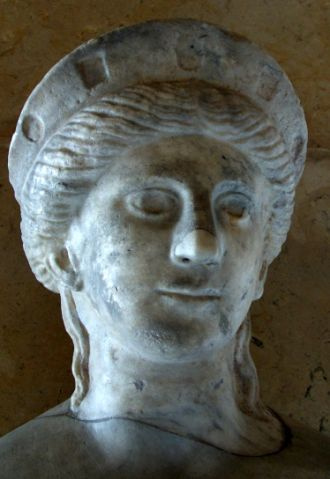
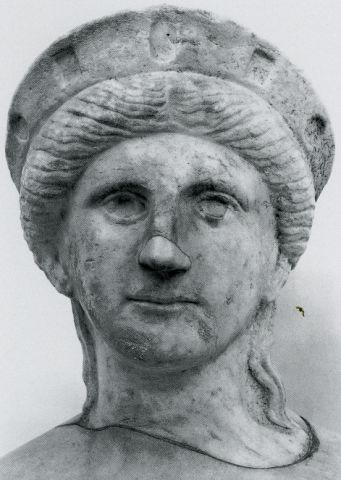
Female head wearing crown with inset stones. Unknown provenance. Late third to fifth century.
Record details
Photographs

Bibliography
- Borg, B., H. von Hesberg, and A. Linfert, Die antiken Skulpturen in Castle Howard (Monumenta artis Romanae. Antike Skulpturen in englischen Schlössern. Monumenta artis Romanae ; 31, Wiesbaden 2005, 74-5, no. 32, pl. 32 (A. Linfert, first century)
Discussion
DESCRIPTION (Object)
Life-size head. H: 32 cm. Yellow grey low quality marble with porous inclusions and bluish highlights.
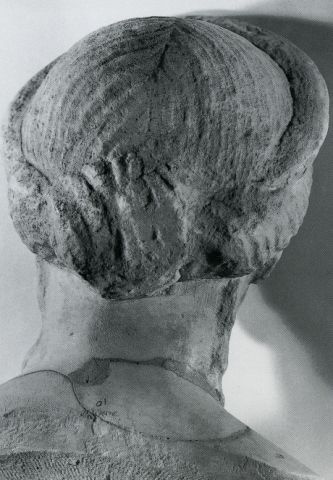
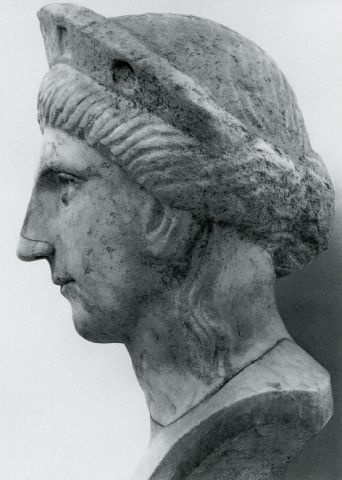
The head is broken around the base of the neck. The break has been cleaned by a modern restorer who set it on a modern bust. The tip of the nose is missing. Inset stones in the eyes and crown are also missing. The hair bun at the back of the head appears never to have been fully worked out and to have been partially smoothed, perhaps in order to fit it against another element.
The flat chisel has been used extensively in the hair. There is no drill work visible.
PROVENANCE
Unknown. Yet it seems almost certain that the Castle Howard collection was acquired in Rome and should have Italian provenance.
DESCRIPTION (Subject)
The head depicts a female with a classical hairstyle, no signs of age, and a diadem. The use of inset stones for the decoration of the crown and the irises is unusual.
The hair is parted in the centre and pulled back into a bun at the base of the skull. It covers the tops of the ears. Behind each ear, a wavy lock falls onto the shoulders. The facial features are regular; the bridge of the nose continues unbroken; and the only irregularity is ???that lower part of the face recedes???.
The diadem features five cuttings for decorative details. The central element was a vertically set oval. It is flanked by two rectangular cuttings which in turn are flanked by circular cuttings.
DATE
The use of inserted decoration, probably glass or stone, on the diadem and in the eyes is uncommon on statuary of the high imperial period. Moreover, the alternation of geometric forms in the diadem is a tendency of late antiquity. These details, combined with the slightly awkward carving and the poor quality marble, would seem to suggest at earliest a date in the fourth century. The ungainly aspect of the face and poorly carved ears might even be the result of the re-carving of an earlier head.
A. Linfert, however, argues that large cuttings in the eyes are a common practice in Egypt, even in the first century AD. The hairstyle, he believes with justification, also fits that era. But the argument is not convincing because the parallels are not so numerous nor so easily dated; see, for example, LSA-1560 and LSA-1561, both of which have inset eyes and seem to be fourth century in date. Moreover, an Egyptian provenance is improbable given the history of the collection at Castle Howard.
IDENTIFICATION
It is unclear whether the head is intended as a portrait of a woman or as a representation of a divinity. The combination of the crown, hairstyle, and regular physiognomy recall most particularly the figure between the deceased couple on the ‘Annona’ sarcophagus in the Museo Nazionale Romano.
Cite: Last Statues of Antiquity, LSA-1222 (J. Lenaghan).