
LSA-1224
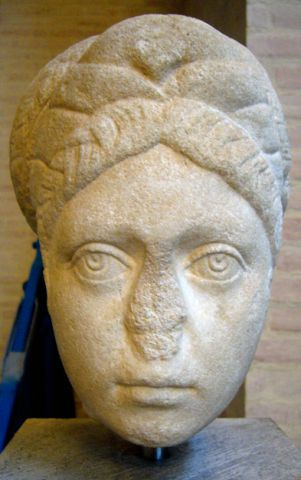
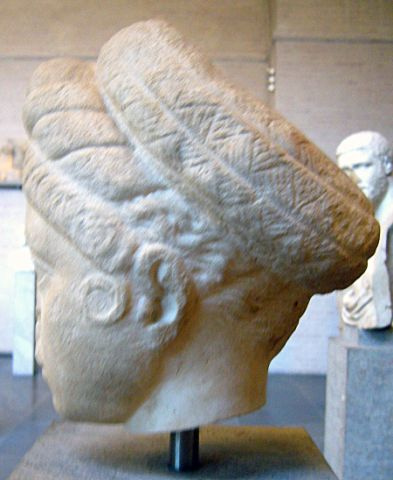
Re-used portrait head of woman with 'turban' hairstyle. Unknown provenance. Fourth century.
Record details
Photographs
Bibliography
- Baumstark, R. (ed.), Rom und Byzanz : Schatzkammerstücke aus bayerischen Sammlungen , Munich 1998, 75-8, no. 3
Discussion
DESCRIPTION (Object)
Life-size head. H: 24 cm. Fine-grained white marble.
The head has been regularly cut through the middle of the neck. This is probably modern. The nose is missing as are the rims of both ears. The chin is abraded. The surface is badly worn.
The drill has been used to create large channels in the vertical element of the hair. Most all other details are rendered with the flat chisel. The irises consist of engraved half-circles made with broad flat chisel. The pupil is U-shaped and made with a bull-nosed chisel.
PROVENANCE
Unknown.
DESCRIPTION (Subject)
The head, which turns gently to its right, depicts a young woman with a turban or toupèe hairstyle that is generally associated with Trajanic and Hadrianic women. The heavily marked eyeballs however attest a fourth century or later use of the head, and closer inspection of the hairstyle also shows subtle modification.
The hair is divided into three sections. A crimped band that peaks over the centre of the brow. This flat sector of brow hair has been given a series of new criss-crossing diagonal lines to make it appear as braided and interwoven. Above this portion of hair is a section that rises like a diadem. Here too hard new lines and perhaps also new shaping give this the appearance of hair wrapped in some sort of cloth. Behind it are braids which encircle the head and sit one atop the other. Stylized curls fall onto the cheek in front of each ear. Neither the braids nor the curls have been altered from their original form.
The face is a regular oval and is unmarked by age. The lips are full and perfectly formed, and the eyes are large. Moreover, the eyeballs are marked by irises and pupils which do not touch the lower lid and which are distinctively shaped.
The careful workmanship of the head on all sides and its life-size scale suggest that it was originally worked for a bust. However, it could also have been made for a small unveiled statue; it would, for example, suit a Small Herculaneum type both in scale and in youthful representation. The slight turn of the head would be appropriate for both options.
DATE
The hairstyle depicted in this portrait was first introduced in the Roman world in the late first century and gained popularity in the early second century. A similar style, featuring braids that encircled the head, returned to fashion in the fourth century. The most significant difference was that in the fourth century the towering frontal arrangement was not resuscitated. Here the frontal arrangement has been re-worked into a rolled and banded mass of hair that seems to rest on a flat braided area. Moreover, the eyeballs have been marked in the distinctive mode of late antiquity. Thus, the head seems to have been re-used. Other similar examples include heads in Copenhagen (LSA-372), Vienna (LSA-976), and Istanbul (LSA-301).
Discussion references
- von Heintze, H. ‘Ein spätantikes Mädchenportät in Bonn. Zur stilitischen Entwicklung des Frauenbildnisses im 4. und 5. Jahrhundert’, Jahrbuch für Antike und Christentum 14, Münster 1971, 78, no. V 6, pl. 14a (360-390)
Cite: Last Statues of Antiquity, LSA-1224 (J. Lenaghan).