
LSA-1226
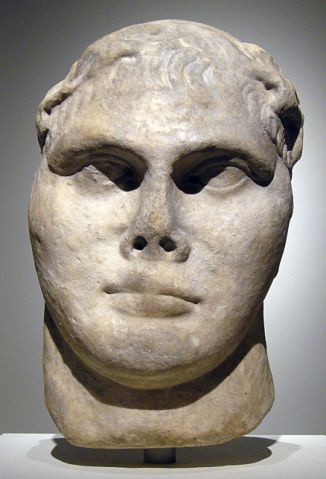
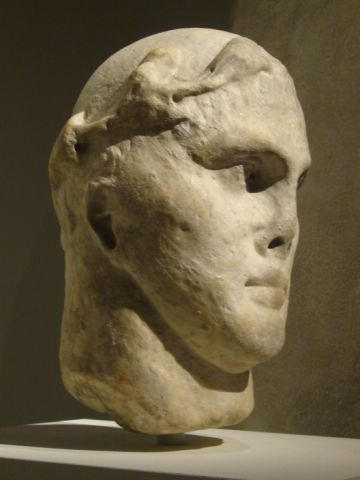
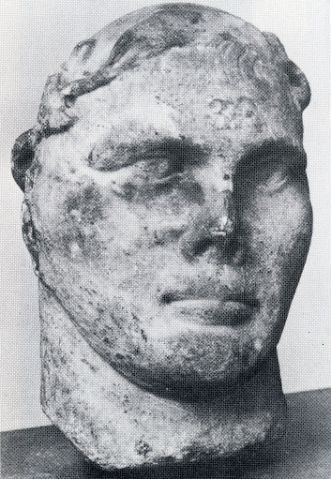
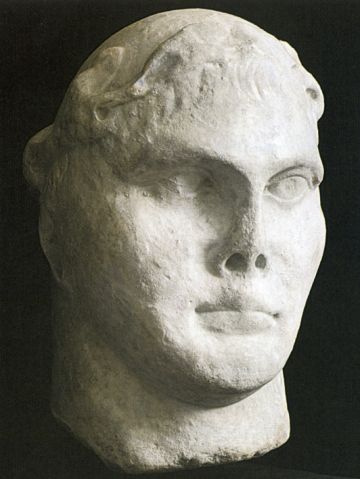
Over life-size portrait wearing wreath, Constantine? From Eburacum. Early fourth century.
Record details
Photographs
Bibliography
- Rinaldi Tufi, S., Yorkshire. Corpus signorum imperii Romani. Great Britain ; v.1, fasc.3 , Oxford 1983, 23, no. 38, pl. 12
Discussion
DESCRIPTION (Object)
Over life-size head made for insertion. H: 42, W: 24, D: 30 cm. Magnesian limestone (Rinaldi Tucci), fine-grained white arble, possibly Carrara (Bergmann).
The head was worked together with the neck. The nose is missing; the right ear is chipped; the surface is heavily weathered. Pupil and iris are marked though traces are worn (Rinaldi Tufi). The hair above the crown is not rendered.
The head has been re-cut from an earlier portrait. The small-size of the head on the neck, the rounded crown, the retracted lower face, the odd placement of the ears indicate this. The original portrait seems to have been bearded which explains the length of the chin.
PROVENANCE
Found while digging a drain at Stonegate, York, before 1823. In that year it was acquired by the York Philosophical Society. Stonegate is the name of the street that ran in Antiquity from the main gate to the bridge over the river.
DESCRIPTION (Subject)
The large head turns to its left and wears a crown, the leaves of which may be oak or laurel. The hair falls in medium-length, flat, C-shaped locks on the brow. Similar locks can be seen behind the ears.
The face has wide-set cheekbones and large full cheeks. The brow is unmarked and the eyebrows shadow long, narrow eyes. The nose is short, and the skin dimples around the corners of the nostrils. The mouth is broad and has a pouting lower lip. The chin is long and recessed.
DATE
The portrait has been identified as Constantine, even though it does not follow the standard typology for portraits of Constantine: see LSA-558 and LSA-834.
It is well over-life size, made of marble (Bergmann) in remote Britain, and portrays a clean-shaven man with short locks across the brow. His special position is indicated by his crown (albeit not clearly made of oak leaves). The markings in the eyes suggest a date after Hadrian. Thus, the honorand was a signifcant beardless individual of the later Roman Empire. This combined with the fact that York had a special connection to Constantine--he was proclaimed Emperor there in 306---makes the identification highly probable. The fact that it has been re-cut from an earlier head explains the unusual physiognomy.
Discussion references
- Demandt, A. and J. Engemann, (eds.), Konstantin der Grosse, Mainz 2007
, no. I.8.6 (Bergmann: early Constantine) - Donati, A. and G. Gentili, Costantino il Grande. La civiltà antica al bivio tra Occidente e Oriente, Milan 2005, 288-9, no. 131 (S. Rinaldi Tufi)
Cite: Last Statues of Antiquity, LSA-1226 (J. Lenaghan).