
LSA-123
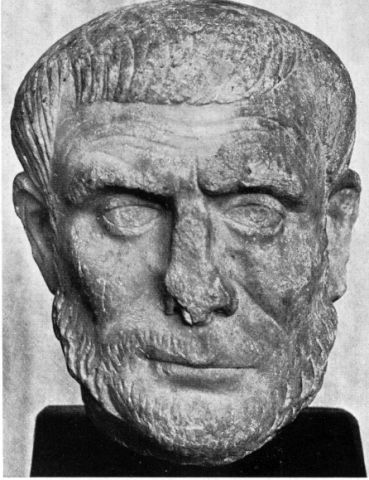
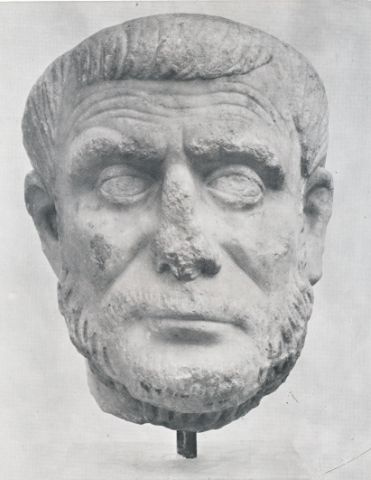
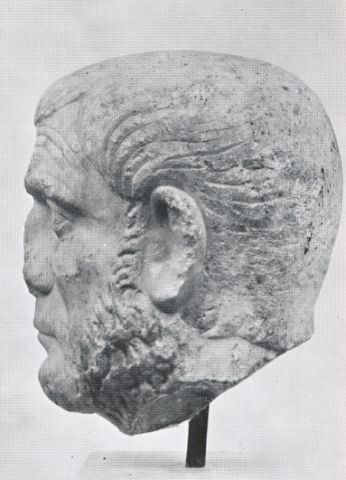
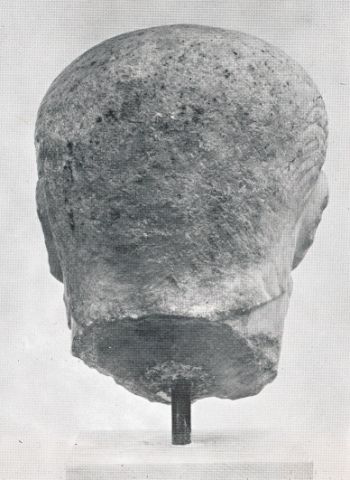
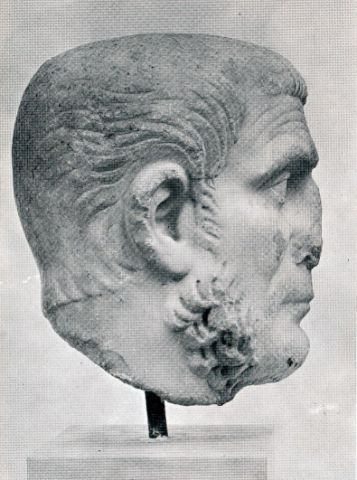
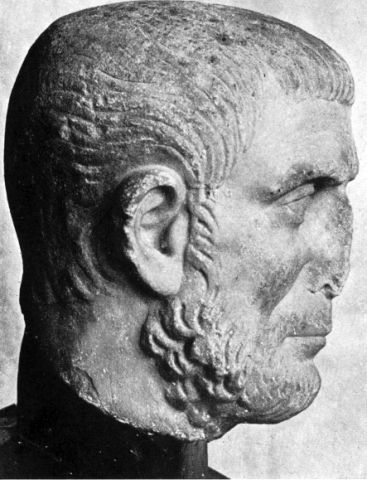
Portrait head of bearded man. Athens. Mid to late third century
Record details
Photographs
Bibliography
- L'Orange, H. P., Studien zur Geschichte des spätantiken Porträts, Oslo 1933, pp. 43-4, 126 no. 67 figs. 118, 119
Discussion
DESCRIPTION (Object)
Neck broken at the throat; marble (pentelic according to L'Orange 1933, 126, and Datsoule-Stavride 1985, 86); H 23.5 cm, W. 18 cm. The bridge of the nose and a part of the left earlobe are chipped off; large chips on left cheek and eyebrow and on the right eyeball; minor chips are scattered over the head.
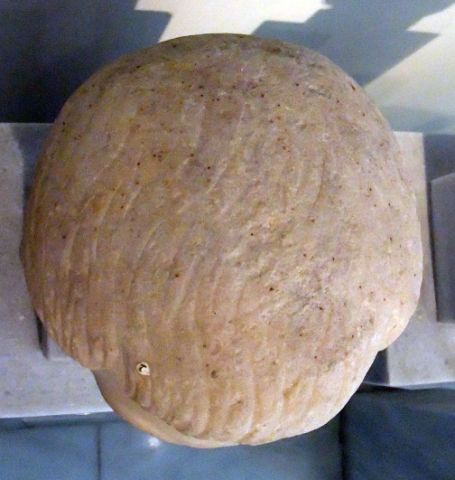
The lank, forward-brushed hair is indicated by long, thin, parallel lines incised with a chisel. The beard is articulated by short chisel strokes around the mouth; under the jaws and in front of the ears short drill lines articulate single strands.
The eyebrows are contracted and irregular; they are marked by short vertical chisel strokes. The iris is circumscribed by a thin circular line, the pupil drilled into pelta-shape.
The forehead is furrowed by four sinuous horizontal folds incsed with a chisel, and by a short vertical fold raising steeply fom the inner angle of the (proper) left eye. The naso-labial folds mark a sharp caesura between cheeks and mouth. The lips are pressed together, separated by a straight (chiselled or drilled) line.
PROVENANCE/ LOCATION
There is no published record of the provenance of the head. Today it is in the National Archaeological Museum in Athens, inv. no. 334.
DESCRIPTION (Subject)
The portrayed is a man of mature age with lank hair and a full beard. The hair is trimmed, brushed forward to cover the upper third of the brow. Above the (proper) left temple, the strands falling into the forehead are brushed to the right side, leaving a triangular recess. Another, smaller recess is left above the right temple. The beard is sparse and trimmed around the mouth and on the cheeks but more voluminous under the jaws where it tapers off into single locks, a fashion which reappears on monetary portraits of the emperor Tacitus (275-6; see below, 'Date'). The face is dominated by striking asymmetries. On the (proper) right side eyebrow, cheek and corner of the mouth are drawn upwards which lends a triangular form to this half of the face, as opposed to a basically rectangular form of the left half; the right eye sits slightly higher than the left one. The eyes are heavily contracted; this, together with the furrowed brow is suggestive of laborious thought.
An attribution to the emperor Philipp the Arab was considered, if reluctantly, by Vermeule 1968; he remained, however, non-commital and considered a private person as equally or more likely.
The short hair and trimmed beard distinguish our head from the long-haired, long-bearded portraits in the 'philosopher'- or 'Holy man' type (LSA-1083). While an iconographic quotation of a portrait of one of the heroes of the great Athenian past, as observable in many portraits of the second and third centuries in Athens, is not evident in our head, the beard follows a fashion of the 270s (see above, and below, 'Date'). The portrayed may have been a local man, or he may have been a magistrate of the Roman state.
DATE
L'Orange 1933, 44 assigned our head to the tetrarchic art of the ending 3rd century because of the 'violent asymmetries' in the construction and of the hairstyle ('gewaltsame[ ] Asymmetrien der Mund- und Stirnmuskulatur', L'Orange l. c.).
The mid-3rd-century date implied in Vermeule's comparison of the head to portraits of Philipp the Arab (see above, 'Description (Subject)') has been adopted by Datsoule-Stavride 1985, Romiopoulou 1997, and Kaltsas 2002.
In my view, a date in the 3rd quarter of the 3rd century is favoured by the beard-fashion displayed by our head. The same type of beard, sparse on the cheeks, more voluminous at the jaws and extending to the neck was worn by the emperor Tacitus (275-5; coin portraits of Tacitus in Delbrueck 1940 pl. 25). The asymmetric muscular movements in the face admittedly are observable in imperial portraits of the 2nd quarter of the century, more obvious, in our view, in the portrait of Traianus Decius (Fittschen & Zanker 1994(2)) than of Philipp the Arab. The heavy movements are also present, if presented more balanced, in the portrait Louvre MA 1018 attributed to Tacitus because of its resemblance with coin portraits of that emperor (de Kersauson 1996; Delbrueck 1940 pl. 25). The same beard-fashion, in connection again with marked muscular movement in the face, is displayed by the male portrait head of the post-Gallienian so-called 'Annona-sarcophagus' (Reinsberg 2006 pl. 67, 3; 69, 8). Likewise comparable is the hairstyle of the portrait on the sarcophagus, notably in the detail of length and arrangement of the strands in the brow. The forward-swept hairstyles of imperial coin-portraits in the period between Gallienus and the tetrarchy have already been quoted by Harrison 1953, 99 to support the late/ post-Gallienian date of the ephebe's-head LSA-121; the hairstyle of our head would suit well a date in the 3rd quarter of the 3rd century.
Discussion references
- de Kersauson, K., Les portraits romains II; de l’année de la guerre civile (68-69 après J-C) à la fin de l’Empire , Paris 1996, pp. 514-15 no. 245
- Delbrueck, R., Die Münzbildnisse von Maximinus bis Carinus (Das römische Herrscherbild III. Abteilung Band 2), Berlin 1940
- Fittschen, K. and P. Zanker, Katalog der Porträts in den Capitolischen Museen und den anderen kommunalen Sammlungen der Stadt Rom, Band I, Mainz 1985, no. 110 pl. 136-7
- Harrison, E. B., Portrait Sculpture: The Athenian Agora I, Princeton, N. J. 1953, p. 99
- Kaltsas, N., Sculpture in the National Archaeological Museum, Athens, Athens 2002, p. 370 no. 789
- Reinsberg, C., Die Sarkophage mit Darstellungen aus dem Menschenleben. Dritter Teil. Vita Romana (ASR I Teil 3), Berlin 2006
- Vermeule, C. C., Roman imperial art in Greece and Asia Minor, Cambridge, Mass. 1968, p. 403 Philipp the Arab 1
- Ντατσούλη Σταυρίδι, Α., Ρωμαικά Πορτραίτα στο Εθνικό Αρχαιολογικό Μουσείο της Αθήνας, Athens 1985, pp. 85-6 no. 334 pl. 122, 123 α-γ
- Ρωμιοπούλου, Κ., Ελληνορωμαικά Γλυπτά του Εθνικού Αρχαιολογικού Μουσείου, Athens 1997, p. 127 no. 136
Cite: Last Statues of Antiquity, LSA-123 (Ulrich Gehn).