
LSA-1231
Marble plaque with dedication to Dorotheus, perhaps associated with statue. Southern Palestine (Palaestina Salutaris). 452-453
Record details
Photographs
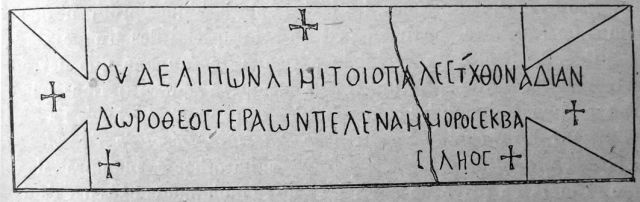
Inscription
Οὐδὲ λιπὼν λιμίτοιο Παλεστ(ίνης) χθόνα δῖαν / Δωρόθεος γεράων πέλεν ἄμμορος ἐκ βα- / σιλῆος
Inscription translation
(Even) having left the holy earth of Palestine's border Dorotheus did not become without a share of awards from the emperor.
Bibliography
- Feissel, D. 'Notes d' Épigraphie chrétienne', Bulletin de Correspondance Hellénique 108, 545-579, Paris 1984, pp. 545-7,556-7
Discussion
INSCRIPTION
In three lines:
Οὐδὲ λιπὼν λιμίτοιο Παλεστ(ίνης) χθόνα δῖαν / Δωρόθεος γεράων πέλεν ἄμμορος ἐκ βα- / σιλῆος
'(Even) having left the holy earth of Palestine's border Dorotheus did not become without a share of awards from the emperor.'
In the first line, the sculptor skipped the last two syllables of Παλεστίνης, in order to make the first hexameter fit into one line; for the metre, however, they must necessarily be pronounced when reading the verse (see also below, 'Description'). The inscription states in two hexameters that Dorotheus gained rewards from the emperor although he quit the border (limes) of Palestine. This understanding of the text which is reflected in our translation is shared by most, but not all scholars; Clairmond-Ganneau 1924 adopted another, grammatically likewise possible translation: 'Dorotheus did not leave the holy soil of Palestine's border; he remained without share of the awards by the emperor'.
Of which kind the rewards are, is not made explicit. The first editor Abel 1920, thought it was a state funeral that Dorotheus received. Clairmond-Ganneau 1924 considered it was the honorable dismissal (honesta missio which Dorotheus did not receive because of his untimely death; Alt 1923 considered it was stipends or donatives he did indeed receive; all scholars supposed that he was a soldier.
Feissel 1984 proposed to recognize a statue monument in the reward (γέρας), in the sense the word appears in other late antique honorific inscriptions (LSA-877, LSA-349, LSA-361; Feissel 1984, 547-8). Dorotheus, according to Feissel, was not a soldier but a provincial governor (see below, 'Honorand, Awarder, and Date').
Letter height 3-4 cm.
DESCRIPTION (from Feissel 1984 and the published image)
Oblong rectangular plaque of white marble, H 27 cm, W 92 cm, D 3 cm. The whole space of the plaque is exhausted by a tabula ansata. In order to store the first hexameter in one line, the sculptor had to extend that line into the right ansa. This was not possible for the second hexameter because it would have disturbed the cross there; the last three syllables of the second hexameter are therefore squeezed into the lower right corner of the epigraphic field, below the second line. The tabula is decorated symmetrically with five crosses, one central above the inscription, one in each ansa, and one in each lower angle of the tabula.
The width of the block raises doubts wether this is really a statue base; it would indeed rather match an archetectonic element, like a lintel of a grave aedicula.
PROVENANCE AND CURRENT LOCATION
In the 1920s the inscription is recorded in the museum of the Dormitio-abbey of the German Benedictines in Jerusalem, without published inv. no. According to the first editor Abel 1920, it comes with certainty from the ruin-cities of southern Palestine, but of its exact findplace nothing can be said (Abel 1920, 120). Alt 1930, 45 argues that it probably comes from Ber-Sheba ('wahrscheinlich aus bir es-seba') but gives no source for that assumption. According to Feissel 1984, 545 n. 1, it is still today in Jerusalem.
HONORAND, AWARDER AND DATE
Feissel 1984, 556 proposes to identify the honorand with Dorotheus, dux Palaestinae in 452-3 (PLRE II 377-8, Dorotheus 7). No title or rank attribute is given in the inscription, but the allusion to the border (limes Palaestinae, λιμίτοιο Παλεστ(ίνης), line 1) makes it almost certain that Dorotheus was a military man.
If the honorand is the dux Palaestinae of 452-3, then the emperor who rewarded him with a statue was Marcian.
Discussion references
- Abel, F. M., Épigraphie du Sud Palestinien, Revue biblique 29, 113-26, Paris 1929, pp. 121-2 no. 13
- Alt, A., Zeitschrift des Deutschen Palästina-Vereins 46, Leipzig 1923, p. 46 no. 19
- Alt, A., Limes Palaestinae. Die römische Grenzmark am Südrand Palästinas, Palästinajahrbuch des Deutschen evangelischen Instituts für Altertumswissenschaft des Heiligen Landes zu Jerusalem 26, pp. 43-82, Berlin 1930
- Clermont-Ganneau, Ch., Recueil d'archéologie orientale V, Paris 1924, pp. 168-9
Cite: Last Statues of Antiquity, LSA-1231 (Ulrich Gehn).