
LSA-1232
Honorific inscription for Ulpianus, possibly governor (dux et praeses) of Arabia, possibly indicating statue. Dodecapolis region (Arabia). Fourth to sixth century?
Record details
Photographs
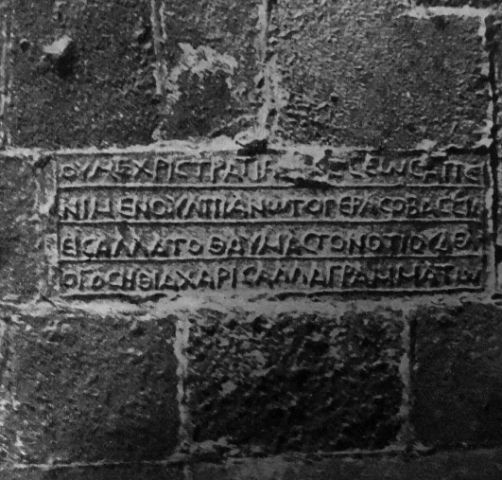
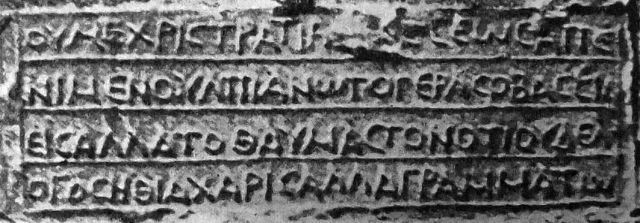
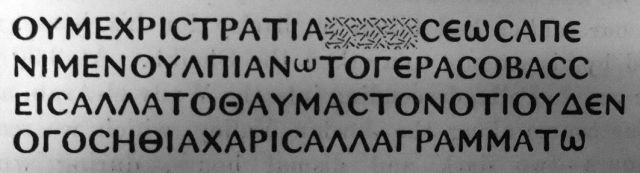
Inscription
Οὐ μέχρι στρατιᾶ[ς ἀπολύ]σεως ἀπέ- / νιμεν Οὐλπιανῷ τὸ γέρ(α)ς ὁ βασσιλ- / (3) ε(ύ)ς, ἀλλὰ τὸ θαυμαστὸν ὅτι οὐδὲ λ- / όγος ἡ θία χάρις ἀλλὰ γραμμάτω(ν)
Inscription translation
Not until the resolution of his military service did the emperor assign to Ulpianus his reward; but the miracle is that the divine (=imperial) grace is not a word, but grammaton.
Bibliography
- Feissel, D. 'Notes d' Épigraphie chrétienne', Bulletin de Correspondance Hellénique 108, 545-579, Paris 1984, 557-8
Discussion
INSCRIPTION
In four lines:
Οὐ μέχρι στρατιᾶ[ς ἀπολύ]σεως ἀπέ- / νιμεν Οὐλπιανῷ τὸ γέρ(α)ς ὁ βασσιλ- / (3) ε(ύ)ς, ἀλλὰ τὸ θαυμαστὸν ὅτι οὐδὲ λ- / όγος ἡ θία χάρις ἀλλὰ γραμμάτω(ν)
'Not until the resolution of his military service did the emperor assign to Ulpianus his reward; but the miracle is that the divine (=imperial) grace is not a word, but grammaton.'
We reproduce the inscription in the version given by Feissel 1984. Following Feissel, we do not dare a translation of the last word the grammar and meaning of which in this context remains unclear; the reader is referred to the discussion by Feissel 1984, 557-8.
Letter height not recorded.
The inscription, laid out in four lines, resembles (and maybe intends to emulate) in form verse inscriptions, without, however, being really metrical. Whereas earlier scholars thought that this was a funerary inscription to a soldier, Feissel 1984 proposed to understand γέρας (line 2) as 'statue', in the same sense as it occurs in other late antique inscriptions (LSA-877, LSA-349, LSA-361; Feissel 1984, 547-8; see also LSA-1231). The imperial reward would then be the concession of the honour of a statue to Ulpianus. Ulpianus, in consequence, is not a soldier, but a high ranking state official, possibly a dux et praeses Arabiae (see below, 'Honorand, Awarder, and Date').
DESCRIPTION (from the published photo)
Rectangular block; no measurements are published. The inscription is not carved into the stone, but standing proud. The epigraphic field is framed by a thin line standing proud, and is separated into four approximately equal subfields by horizontal lines of the same kind. The inscription is complete except for a blur in the centre of the first line, caused by weathering or building material (mortar).
PROVENANCE AND CURRENT LOCATION
The inscription was first recorded 1897 built into a wall of the sheikh's house in Sheikh-Miskin (Fossey, Bulletin de correspondance héllenique 21, 1897, p. 51 no. 45). A photo of it was taken there by G. A. Smith in 1901 (see images). Sheikh-Miskin is situated in the region of the Dekapolis; the inscription is probably from one of the ancient cities of that region. There is no published record of its present location.
HONORAND AND DATE
Feissel 1984, 558 proposes as honorand Ulpianus, governor (dux et praeses) of Arabia in 364 (PLRE I, 973-4 Ulpianus 3, Sartre 1982, 104). Ulpianus is known from some letters by Libanius. Although Libanius alludes to military operations only, Ulpianus was probably dux et praeses (that is, he held military command and governorship at a time), because unlike in other provinces at this time, in Arabia military and civil responsibilities were not separated (Sartre 1982, 104. 117-18; Brünnow & Domaszewski 1909 p. 281).
The identification of our Ulpianus with the governor of Arabia of 364 is not based on any evidence given by the inscription itself. We therefore prefere to leave as a broad outer date the 4th-6th centuries (see below, 'Further Discussion').
If the dux et praeses of Arabia of 364 is the honorand of our inscription, then the single emperor referred to in the inscription takes wonder at a time when the brothers Valens and Valentinian I exercised common power.
FURTHER DISCUSSION
The inscription with its incapability to perform a proper metrum, as with its lack of any allusion to personal, military or administrative virtues of the honorand, appears odd among the late antique honorific verse inscriptions. To quote Feissel 1984 pp. 557-8 n. 67: 'Il est frappant qu'une inscription aussi maladroite se rapporte à un aussi haut personnage'.
Discussion references
- Brünnow, R. E. & A. v. Domaszewski, Die Provincia Arabia, auf Grund zweier in den Jahren 1897 und 1898 unternommenen Reisen und der Berichte früherer Reisender beschrieben von Rudolf Ernst Brünnow und Alfred v. Domaszewski. Bd. III, Straßburg 1909
- Martindale, J. R., The Prosopography of the Later Roman Empire. Vol. II A.D. 395-527, Cambridge 1980
- Sartre, M., Trois études sur l'Arabie romaine et byzantine, Bruxelles 1982, p. 104 no. 71 Ulpianus
Cite: Last Statues of Antiquity, LSA-1232 (Ulrich Gehn).