
LSA-1234
Base for re-erected statue, possibly of Hercules. Aquileia (Venetia et Histria). Earlier to mid-fourth century
Record details
Photographs
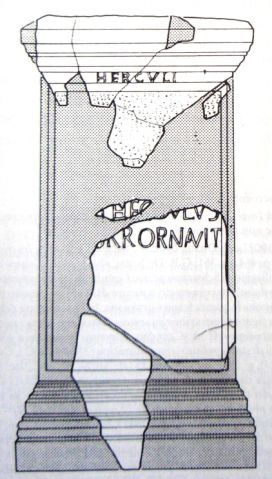
Inscription
Herculi. // [Sept(imius)] Theodulus, / [v(ir) c(larissimus), c]orr[ector], ornavit.
Inscription translation
To Hercules (OR: [Statue] of Herculius). Septimius Theodulus, of clarissimus rank, governor (corrector), decorated [the forum with this].
Bibliography
- L'Année épigraphique, , 1996, 685
- Maselli-Scotti, F. and C. Zaccaria, Novità epigrafiche dal foro di Aquileia, Epigrafia romana in area adriatica (Actes de la IXe rencontre franco-italienne sur l’épigraphie du monde romain, Macerata, 10-11 Novembre 1995, 113-60, Macerata 1998, 145-52 no. 2
Discussion
INSCRIPTION
Fragmentarily preserved in three lines:
Herculi. // [Sept(imius)] Theodulus/ [v(ir) c(larissimus) c]orr[ector] ornavit.
'To Hercules (OR: [Statue] of Herculius). Septimius Theodulus, of clarissimus rank, governor (corrector), decorated [the forum with this]'.
Letter height 3.2 – 7 cm.
Enough survives of this fragmentary inscription to restore the name of the awarder (see below, ‘Honorand, Awarder and Date’).
DESCRIPTION (from Maselli-Scotti and Zaccaria 1998, and the published images)
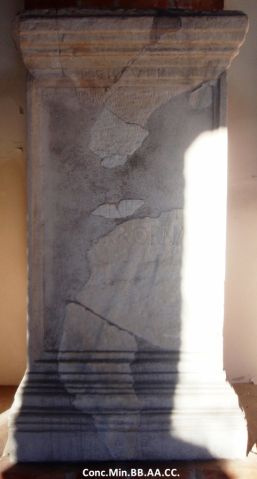
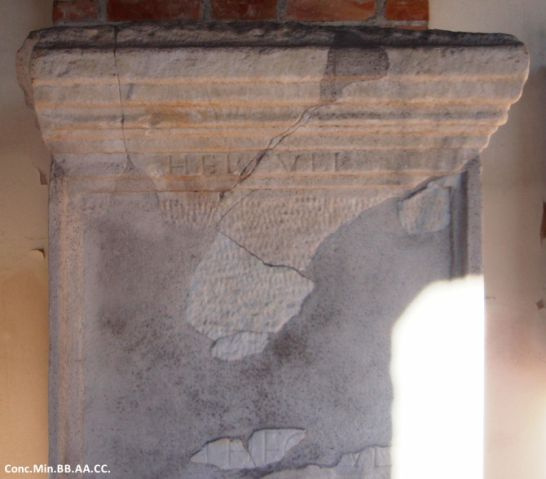
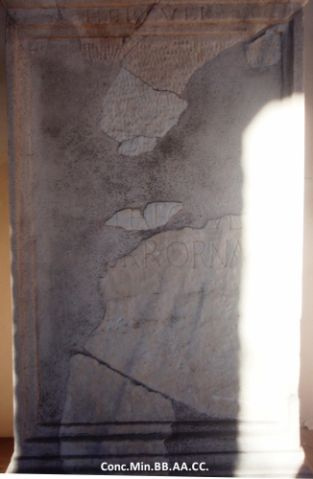
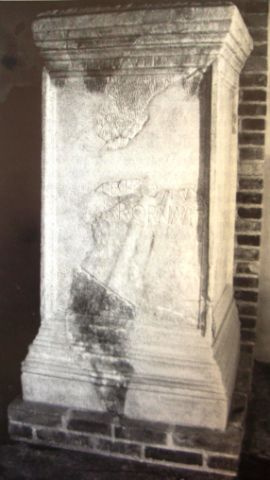
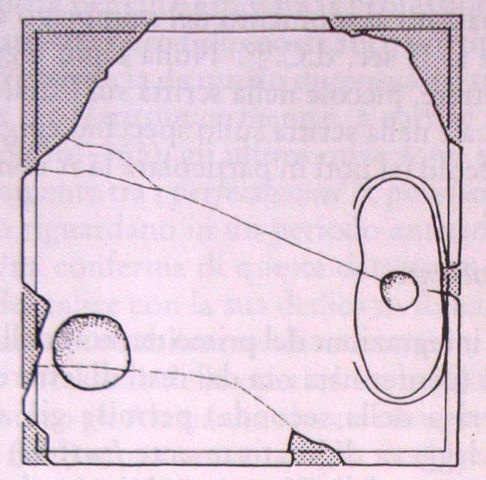
Fragments of a marble statue base moulded at top and bottom. A large portion of the upper moulding with the top face and a portion of the epigraphic field is preserved in adjoining fragments. On the top face, there are fittings for a bronze statue (Zaccaria 2000, 97 was convinced that the shape of the holes visible on top pointed to a statue of Hercules leaning on his club; see below, 'Honorand, Awarder and Date').
Line 1 is engraved on a band that frames the epigraphic field. Line 2 is distributed over two small, adjoining fragments from the centre of the shaft, and a larger fragment that also contains the extant remains of line 3; this larger fragment preserves a portion of the right margin. A further large fragment preserves a portion of the lower moulding, but is not inscribed.
As Maselli-Scotti and Zaccaria 1998, 148 point out, the typology of the mouldings suggests a date in the 2nd century for the original use of our base. Our inscription is carved over an erased earlier one; of this nothing is now legible in the epigraphic field (see also below, ‘Honorand, Awarder and Date’ and ‘Further Discussion’).
On basis of the extant fragments, Maselli-Scotti and Zaccaria 1998 calculated the following dimensions: H 165, W 90, D c. 80 cm.
PROVENANCE AND CURRENT LOCATION
The inscription was found during excavations in 1994/5 in the western part of the forum of Aquileia (Maselli-Scotti and Ventura 1994).
The fragments were integrated with plaster, and the restored base is now in the Museo Archeologico Nazionale of Aquileia (without published inv. no.).
HONORAND, AWARDER AND DATE
Maselli-Scotti and Zaccaria 1998 suggested that line 1 belonged to our inscription, and that the base carried a statue of the god Hercules, addressed in the dative. Zaccaria 2000, 97 however suggested that line 1 was rather a signum ('[Statue] of Herculius') from an earlier inscription which was incorporated into our inscription. Zaccaria 2001, 487 suggested that the signum of the earlier dedication, perhaps of the late 2nd or early 3rd century, was probably plastered over when our base was rededicated in the 4th century (see below, 'Further Discussion'). If so, the honorand is not recorded in our inscription (see also LSA-1233 and LSA-2659, likewise set up by Theodulus).
The inscription was set up by Septimius Theodulus, provincial governor (corrector) of Venetia et Histria. Two further statue dedications by this governor are known from Aquileia (LSA-1233, and LSA-2659). Theodulus held office in the earlier to mid- 4th century; he was a Christian (see LSA-1233, ‘Honorand, Awarder and Date’).
FURTHER DISCUSSION
Maselli-Scotti and Zaccaria 1998 suggested that the dedications by the governor Theodulus, all found in the same area at the western side of the forum of Aquileia, formed part of a gallery of statues to figures of historical or mythological relevance for the city, as a visible affirmation and celebration, set up in the city centre, of the city’s great traditions and history (see map Maselli-Scotti and Zaccaria 1998, 117 fig 1). Likewise from the forum (but from a different spot) is a re-inscribed base to Publius Valerius Maro, father of the poet Vergil (LSA-2660).
Zaccaria 2001 based his suggestion to assign line 1 to an earlier inscription (see above, 'Honorand, Awarder and Date') on the different carving technique and size of the letters. We would support this suggestion with another argument: of the 148 inscriptions in our database recording repair or transposition of statues, only a handful make the name of the subject explicit. Of these, a group from the baths of Caesarea (Mauretania Caesariensis) stands out (LSA 2313, LSA 2314, LSA 2315, LSA 2316, LSA 2317, LSA 2318); however, this group may well have been moved to the baths as early as in the late-2nd/early-3rd century. The very few other cases in the West which make the name of the honorand explicit do not address him in the dative (as usual with honorific inscriptions) but refer to the statue as the object of the action taken (LSA 791, LSA 1471, LSA 1505). Addressing the (pagan) deity in an inscription of this type would be unparalleled in our records, and is made even more unlikely by the Christian faith of the governor.
Discussion references
- Maselli-Scotti, F. and P. Ventura, Aquileia, Foro romano. Scavi 1993-94, Aquileia Nostra LXV, 1994, 329-37, Aquileia 1994, 330. 331 fig. 1
- Zaccaria, C., "La 'trasformazione' del messaggio epigrafico tra II e IV secolo d.C. A proposito di un palinsesto rinvenuto nel foro di Aquileia", Varia Epigraphica. Atti del Colloquio Internazionale di Epigrafia. Bertinoro, 8-10 giugno 2000, 475-494, Faenza 2001, 487
- Zaccaria, C., Permanenza dell’ideale civico romano in epoca tardoantica: nuove evidenze da Aquileia, Antichità Altoadriatiche 47, 2000, 91-113, Aquileia 2000, 96-7
Cite: Last Statues of Antiquity, LSA-1234 (Ulrich Gehn and Carlos Machado, discussion added 5/2014).