
LSA-124
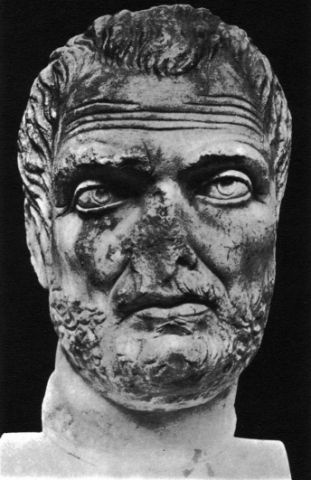
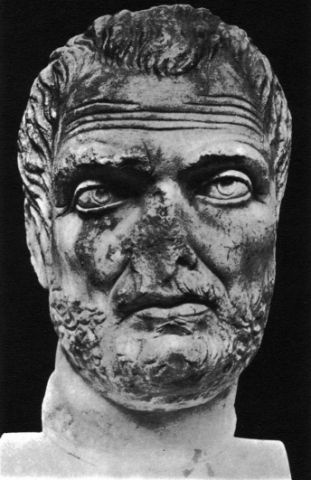
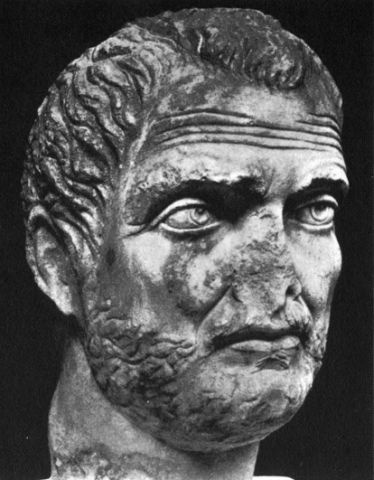
Portrait head of bearded man. Athens. Late third century
Record details
Photographs
Bibliography
- L'Orange, H. P., Studien zur Geschichte des spätantiken Porträts, Oslo 1933, pp. 39-40, 123-4 no. 56 figs. 103, 104
Discussion
DESCRIPTION (Object)
Portrait head of a bearded male, large-cristalled (L'Orange 1933) marble, pentelic according to Kavvadias 1892. Worked for insertion (L'Orange 1933, 123; on the published images the conical shape for the insertion appears in the view from the right side). The nose is chipped off; minor chips on eyebrows, chin, moustache, and earshells. Traces of sinter on the right cheak, of roots on the left. Apart from that, the head is in an excellent state of preservation.
The head is slightly bending to its right, the right eye lies deeper, the right cheek is more contracted than the left.
The hair is brushed forwards, receding over the temples; single strands are indicated by wavy chisel-strokes. The beard is marked by shorter, irregularly running chisel-strokes.
The flat arching brows are sharply edged. The iris is circumsribed by an incised line, the pupil indicated by a shallowly drilled pelta-shaped hole. The eyeball is separated from the caruncle by an additional incised line. The heavy lids surround the caruncle in an uninterrupted line, while at the outer edges the upper lid overlaps the lower, running out into deeply incised wrinkles.
The forehead is furrowed by five horizontal grooves of various length. Deep naso-labial folds rund from the nostrils to the corners of the mouth. The surface is not polished.
PROVENANCE/ LOCATION
The head was found in Athens in the odos Sophocleous during foundation work for the 'house Bronteses' (Kavvadias 1892, 296 no. 573. See also Archaiologikon Deltion 1890, 138, 8; this is the quarter north of the Acropolis). The head is today in the storerooms of the National Museum in Athens, inv. no. 573.
DESCRIPTION (Subject)
The portrayed is a man of mature age as indicated by the full beard, the receding hair, and the wrinkles. The portrait type with short hair and beard contrasts markedly with the long-haired, long-bearded portrait type of the 'Holy man' (LSA-1083). The portrayed has himself styled as a citizen or an official, not as a marked intellectual.
DATE
The stylistic features of the head with the anxiously adjourning muscles and the striking asymmetries date the head to the tetrarchic period, in the late 3rd century. I share this assessment, already made by L'Orange 1933, 39.
Discussion references
- Kabbadias, P, Glypta tou Ethnikou Mouseiou, Perigraphikos Katalogos, Athens 1890-1892, pp. 295-6 no. 573
Cite: Last Statues of Antiquity, LSA-124 (Ulrich Gehn).