
LSA-1249
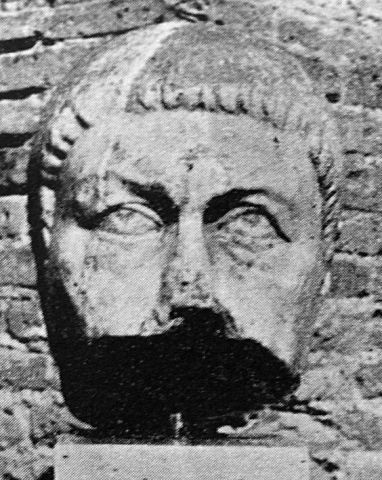
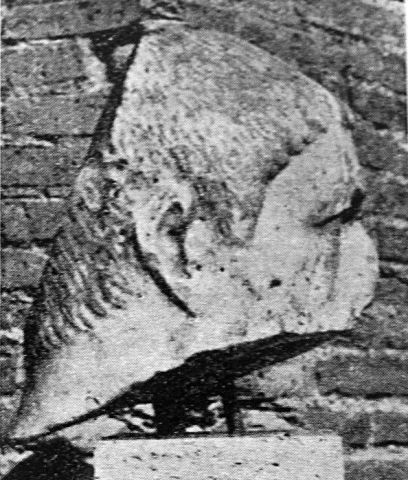
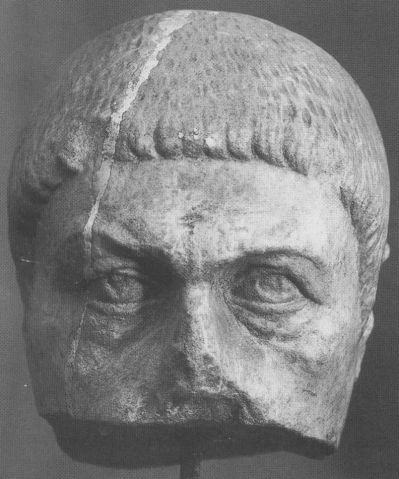
Fragmentary portrait head, possibly of Emperor. From Ostia. Second-quarter to end of fourth century.
Record details
Photographs
Bibliography
- Squarciapino, M.F. 'Ancora sui ritratti di Valente', Bullettino della commissione archeologica comunale di Roma, Rome 1949, 97-9, figs. 1-2
Discussion
DESCRIPTION (Object)
Over life-size head preserved in two fragments. H (at front): 26, H (at back) 37 cm. Italian marble with yellowish hue.
The head is preserved in two fragments which have been joined together in the modern period. One fragment preserves the nape of the neck, right ear, and some of the right cheek until the corner of the right eye. The second fragment preserves the face from the nostrils upwards, the hair over the front of the head, and ***the some*** of the left side of the head. The back of the head was separately worked and is missing. The tip of the nose and lower face are also missing.
The compact uniform surface of the hair is engraved with numerous lines made by a fine flat chisel. The pupils have been drilled out into a U-shape.
PROVENANCE
Found in Forum Baths at Ostia
DESCRIPTION (Subject)
The partially-preserved portrait head is over life-size and re-cut from an earlier portrait. It depicts a clean-shaven man with short hair that arches over the brow. Between the temples the hair ends in short spits, all of which bend to the proper left. The rest of the hair is rendered in longer strands without any drilled separation.
The man has a full rectangular face with a hooked nose and clear signs of age. A crease runs across the brow, and two vertical folds run upwards from the base of the nose. The right eyebrow is more clearly raised than the left, and the area between the eyebrows and the upper eyelids sags heavily over the eye. The skin beneath the eyes is also loose and especially well-defined under the left eye. The right eyebrow and the ‘bag’ beneath the left eye give the portrait an asymmetrical aspect.
DATE
The portrait belongs in the fourth century after Constantine both for reasons of fashion (clean-shaven and short brushed forward hair) and technique (the U-shaped pupils and the cap-like hair engraved with a flat chisel). The Forum Baths at Ostia were restored both in the Constantinian period and then again in the third-quarter of the fourth century.
IDENTIFICATION
The size of the head suggests that it might be an Emperor. The distinct signs of age, especially the creases on the brow and the flaring eyebrows, recall portraits of the Conservatori-Copenhagen-Uffizi type (LSA 578 Copenhagen, LSA 581 Tivoli, LSA 582 Uffizi, LSA 597 Conservatori) which is usually ascribed to Valentinian or Valens. Thus in its first publication Squarciapino identified it as Valens.
The portrait does not however wear a diadem, a feature of all of the other portraits of Valentinian/Valens. The hair at the nape of the neck is also shorter, and the locks of hair across the brow all turn to the proper left as opposed to converging inwards from each side. Whereas none of these objections are compelling, they do lead one to consider two other possibilities, a successor of Constantine or a private individual. Against the former identification is the creased forehead and sagging eyes, and against the latter identification is the sheer size of the object.
Discussion references
- Meischner, J., 'Das Porträt der valentianischen Epoche,', Jahrbuch des Deutschen Archäologischen Instituts, 107 (1992), 217-34, pl. 87-91, 232-3, pl. 91.1 (Tetrarchic)
Cite: Last Statues of Antiquity, LSA-1249 (J. Lenaghan).