
LSA-125
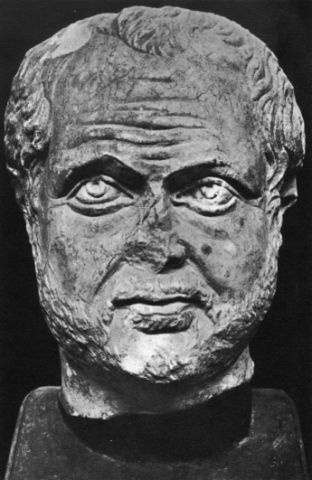
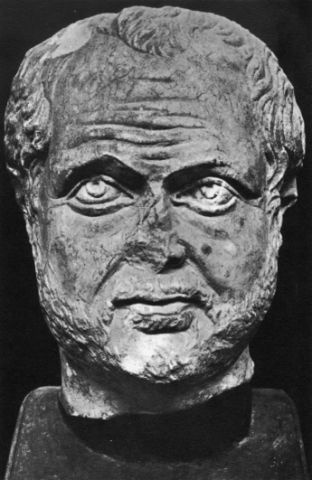
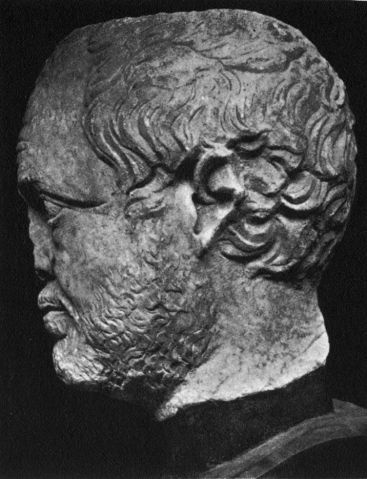
Portrait head of bearded man. Athens. Late third century
Record details
Photographs
Bibliography
- L'Orange, H. P., Studien zur Geschichte des spätantiken Porträts, Oslo 1933, pp. 39-40 no. 3, p. 123 cat. no. 55 figs. 102, 105
Discussion
DESCRIPTION (Object)
Portrait head of a bearded male, worked for insertion. Pentelic marble, H 29 cm. The neck is broken off below the Adam's apple in a bevelled line and the right half of the nose is chipped off. The rim of the left ear is chipped, and there are two large chips above the right temple and at the right side of the chin. The surface is covered with roots; apart from these damages, however, the head is in an excellent state of preservation.
The hair is brushed foreward, with a triangular languet only scantily concealing the bold forehead. It is worked out on all sides; above the forehead and at the left side above the ear single strands are separated by shallow chisel strokes, whereas under the left ear the encroachment of the chisel goes deeper, giving more plasticity to the single locks.The upper part of the coiffure must be the result of a late-antique rework of an earlier head, where a layer of the original substance has been taken away.
The trimmed beard consists of short curls incised by shallow chisel strokes.
The forehead is furrowed by six wrinkles of unequal length and depth, incised with a chisel and just approximately parallel. The mouth is protruding, deep naso-labial folds separate the mouth from the cheeks, the lower lip is disposed from the chin by a marked line.
The asymmetry of the wrinkles of the forehead is underlined by the deeply shadowing, sharp-edged, unequally raised eyebrows. The lids are separated from the orbital by a drilled channel. They surround the eyes in a bulging line. At the outer side of the left eye the upper lid is overlapping the lower one. Both eyes have wrinkles at the edges. Flabby lacrimal sacs are sharply separated from the bulging lower lids. The protruding eyeballs are separated from the lids by drillwork. The iris is standing proud, circumscribed by a deeply cut line, the pupil is a circular drilled hole. The caruncles are marked by drill-points.
PROVENANCE/ LOCATION
The head was found in the sanctuary of Aslepius at the southern slope of the Acropolis (Kabbadias 1892; Rhomioupoulou 1997). It is today in the National Archaelogical Museum in Athens, inv. no. 446.
DESCRIPTION (Subject)
The portrait is of a mature man with full beard, the forehead almost bold. The advanced age is underlined by the numerous wrinkles in the face. According to L'Orange 1933, 123 a piece of garment is preserved at the back side of the neck. The portrait type with the trimmed beard distinguishes markedly from the 'Holy -Man' portrait type (LSA-1083). The honorand has himself styled as a citizen or office-holder rather than an outstanding intellectual.
DATE
The head has been dated to the period of the first tetrarchy by L'Orange 1933, 39, by stylistic reasons (the adjournments of the muscles in the face, hairstyle and short beard) and by close comparison, both stylistically and iconographically, to another head in Athens (L'Orange 1933 no. 53 = LSA-127) which he considered as the prototypical representative of this period in the portraiture of Greece. The tetrarchic date has been adopted by Rhomiopoulou 1997 and Kaltsas 2002, and is, I believe, correct.
Discussion references
- Kaltsas, N., Sculpture in the National Archaeological Museum, Athens, Athens 2002, 372 no. 794
- Καββαδίας, Π., Γλυπτά του Εθνικού Μουσείου, Περιγραφικός Κατάλογος, Athens 1890-1892, 271 no. 446
- Ρωμιοπούλου, Κ., Ελληνορωμαικά Γλυπτά του Εθνικού Αρχαιολογικού Μουσείου, Athens 1997, 136 no. 148
Cite: Last Statues of Antiquity, LSA-125 (Ulrich Gehn).