
LSA-1253
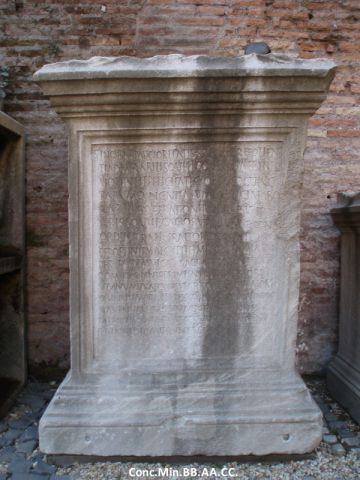
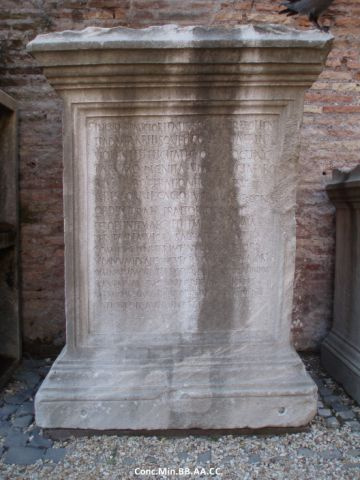
Base for statue of Vulcacius Rufinus, consul and praetorian prefect; erected by inhabitants of Ravenna. Rome. 347.
Record details
Photographs
Inscription
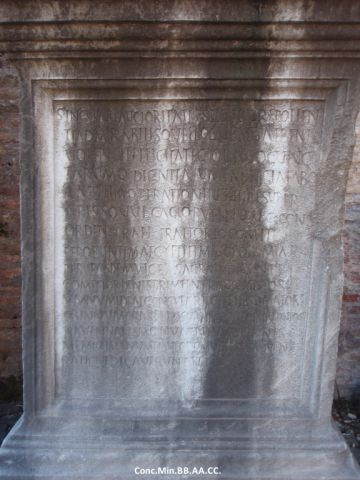
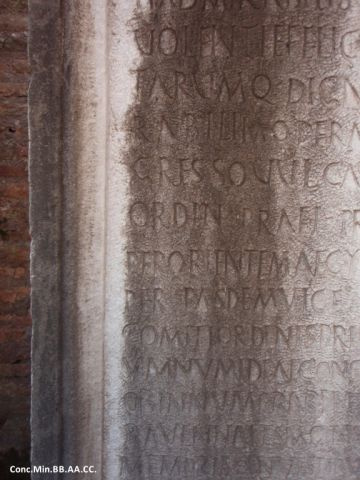
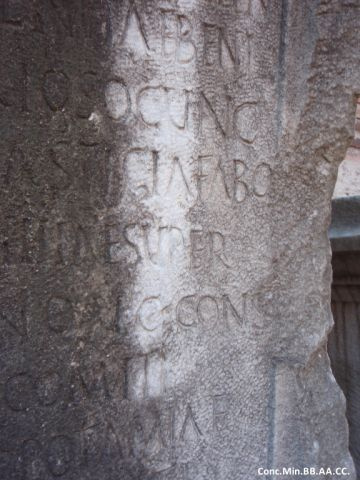
Singulari auctoritatis splendore pollen/ti, admirabilisque eloquentiae beni/volenti(a)e felicitate glorioso, cunc/tarumq(ue) dignitaIum (sic, for 'dignitatum') fastigia fabo/rabili moderatione iusIiIiae (sic, for 'iustitiae') super/gresso, Vulcacio Rufino, v(iro) c(larissimo), cons(uli) /(7) ordin(ario), praeI(ecto) (sic, for 'praefecto') praetorio, comiti / per Orientem Aecypti (sic, for 'Aegypti') et Mesopotamiae, / per pasdem (sic, for 'easdem') vice sacra iudicanti, /(10) comiti ordinis primi intra consistori/um, Numidiae consulari, pontieici (sic, for 'pontifici') maiori, / ob innumerabiles sublimis benig(ni)tatis tiIulos (sic, for 'titulos'), / Ravennates monumentum perennis /(14) memoriae in vestibulo domus statuali vene/ratione dicaverunt. ut (sic).
Inscription translation
Vigorous in the remarkable splendour of authority, glorious in the good fortune of admirable eloquence and benevolence, to one who has undertaken the burdens of all offices with favourable moderation, Vulcacius Rufinus, of clarissimus rank, consul (consul ordinarius), praetorian prefect and judge representing the emperor (vice sacra iudicanti) for Oriens, Egypt, and Mesopotamia, count in the imperial council, governor (consularis) of Numidia, higher pontiff. On account of the countless examples of his eminent favour, the people of Ravenna dedicated this monument for his eternal memory in the vestibule of his house, honouring him with a statue (statuali veneratione). So that.
Bibliography
- Corpus Inscriptionum Latinarum; , VI, 32051 (+p. 4807)
Discussion
INSCRIPTION
In 15 lines:
We give the inscription as it was carved, with an unneeded 'ut' ('so that') at its close, and with a number of words in the text that are inaccurately written. Letter height: 3.5-2.5 cm.
Singulari auctoritatis splendore pollen/ti, admirabilisque eloquentiae beni/volenti(a)e felicitate glorioso, cunc/tarumq(ue) dignitaIum (sic, for 'dignitatum') fastigia fabo/rabili moderatione iusIiIiae (sic, for 'iustitiae') super/gresso, Vulcacio Rufino, v(iro) c(larissimo), cons(uli) /(7) ordin(ario), praeI(ecto) (sic, for 'praefecto') praetorio, comiti / per Orientem Aecypti (sic, for 'Aegypti') et Mesopotamiae, / per pasdem (sic, for 'easdem') vice sacra iudicanti, /(10) comiti ordinis primi intra consistori/um, Numidiae consulari, pontieici (sic, for 'pontifici') maiori, / ob innumerabiles sublimis benig(ni)tatis tiIulos (sic, for 'titulos'), / Ravennates monumentum perennis /(14) memoriae in vestibulo domus statuali vene/ratione dicaverunt. ut (sic).
'Vigorous in the remarkable splendour of authority, glorious in the good fortune of admirable eloquence and benevolence, to one who has undertaken the burdens of all offices with favourable moderation, Vulcacius Rufinus, of clarissimus rank, consul (consul ordinarius), praetorian prefect and judge representing the emperor (vice sacra iudicanti) for Oriens, Egypt, and Mesopotamia, count in the imperial council, governor (consularis) of Numidia, higher pontiff. On account of the countless examples of his eminent favour, the people of Ravenna dedicated this monument for his eternal memory in the vestibule of his house, honouring him with a statue (statuali veneratione) . So that.'
As noted above, the inscription contains many mistakes in the carving, with misspellings and an unwanted ut at the end.
DESCRIPTION (personal inspection)
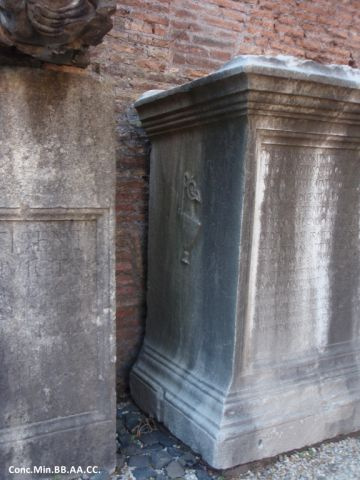
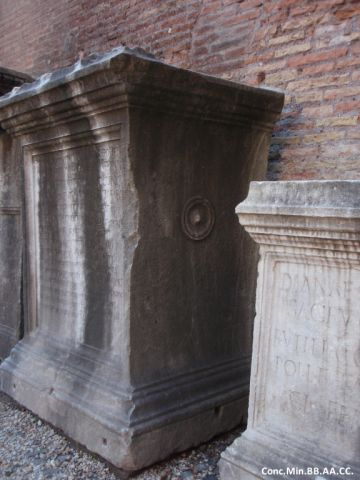
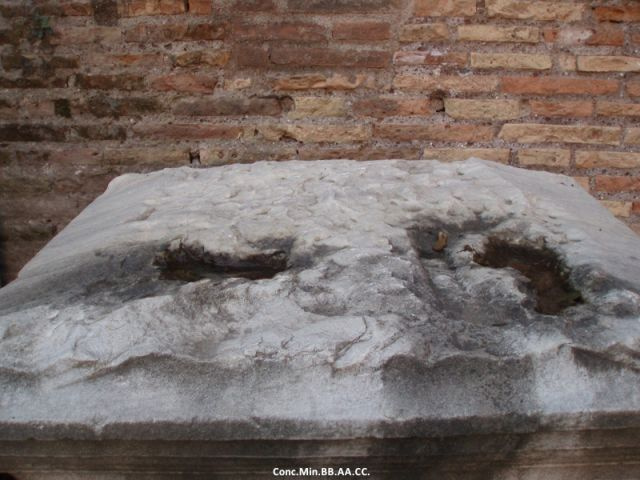
White marble base, with prominent mouldings at top and bottom on three sides: H 147, W 105, D 87 cm. The epigraphic field is framed by a moulding, damaged on the right side. Its surface is rough and irregular, clearly due to the erasure of an earlier inscription. There are three small round holes on the lower part of the base, below the epigraphic field. The right side has a patera and the left side an urceus. Each side has one hole near the bottom, perhaps for affixing the base to a structure below. The back is roughly finished. The top is very rough, and it looks as though a sloping gable (dating from the first use of the block, probably as an altar) was truncated in order to take our statue. Within the rough finish of the top are two holes and the marks of feet, presumably to support a statue in bronze.
PROVENANCE AND CURRENT LOCATION
The base was discovered during excavations for the foundations of the Italian Ministry of War on via Modena, on the Quirinal. The inscription informs us that the dedication was made in the vestibule of the house of Rufinus (Guidobaldi 1995, 172-173). It is now in the Museo Nazionale Romano, at the Terme di Diocleziano, in the entrance courtyard (inv. n. 707).
HONORAND, AWARDER, AND DATE
Vulcacius Rufinus was a brother of Neratius Cerealis, consul in 358, and of Galla (mother of the Caesar Gallus), through whom he was related to the Constantinian family. He pursued a successful career in different parts of the empire and at court, attaining the consulship in 347 (PLRE I, 782-783 Rufinus 25). He occupied the praetorian prefecture on three more occasions, after this monument was set up.
The statue was dedicated by the people of Ravenna, on account of unspecified favours. Chastagnol (1992, 444 n. 70) suggested that he was patron of the city, but this is not explicit in the inscription.
The dating of Rufinus' consulship, the occasion of the erection of this statue, to 347 is uncontroversial (Gordon 1965, 118-120; PLRE I, 782-783 Rufinus 25). The fact that the inscription only mentions his first praetorian prefecture confirms this dating (see also Barnes 1992, 257).
Discussion references
- Barnes, T. D., "Praetorian Prefects, 337-361", Zeitschrift für Papyrologie und Epigraphik, 94, 1992, pp. 249-260
- Chastagnol, A.,, Le Sénat romain à l'époque impériale, Paris 1992
- Gordon, A. E., Album of Dated Latin Inscriptions, vol. 3, Berkeley 1965
- Guidobaldi, F. "Domus: Vulcacius Rufinus", Lexicon Topographicum Urbis Romae, vol. 2, Rome 1995, pp. 172-173
- Jones, A. H. M. et al., The Prosopography of the Later Roman Empire. Vol. I 260-395, Cambridge et al. 1971 (1975), pp. 782-783 Rufinus 25
Cite: Last Statues of Antiquity, LSA-1253 (Carlos Machado).