
LSA-1255
Base for statue of Diocletian, emperor (later re-used for Constantine I); erected by the guild of tanners (coriarii). Rome. 287 and 312-337
Record details
Photographs
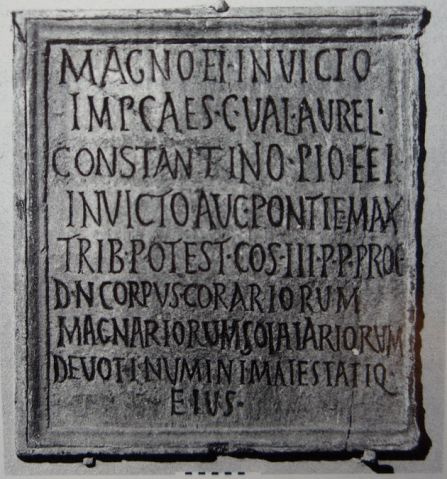
Inscription
Magno eI (sic, for 'et') invicto / imp(eratori), Caes(ari) C(aio) Val(erio) Aurel(io) / [[[Diocletia]]]no [later altered to 'Constantino'], pio, fel(ici), / invicto Aug(usto), pontie(ici) (pontif(ici)) max(imo), /(5) trib(unicia) potest(ate), co(n)s(uli) III, p(atri) p(atriae), proc(onsuli), / d(omino) n(ostro). Corpus cor(i)ariorum, / magnariorum, solaIariorum (solatariorum), / devoti numini maiestatiq(ue) / eius. // (on the side) Dedicatae / Kal(endis) Ian(uariis) / dd(ominis) nn(ostris) Diocleliano (Diocletiano) III et / Maximiano co(n)ss(ulibus), / curante Lhessio (Thessio) Secundo p(atrono?) c(orporis?) / cor(i)ariorum.
Inscription translation
To the great and unconquered emperor, Caesar Caius Valerius Aurelius Diocletianus (later altered to Constantinus), pious, fortunate, unconquered Augustus, highest priest, with tribunician power, consul for the third time, father of the fatherland, proconsul, our lord. The corporation of tanners and leather-merchants, devoted to his divine spirit and majesty [set this up]. (On the side of the base) Dedicated on the Kalends of January (= January 1st), in the consulship of our lords Diocletian for the third time and Maximian, under the supervision of Thessius Secundus, patron(?) of the corporation of the tanners.
Bibliography
- Corpus Inscriptionum Latinarum; , VI, 1117 (+p.4325)
- Gregori, G. L. (ed.), Supplementa Italica. Imagines. Roma (CIL VI), 1. Musei Capitolini, Rome 1999, no 193
Discussion
INSCRIPTION
In nines lines (main inscription). Letter heights: 6.5 - 4 cm on the front. 3 - 2 cm on the side (Gordon 1965, 98-99).
Magno eI (sic, for 'et') invicto / imp(eratori), Caes(ari) C(aio) Val(erio) Aurel(io) / [[[Diocletia]]]no [later altered to 'Constantino'], pio, fel(ici), / invicto Aug(usto), pontie(ici) (pontif(ici)) max(imo), /(5) trib(unicia) potest(ate), co(n)s(uli) III, p(atri) p(atriae), proc(onsuli), / d(omino) n(ostro). Corpus cor(i)ariorum, / magnariorum, solaIariorum (solatariorum), / devoti numini maiestatiq(ue) / eius. // (on the side) Dedicatae / Kal(endis) Ian(uariis) / dd(ominis) nn(ostris) Diocleliano (Diocletiano) III et / Maximiano co(n)ss(ulibus), / curante Lhessio (Thessio) Secundo p(atrono?) c(orporis?) / cor(i)ariorum.
'To the great and unconquered emperor, Caesar Caius Valerius Aurelius Diocletianus (later altered to 'Constantinus'), pious, fortunate, unconquered Augustus, highest priest, with tribunician power, consul for the third time, father of the fatherland, proconsul, our lord. The corporation of tanners and leather-merchants, devoted to his divine spirit and majesty [set this up]. (On the side of the base) Dedicated on the Kalends of January (= January 1st), in the consulship of our lords Diocletian for the third time and Maximian, under the supervision of Thessius Secundus, patron(?) of the corporation of the tanners.'
The name of the emperor Diocletian (Caius Valerius Aurelius Diocletianus) has been partially erased, and replaced (but only partially) by the name of Constantine. As a result, in the new version Constantine appears incorrectly as 'Caius Valerius Aurelius Constantinus', and not as he should, as 'Flavius Valerius Constantinus'; and, of course, with the wrong date of dedication on the side of the base.
DESCRIPTION (From Gregori)
Front and part of the side of a marble base: 70.5 x 61.5 cm. The two parts have been separated and set into a wall. The epigraphic field is framed by a moulding.
PROVENANCE AND CURRENT LOCATION
The base was discovered in Trastevere, near the church of S. Crisogono. It is not clear whether this was its original location, but it is likely to have come from the immediate vicinity, probably the headquarters of the corporation of the tanners, as LSA-1256, another imperial dedication by this same group, was found in the same area.
HONORAND, AWARDER, AND DATE
The base was dedicated to the emperor Diocletian (284-305), and later crudely adapted into a dedication to Constantine I (312-337), by altering part of the name (see above, 'Inscription')
The statue was set up by the Corpus coriariorum magnariorum solatariorum, the corporation of tanners and retail leather-merchants. The dedication was supervised by Thessius Secundus, probably patron of the corporation, who is otherwise unknown (Waltzing vol. 3, 370).
The first dedication was carried out on the first of January 287, the day Diocletian began his third term as consul (and Maximian his first term) (Kienast 1996, 266-269). There is no internal evidence from our base to date its second dedication, to Constantine, more precisely than to the years of his rule over Rome (312 -37). However, if this second dedication occurred at the same time as that of a probable paired base, which was rededicated to Constantine's eldest son, the Caesar Constantine II (LSA-1256; see below 'Further Discussion'), then our base will have been re-used for Constantine I after Constantine II was elevated to the rank of Caesar in 317.
FURTHER DISCUSSION
In the dating inscription on the side of the base, the plural 'dedicatae</I>' for the dedicated objects is used. This would be appropriate for statues (statuae), but inappropriate for a single statue (statua). Almost certainly a second statue and base were dedicated at the same time, presumably to Diocletian's imperial colleague Maximian (who also assumed consular office on 1st January 287). The base for this second statue is probably LSA-1256, which was later re-used for the Caesar Constantine II (317-37).
Discussion references
- Gordon, A. E., Album of Dated Latin Inscriptions, vol. 3, Berkeley 1965, 98-99
- Kienast, D., Römische Kaisertabelle. Grundzüge einer römischen Kaiserchronologie, Darmstadt (2)1996, 266-269
- Waltzig, J.-P., Étude historique sur les corporations professionnelles chez les Romains: depuis les origines jusqu'à la chute de l'Empire d'Occident , Louvain 1895-1900 , vol. 3, p. 370
Cite: Last Statues of Antiquity, LSA-1255 (Carlos Machado).