
LSA-126
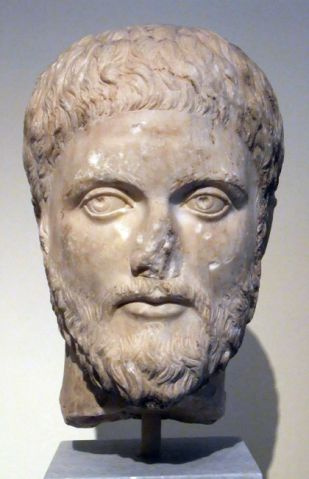
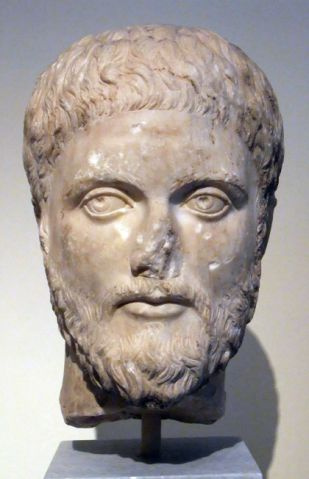
Portrait head of bearded man, traditionally dated late antique. Athens. Late second to early third century
Record details
Photographs
Bibliography
- L'Orange, H. P., Studien zur Geschichte des spätantiken Porträts, Oslo 1933, pp. 43-6, 126 no. 66 figs. 116, 117
Discussion
DESCRIPTION (Object)
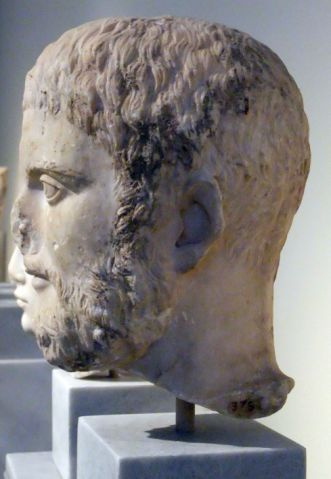
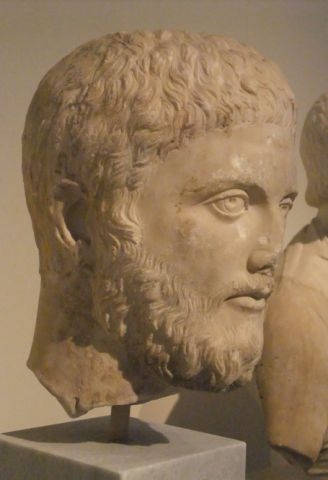
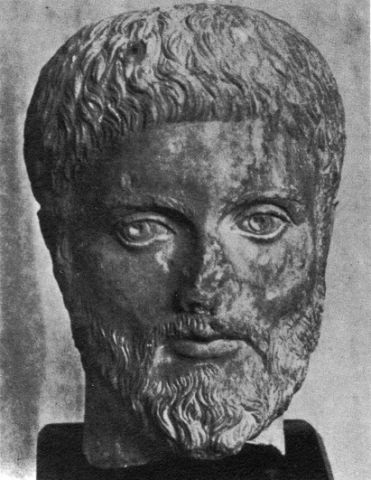
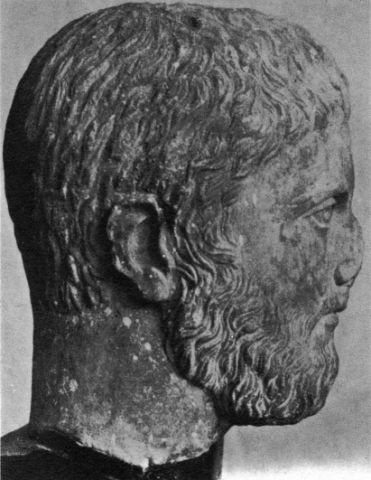
Portrait head of a bearded male, pentelic marble, H 33 cm. The neck is broken below the chin, the tip of the nose is chipped off. Further chips on earlaps, forehead, and cheeks. Apart from that, the head is in a good state of preservation. L'Orange 1933, 126 no. 66, thought that it was made for insertion into a herm.
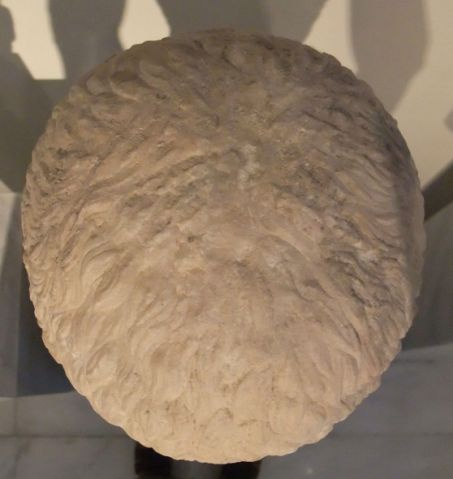
The hair is a compact mass, divided into crescent shaped strands by chisel work. It is combed towards all sides from the vertex and markedly more elaborate around the face than on the back. The stringy appearance at the backside results from the removal of material in the late-antique re-working process. In the centre of the forehead the strands are reduced to short fringes, all combed to the (proper) right. This part of the hairline appears odd as against the surrounding parts, and the hair is deprived of some volume here. This again is the result of the late-antique re-work which adapted the hairstyle to contemporaneous fashion (see below, 'Date'). The hairline confines the forehead in a perfectly symmetrical low-arching line. The beard is rendered in the same way as the hair.
The eyes are almond-shaped, the upper lid overlaps at the outer corners. The low-arching brows are sharp edged, hair is indicated by short chisel strokes. The iris is indicated by an incised circular line, the pupil drilled into bean-shape. The caruncle is defined against the eyeball by an incised line.
No wrinkles disturb the polished smoothness of the flesh. The contour line circumscribes the head in a perfect oval, the head is modelled without any marked caesura.
PROVENANCE/ LOCATION
No exact data about the provenance is published; according to Romiopoulou 1997 it is from Athens (marked wit a query). The material (pentelic marble) supports this. Today it is in the National Archaeological Museum in Athens, inv. no. 375.
DESCRIPTION (Subject)
The full beard marks the portrayed as a man of mature age, despite the fact that no wrinkles whatsoever disturb the polished smoothness of the flesh. The portrait type with the cultivated hair and beard displays the ideal of the Athenian citizen as it encounters in numerous portrait heads of the Roman period.
DATE
L'Orange 1933, 43 saw ties with the art of the tetrarchic period in the 'stalling of plastic sensitivity' allegedly displayed by our head, and in its 'resolution into mazy and dismembered single motifs' ('Absterben des plastischen Gefühls (...) und die eigentümliche Auflösung in kleine wirre und zersplitterte Einzelmotive'). At the same time he saw an influence 'of the new Constantinian art' in plastic style and hairstyle; this led him to a date of 300-320.
Romiopoulou 1997, and Kaltasas 2002, both date to the 2nd tetrarchy 306-324.
L'Orange's main witness for his date was the head of a youth in the Athenian National Museum (inv. no. 399 = LSA-121). The 'Constantinian' hairstyle of this head has been reworked from an earlier portrait; its fourth century date has been challenged by Bergmann 1977, 88 and is all but secured. Similarities to our head in contour and plastic values do exist; in our view they do not support, however, an early fourth century date for our head. Notably the hairstyle of our portrait with its crescent shaped strands, all plastically rendered, resembles the a-penna hairstyle of the earlier third century and is markedly different from the lank forward-brushed hairstyle of the youth which is the result of a re-work.
L'Oranges arguments for an early 4th-century date do not convince me; the difficulties provided by our head might allow for a somewhat more detailed discussion.
The closest parallel among the Athenian portrait heads, in my view, is provided by the portrait of a cosmete in the National Museum in Athens, inv. no. 398 (Graindor 1915, 360-2 no. 25 pl. 23; Lattanzi 1968, 60-1 no. 28 pl. 28). Beyond the smoothened, symmetrical, classicising treatment of the facial features, this head equals ours in the trimmed and neatly cultivated hair and, technically spoken, in the way in which the chisel work without deep intrusion into the material nonetheless lends plastic value to the single strands, creating the impression of a pillowy material. The cosmete head had been dated to the period of Gallienus already by Graindor 1915, followed by Lattanzi 1968. Whereas a Gallienic date would seem acceptable for me, and more appropriate than a date in the ealy 4th century, the eggshell-like smoothness of the face together with the oval contour line speak in favour of an even earlier, late severan date for our head; also the a-penna-like strands of our head support such an early date.
Further support of this early date is provided by the eyes which with their bean shaped drillings have the characteristic form of the late 2nd/ earlier 3rd century; forms which can hardly be expected by the late 3rd century or later.
FURTHER DISCUSSION
A similar case of a head traditionally dated late and asociated with the 'Theodosian classicism', but dating to the late 2nd or early 3rd century in my view, is LSA-132.
Discussion references
- Bergmann, M., Studien zum römischen Porträt des 3. Jahrhunderts n. Chr., Bonn 1977
- Graindor, P., Les cosmètes du Musée d'Athènes, Bulletin de Correspondance Hellénique 39, 241-401, Paris 1915, pp. 360-2 no. 25 pl. 23
- Kaltsas, N., Sculpture in the National Archaeological Museum, Athens, Athens 2002, p. 372 no. 797
- Lattanzi, E., I ritratti dei Cosmeti nel Museo Nazionale di Atene, Rome 1968, pp. 60-1 no. 28 pl. 28
- Ρωμιοπούλου, Κ., Ελληνορωμαικά Γλυπτά του Εθνικού Αρχαιολογικού Μουσείου, Athens 1997, p. 131 no. 142
Cite: Last Statues of Antiquity, LSA-126 (Ulrich Gehn).