
LSA-1266
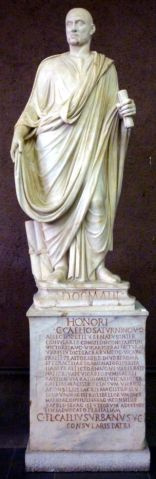
Base for statue of Caius Caelius Saturninus signo Dogmatius, senator and deputy prefect of the City (statue LSA-903); erected by his son. Rome. 324-37
Record details
Photographs
Inscription
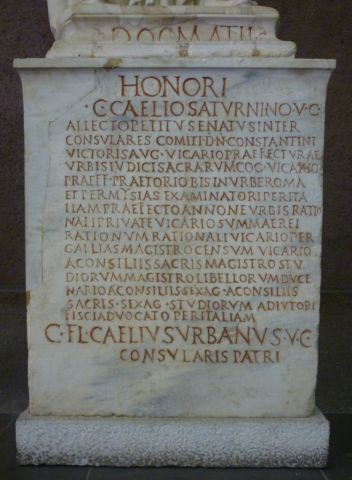
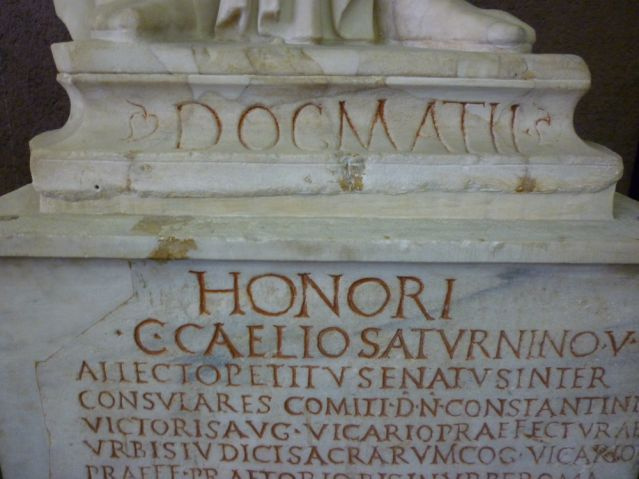
Dogmatii / honori. / C(aio) Caelio Saturnino, v(iro) c(larissimo), / allectu petitu senatus inter / consulares, comiti d(omini) n(ostri) Constantini / victoris Aug(usti), vicario praefecturae / Urbis, iudici sacrarum cog(nitionum), vicario / praef(ectorum) praetorio bis: in urbe Roma / et per Mysias, examinatori per Ita/iiam (sic), praefecto annon(a)e Urbis, ratio/nali privat(a)e, vicario summae rei / rationum, rationali vicario per / Gallias, magistro censu(u)m, vicario / a consiliis sacris, magistro stu/diorum, magistro libellorum, duce/nario a consiliis <sacris>, sexag(enario) a consiliis / sacris, sexag(enario) studiorum adiutori, / fisci advocato per Italiam. / C(aius) Fl(avius) Caelius Urbanus, v(ir) c(larissimus), / consularis patri.
Inscription translation
In honour of Dogmatius. To Caius Caelius Saturninus, of clarissimus rank, enrolled by request of the senate in the rank of consularis, count of our lord the victorious Augustus Constantine, deputy (vicarius) of the urban prefecture, judge in the sacred court of appeal, twice deputy (vicarius) of the praetorian prefects: in the city of Rome and for the (provinces of) Moesia, financial inspector for Italy, prefect of the annona of the city, chief officer of the imperial patrimony, deputy of the chief officer of the imperial fisc, deputy chief officer of the imperial patrimony in Gaul, head of the census, deputy at the imperial council, head of the imperial records (magister studiorum), head of the office of petitions (magister libellorum), functionary of the imperial council receiving an annual salary of 200,000 sestertii, functionary of the imperial council receiving an annual salary of 60,000 sestertii, assistant functionary at the records office (studiorum adiutori) receiving an annual salary of 60,0000 sestertii, advocate of the fiscus in Italy. [Set up by] Caius Flavius Caelius Urbanus, of clarissimus rank with rank of consularis, to his father.
Bibliography
- Corpus Inscriptionum Latinarum; , VI, 1704 (+p. 4739)
- Di Stefano Manzella, I. and S. Orlandi, "Dedica onoraria e carriera di Caius Caelius Saturninus", in I. Di Stefano Manzella (ed), Le iscrizioni dei cristiani in Vaticano. Materiali e contributi scientifici per una mostra epigrafica (Inscriptiones Sanctae Sedis 2), Vatican City 1997, 267-9
Discussion
INSCRIPTION
In 19 lines. Letter height: 6-2 cm.
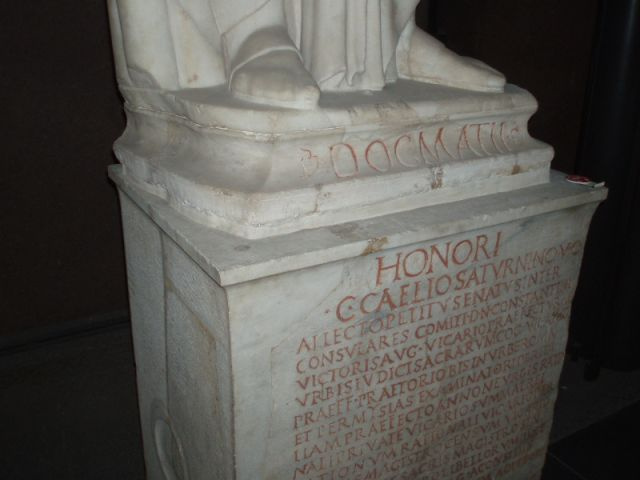
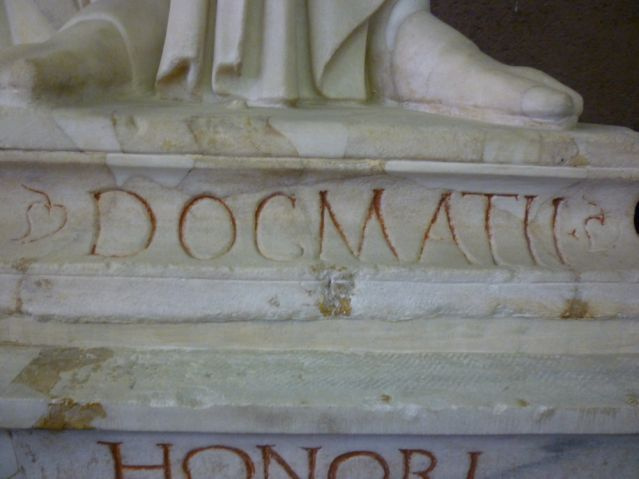
(On the plinth of the statue, flanked by ivy leaves) Dogmatii
(On the base) honori. / C(aio) Caelio Saturnino, v(iro) c(larissimo), / allectu petitu senatus inter / (5) consulares, comiti d(omini) n(ostri) Constantini / victoris Aug(usti), vicario praefecturae / Urbis, iudici sacrarum cog(nitionum), vicario / praef(ectorum) praetorio bis: in urbe Roma / et per Mysias, examinatori per Ita/iiam (sic), praefecto annon(a)e Urbis, ratio/nali privat(a)e, vicario summae rei / (11) rationum, rationali vicario per / Gallias, magistro censu(u)m, vicario / a consiliis sacris, magistro stu/diorum, magistro libellorum, duce/nario a consiliis <sacris>, sexag(enario) a consiliis / (16) sacris, sexag(enario) studiorum adiutori, / fisci advocato per Italiam. / C(aius) Fl(avius) Caelius Urbanus, v(ir) c(larissimus), / consularis patri.
'In honour of Dogmatius. To Caius Caelius Saturninus, of clarissimus rank, enrolled by request of the Senate into the rank of consularis, count of our lord the victorious Augustus Constantine, deputy (vicarius) of the prefecture of the city, judge in the imperial court of appeal (iudici sacrarum cognitionum), twice deputy (vicarius) of the praetorian prefects: in the City of Rome and for the (provinces of) Moesia, financial inspector for Italy, prefect of the annona of the City, chief officer of the imperial patrimony (rationali privatae), deputy of the chief officer of the imperial fisc (vicario summae rei rationum), deputy chief officer of the imperial patrimony in Gaul, head of the census, deputy at the imperial council, head of the imperial records (magister studiorum), head of the office of petitions (magister libellorum), functionary of the imperial council receiving an annual salary of 200,000 sestertii, functionary of the imperial council receiving an annual salary of 60,000 sestertii, assistant functionary at the records office (studiorum adiutori) receiving an annual salary of 60,0000 sestertii, advocate of the fiscus in Italy. Caius Flavius Caelius Urbanus, of clarissimus rank with the rank of consularis, [set this up] to his father.'
The inscription is a dedication to Saturninus by his son. It is an important document for the understanding of the working of the imperial administration under the tetrarchs and Constantine, especially of the financial services. It presents the cursus of Saturninus in inverted order, starting with his highest post at the time (he was later appointed praetorian prefect, see LSA-1412). The signum of the honorand, 'Dogmatii', is inscribed on the plinth of the statue. However, contrary to usual practice, it is apparently connected to the second line of the inscription (Dogmatii / honori): usually signa appear isolated, visually and synctatically independent from the rest of an inscription. There are a few omissions of letters in lines 8, 9-10, 11, and 13, which we have supplied here. These omissions seem to be the result of abbreviation, rather than proper misspellings. In line 15, the word 'sacris' appears to have been omitted in error. The text is not centred on the epigraphic field, being set slightly to the right.
DESCRIPTION
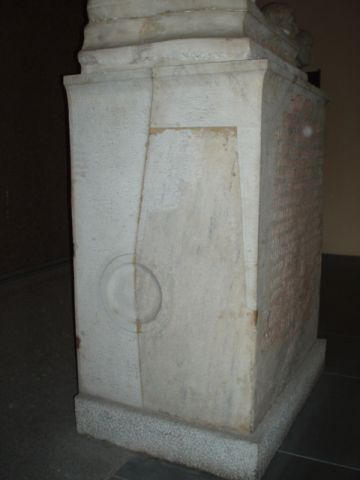
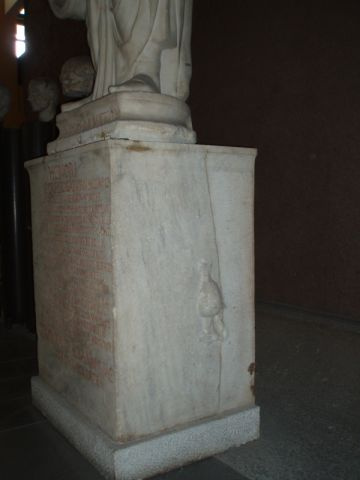
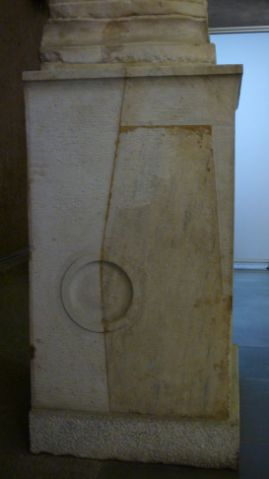
White marble base, with plinth and statue on top (these are discussed as LSA-903). Much of the left-hand edge of the front face, the top left corner, and much of the back of the base, are the result of modern restoration (Di Stefano Manzella and Orlandi 1997, 267-9). Measurements: 94 x 79 x 56 cm (this latter measurement is of the restored depth). It has an urceus on its right side, and a patera on its left, both turned upside down.
The base was clearly a re-used piece, but there is no trace of an earlier inscription or of its erasure. Either the first-use inscription was removed with unusual thoroughness, or the base was an altar prepared for use, but never actually used or inscribed.
PROVENANCE AND CURRENT LOCATION
Base and statue were discovered together in 1856 in the foundations of Palazzo Filipponi on via della Pilotta (northern side of piazza della Pilotta), near the slope of the Quirinal hill. The connection of the base with its statue is confirmed by the first two words of the inscription 'Dogmatii honori, in honour of Dogmatius', with the first word carved on the statue's plinth, the second on the base.
The statue was dedicated by Saturninus' son Urbanus, and another statue-base, dedicated by the same Urbanus to his father, was found in the same area (LSA-1412). The private character of these two dedications is a strong indication that this was the location of the domus, the aristocratic house, of Saturninus (Guidobaldi 1995, 174). Guidobaldi points out, however, that there are no known traces of a domus under Palazzo Filipponi. An original location within the Porticus Constantini should not be ruled out either, although the character of the dedications make this less likely (see comments by Orlandi in Di Stefano Manzella and Orlandi 1997, 267-269).
Base and statue are displayed together within the Vatican Museums, in the Museo Gregoriano Profano (inv. no. 10.493; 10494).
HONORAND, AWARDER, AND DATE
Caius Caelius Saturninus had a successful career under the second tetrarchy and under the subsequent Constantinian regime (PLRE I, 806 Saturninus 9; the different aspects of his career are fully discussed by Delmaire 1989, 19-21, and by Orlandi in Di Stefano Manzella and Orlandi 1997, 267-269). He was of equestrian rank by birth, and started work as advocate for the imperial fisc in Italy (probably meaning northern Italy). He then entered the imperial administration, taking up posts in the bureaucracy and judicial administration. He was probably connected to the court of a Caesar, possibly Constantius I. He was then made deputy at the imperial council, and entered the financial administration, with posts within the offices of the imperial fisc and patrimony (res privata). He was prefect of the annona in Rome, and vicarius in Moesiae (before 321, when this was incorporated into the vicariate of Thrace) and of Rome (probably in 325). It is probably after this date that he became a senator (clarissimus) and received the rank of consularis, at the request of the Senate itself, and was made deputy of the urban prefect, with the power of appeal. Saturninus was later appointed to the praetorian prefecture (LSA-1412).
The statue was set up by Caius Flavius Caelius Urbanus, son of Saturninus, who inherited from him the rank of clarissimus (PLRE I, 983 Urbanus 4).
The terminus post quem for our inscription is 324, when Constantine adopted the title of victor, as he appears in our inscription (Kienast 1996, 298-303). The terminus ante quem is 337, Constantine's death.
FURTHER DISCUSSION
This is a very important monument, not only because it is one of the very rare examples of a base found with a statue in Rome - that survived. The cursus of Saturninus is a good illustration of the possibilities for social mobility that were open for ambitious men at the time of the tetrarchy and under the Constantinian regime.
Our base and the statue LSA-903 are always considered to be part of the same monument, and on balance this is likely: they were found close to each other, and the style of the head fits well with a dating in the second quarter of the fourth century. However, some doubts must remain: the account of their discovery is very generic (CIL), and does not prove conclusively that statue and base were intimately connected (for instance with the statue found face-down directly in front of the base); and the base was clearly badly damaged when discovered (see above, 'Description'), and so may not have been standing undisturbed in its original location. Furthermore the presumed link between plinth and base, in the two words 'Dogmatii honori' is anomalous (see above, 'Inscription'). It is just possible that 'HONORI' should not be associated with 'Dogmatii', and be translated as 'To the honour of Dogmatius', but was itself a signum 'of Honorius', associated with a different (and now lost) statue.
Discussion references
- Delmaire, R., Les responsables des finances impériales au Bas-Empire romain (IVe-VIe s.). Études prosopographiques, Bruxelles 1989, 19-21
- Guidobaldi, F., "Domus: Caelius Saturninus s. Dogmatius (Honorius), in E. M. Steinby (ed.), Lexicon Topographicum Urbis Romae, vol. 2, Rome 1995, 174
- Jones, A. H. M. et al., The Prosopography of the Later Roman Empire. Vol. I 260-395, Cambridge et al. 1971 (1975), 806 Saturninus 9
- Kienast, D., Römische Kaisertabelle : Grundzüge einer römischen Kaiserchronologie, Darmstadt, 1996, 298-303
Cite: Last Statues of Antiquity, LSA-1266 (Carlos Machado).