
LSA-1269
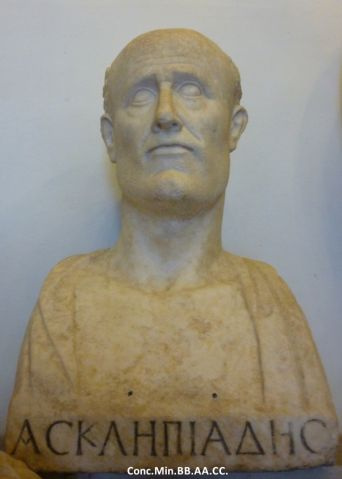
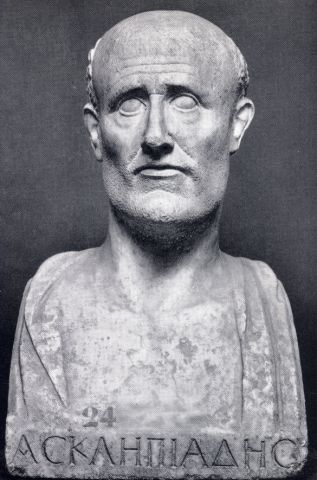
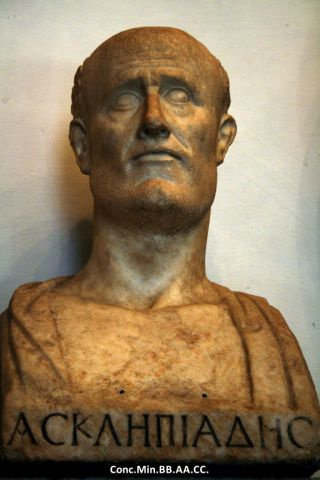
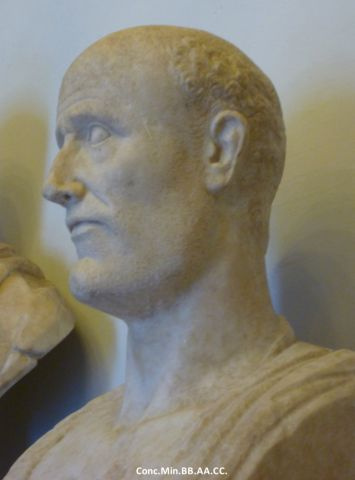
Herm bust of Asclepiades. Rome (Via Appia). Late third to early fourth century.
Record details
Photographs
Bibliography
- Fittschen, K., P. Zanker, and P. Cain, Katalog der Porträts in den Capitolischen Museen und den anderen kommunalen Sammlungen der Stadt Rom. Band II. Die männliche Privatporträts, Berlin 2010, 177-8, no. 176, pls. 219-220 (late Tetrarchic)
- Stuart Jones, H. (ed.), A catalogue of the ancient sculptures preserved in the municipal collections of Rome. [Vol.1]. The sculptures of the Museo capitolino , Oxford 1912, 229, no. 24, pl. 57
Discussion
DESCRIPTION (Object)
Over life-size herm bust. H: 58 cm. H (chin to crown): 28 cm.
The herm bust is completely preserved with a single line of inscription, ΑϹΚΛΕΠΙΑΔΗϹ.
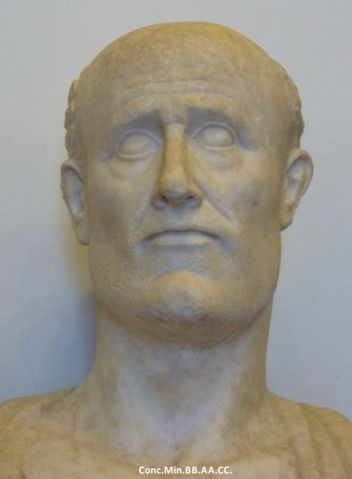
The fine end of a flat chisel has been used to define the facial hair; the hair on the head is also rendered with a flat chisel. The eyeballs are unmarked.
The head has been re-worked; according to P. Zanker and P. Cain, it was re-used twice. Traces of its first use include long locks of hair at the back of the head, the drapery, and the inscription. The extant hair around the ears is considered evidence of a second late first or early second century date. The re-shaping of the face and stubble beard, they consider, proof of a third use.
PROVENANCE
Rome. Found on the Via Appia, within the Aurelian walls, in a tomb in the early 1800s. It was formerly part of the M.A. Sabbadini collection.
DESCRIPTION (Subject)
The herm bust depicts a balding man with a stubble beard and moustache. He turns slightly to his right and wears a himation draped over both shoulders. His chest is bare, and his clavicle protrudes.
The brow and top of the head are bald. Over the ears the hair is short and curly, and it extends low onto the nape.
The tall brow is marked by three horizontal creases, a vertical line over the bridge of the nose, and drooping eyebrows. The eyes are large and close-set with loose skin below. The nose has deep horizontal crease at the root and is slightly hooked and fine. It is flanked by deep nabo-lasial folds. The mouth turns downward, and the upper lip is thin (probably once covered by a moustache). The jaw-line is strong and square, and the cheeks are hollow above it. The chin is prominent, and its upper edge is defined by a line under the lower lip. It is deep and projecting.
Across the bottom of the herm is written the name Asclepiades.
DATE
The extant portrait shows a man with a stubble beard and short hair. This fashion style places it from c. 250 onwards. The rendering of the beard and the stiff re-cutting suggest a date in the Tetrarchic period. Zanker and Cain even suggest that the hooked nose is an aspect which relates to the portraiture of Constantius Chlorurs who had a pronounced version of this nose; see, LSA-806 and LSA-855.
HONORAND
The man depicted wears only a himation which, as the name inscribed on the herm, suggests a Greek origin. Both details, however, Zanker and Cain would understand as remnants of the original ‘philosopher’ portrait and unrelated to the man of the last use. The name could have been plastered over, and the costume in a private setting need not have had significant connotations.
It should be noted however that Asclepiades was a common name, and the bust might even have been chosen for re-use on account of its name.
Discussion references
- Richter, G.M.A., The Portraits of the Greeks, London 1965, 288-9 (third century, unknown honorand)
Cite: Last Statues of Antiquity, LSA-1269 (J. Lenaghan).