
LSA-127
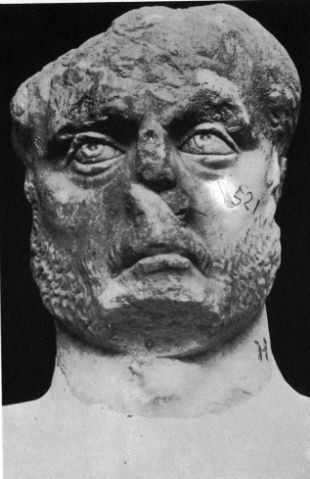
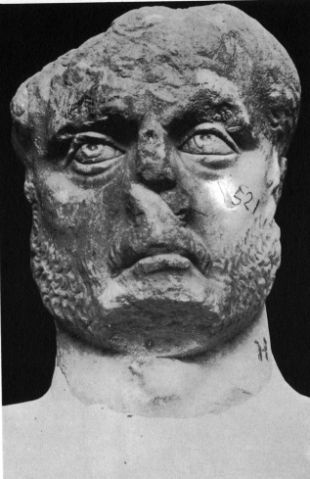
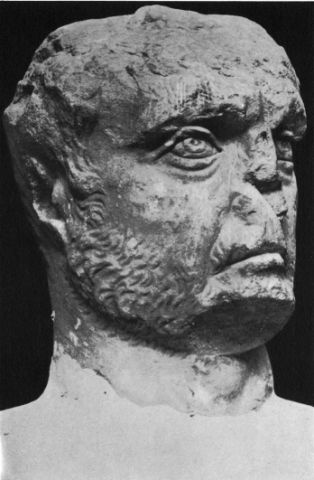
Portrait head of bearded man. Athens. Late third century.
Record details
Photographs
Bibliography
- L'Orange, H. P., Studien zur Geschichte des spätantiken Porträts, Oslo 1933, pp. 38-39, 103, 123 no. 53 figs. 98, 99
Discussion
DESCRIPTION (Object)
Portrait head of a bearded male, small grained marble (pentelic or parian, L'Orange 1933, 123), broken below the adam's apple. The only measurement given by L'Orange 1933 is the distance mouth-breakline on forehead (10 cm). The calvary from right temple to vertex, chin, nose and left ear are broken off; the forehead, both eyebrows, and the right earlap are chipped.
The hair, extant over the left temple, is a compact mass articulated by short crescent shaped chisel strokes; the beard is rendered in the same technique.
The eyes are protruding, the heavy lids separated from the eyeballs by thin drill lines. They are sketched asymmetrically, only the right overlid overlaps at the outer angle. The iris is circumscribed by an incised line, the pupil drilled into bean-shape.
Heavy lacrimal sacs are hanging under the eyes; the mouth is bent downwards. Asymmetries dominate the facial features; the right cheekbone is broader and markedly protruding, and the asymmetrically raised eyebrows are visible despite the damages on the forehead.
PROVENANCE/ LOCATION
There is no published record of the provenance of the head. It is today in the store-rooms of the National Archaeological Museum in Athens, inv. no. 521.
DESCRIPTION (Subject)
The portrayed is an elderly man with a broad face, full beard and bolding head. The portrait type with short hair and trimmed beard styles the honorand as a citizen or an office holder.
DATE
The stylistic and physiognomic features of the head lead L'Orange 1933 to a date in the early tetrarchic period. I fully accept this assessment.
Cite: Last Statues of Antiquity, LSA-127 (Ulrich Gehn).