
LSA-1271
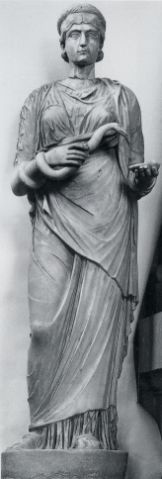
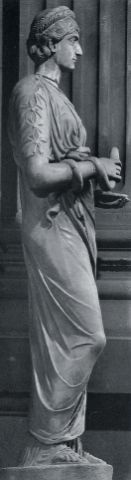
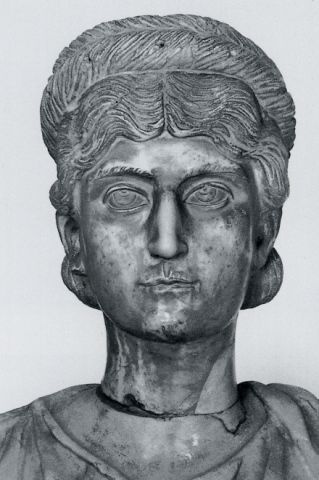
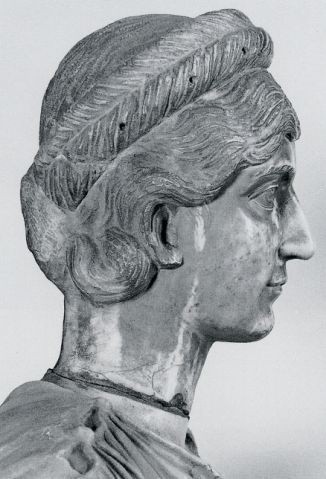
Portrait head of woman on statue of Hygeia. From Italy. Early fourth century.
Record details
Photographs
Bibliography
- Borg, B., H. von Hesberg, and A. Linfert, Die antiken Skulpturen in Castle Howard (Monumenta artis Romanae. Antike Skulpturen in englischen Schlössern. Monumenta artis Romanae ; 31, Wiesbaden 2005, 43-4, no. 8, pls. 9.1-2 and 10.1-2
Discussion
DESCRIPTION (Object)
Life-size head set on statue in antiquity (?). H: 160 cm. Luni marble (head) and medium-grained white marble (statue).
Head
The head is broken unevenly through the neck. A section of the lower left side is missing, and the nose is restored. The back of the head is not as carefully finished as the front. The hair over the nape of the neck has been left as a boss.
There appear to be holes in the lower twisted band for the insertion of some headgear. The eyebrows are depicted as thick with multiple engraved lines, and the irises are large engraved semi-circles. The pupils seem to be defined by a thick, semi-circular groove of a bull-nosed chisel.
Body
The statue is preserved from the tall plinth to the base of the neck. The hands, which feature square fingers as opposed to the graceful toes, are restorations. They belong probably to the same moment as the coils of the snake and bowl. The snake’s head is also restoration, but may belong to a different moment.
There are two drill holes in the body, below the right wrist and at the same height left of the centre of the body. These may be part of the original fixing for the hands and attributes. The area of the chiton seems to A. Linfert to have been worked over.
PROVENANCE
Purchased with assistance of Francesco de’ Ficoroni in 1740 from the collection of Duke of Paganica (branch of the Mattei family; the last Duke of Paganica was Giuseppe Mattei Orsini, 1673-1740). It was purchased together with a head of Augustus set on a Hermes statue, a seated female statue, and headless nude statue of an emperor.
DESCRIPTION (Subject)
The statue depicts a female dressed in a short-sleeved chiton, a himation, and sandals. She holds a a libation bowl in her left hand, and a snake winds around her bare right forearm, clearly connecting her with the goddess Hygeia. The head of the statue, however, is a portrait which wears a hairstyle that was fashionable from the end of the third century into the fourth century.
The chiton features a series of buttons down the exposed right upper arm and some unusual fold patterns over the middle of the chest and left breast; these may have been worked over by a restorer. The himation is draped over the left side of the body, and its unfurling upper border makes a triangular apron over the thighs. The body type is a variation on a well-known and frequently adapted model. The model may date to the fourth century BC; the copies and adaptations are all imperial in date.
The head looks directly forward, and the face is immobile. It has large eyes, arching eyebrows, a bow-shaped mouth with a defined philtrum. The flesh of the cheeks and brow has little modelling.
The hair is parted at the centre and pulled back in gentle waves. It falls down behind the ears before looping up and somehow being incorporated into two rolls of twisted hair that encircle the head like a crown. In the lower band of hair is a series of holes for the attachment of some decorative element.
DATE
The head belongs securely to the period of or after the Tetrarchy. This type of hairstyle can be seen on a head once in the Doria Pamphili collection (LSA-1298) ) where, however, the encircling braids are much more clearly defined. A head in the Vatican (LSA-1194) ) also shows this hairstyle with a rendering of the eyes that is unlikely to be pre-Tetrarchic. A head in Berlin (LSA-967) ) comes closest to the Castle Howard head in its rendering of the two bands or braids of hair. In both heads, the lower band of hair is scored with a series of diagonal lines that run perpendicular to the lines on the upper band of hair. The Berlin head, however, wears the hair around the face in a more styled and crimped fashion which is thought to be Constantinian. A. Linfert compares the handling of eyes and hair of the Castle Howard piece to the Fossombrone head (LSA-395) ) which is certainly fourth century. The Castle Howard head is probably best placed in the early fourth century.
The date of the restorations to the statue is a more difficult question. The hands do not match the feet but would seem to be in keeping with the head. Moreover there is no even cutting at the neck nor any marble filler which were typical techniques for restorers and art dealers interested in creating pastiches. It is therefore possible that the head and statue were first joined in the fourth century rather than in the 18th to 20th century.
Cite: Last Statues of Antiquity, LSA-1271 (J. Lenaghan).