
LSA-1273
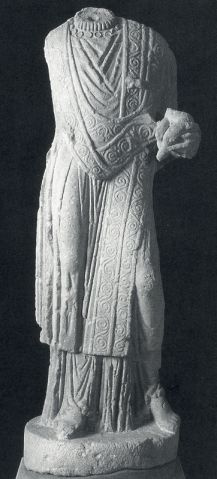
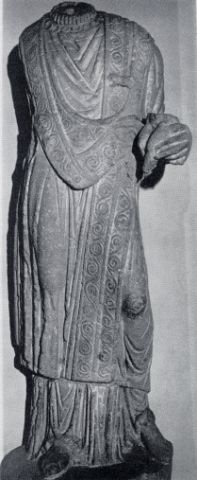
Headless portrait statue of woman. Carnuntum (Pannonia Prima). Late second to earlier fourth century.
Record details
Photographs
Bibliography
- Jobst, W. (ed.), Carnuntum : das Erbe Roms an der Donau : Katalog der Ausstellung des Archäologischen Museums Carnuntinum in Bad Deutsch Altenburg AMC, Vienna 1992, 61, no. 41 (Severan, possibly Julia Mammea)
- Krüger, M-L., Die Rundskulpturen des Stadtgebietes von Carnuntum. Corpus signorum imperii Romani. Österreich ; v.1, fasc.2 , Vienna 1967, 30, no. 82, pl. 29 (third to fourth century)
Discussion
DESCRIPTION (Object)
The statue is made together with the plinth of a fine local freestone, H 161 cm, H of the child 17 cm, H of plinth 14 cm. The head and the right arm are missing, the child’s upper body and feet are broken. The right arm of the child is reaching out at the breast of the statue.
The drapery contours the underlying body.
PROVENANCE AND CURRENT LOCATION
The statue was found in 1883 in the sanctuary of the legionary camp of Carnuntum where it had been set up together with its counterpart LSA-1301. It is today in Deutsch-Altenburg, Museum Carnuntinum, inv. no. 3780.
DESCRIPTION (Subject)
The portrayed is standing over her right leg, the left knee is bent and the left heel raised. Her left arm is bent in the elbow and holding a nude baby.
The attire consists in an ankle-length tunic with rich folds, an upper tunic (colobium) which ends at the shins and is of a heavier material, and a double sash. The latter starts at the lower seam of the upper tunic, is lead to the left shoulder, in the back to the right shoulder, from here across the front side of the body to be hung over the left forearm. The borders a decorated with seams on all sides, and a spiral band in relief. The feet are clad in fine shoes; around the neck there are two chains of pearls and rings.
HONORAND AND DATE
Garment, jewellery and the child identify the portrayed as a female; the association with the cuirassed statue usually ascribed to an emperor (LSA-1301) identifies her as an imperial lady. As in the case of the male statue, the missing head complicates closer identification. The male cuirassed statue possibly is an image of a divinity (Jupiter Dolichenus) which in consequence would identify our female statue as a Syrian goddess.
Schober 1935 proposed to recognize Julia Mamaea who be portrayed along with her son Alexander Severus; this would fit the titles of mater Augusti, mater patriae, mater Castrorum, even mater universi generis humani bestowed on that empress. Jobst 1992 dated to the Severan period (193-235) arguing that this period was the heyday of the cult of Syrian deities in Carnuntum. Schade 2003 readopted an earlier proposal to identify Aurelian’s mother in the portrayed, relating this to the religious program of that emperor. Krüger 1967 considered a date in the later 3rd/early 4th century.
A date in the later 3rd or early 4th century is possibly supported by the decorated border the empress is wearing. Alföldy 1970 observed the same type of garment on coins of Magnia Urbica (wife of Carus, 282-3, Augusta and mater castrorum senatus ac patriae), Galeria Valeria (wife of Galerius, 293-311, Augusta and mater castrorum), Helena (mother of Constantine I, 306-37) and Fausta (wife of Constantine I 307-26).
FURTHER DISCUSSION
A similar sash and necklace are displayed by the headless female bust LSA-1706.
The draping of the sash on our statue resembles that of the late antique toga.
Discussion references
- Alföldi, A. , Die monarchische Repräsentation im römischen Kaiserreiche, Darmstadt 1970, 145
- Schade, K., Frauen in der Spätantike--Status und Repräsentation, Mainz 2003, 29-32, pl. 6.2
Cite: Last Statues of Antiquity, LSA-1273 (Ulrich Gehn).