
LSA-1278
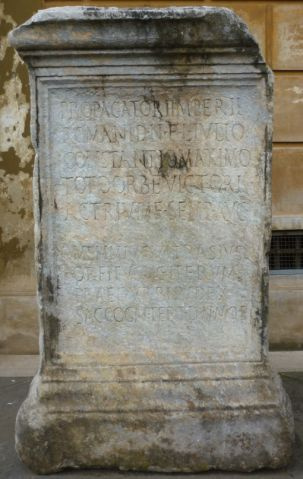
Base for statue of Constantius II, emperor. Rome, from Forum. 357.
Record details
Photographs
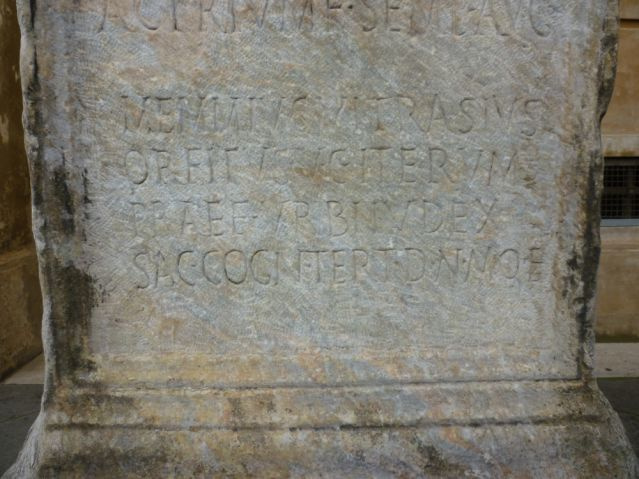
Inscription
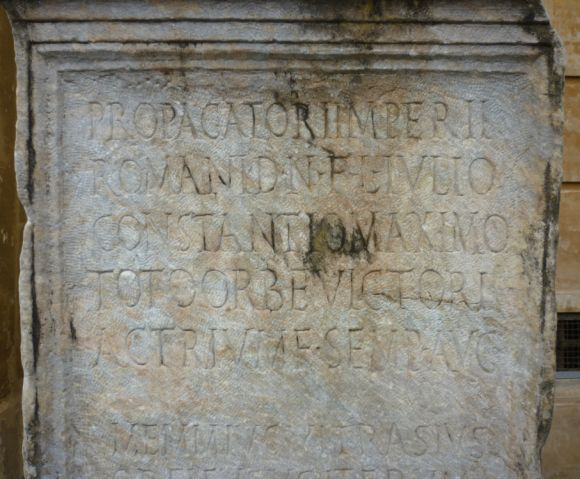
Propagatori imperii / Romani, d(omino) n(ostro) Fl(avio) Iulio / Constantio, maximo, / toto orbe victori / ac triumf(atori), semp(er) Aug(usto). / Memmius Vitrasius / Orfitus, v(ir) c(larissimus), iterum / praef(ectus) urbi, iudex / sac(rarum) cogn(itionum) tert(iUM), d(evotus) n(umini) m(aiestati)q(ue) e(ius).
Inscription translation
To the expander of the Roman empire, our lord Flavius Iulius Constantius, the greatest, victorious and triumphant in the whole world, forever Augustus. Memmius Vitrasius Orfitus, of clarissimus rank, prefect of the City for the second time, judge in the imperial court of appeal for the third time, devoted to his divine spirit and majesty [set this up].
Bibliography
- Corpus Inscriptionum Latinarum; , VI, 1161 (+p.4331)
Discussion
INSCRIPTION
In nine lines. Letter height: 5.5-4 cm.
Propagatori imperii / Romani, d(omino) n(ostro) Fl(avio) Iulio / Constantio, maximo, / toto orbe victori / ac triumf(atori), semp(er) Aug(usto). / Memmius Vitrasius / Orfitus, v(ir) c(larissimus), iterum / praef(ectus) urbi, iudex / sac(rarum) cogn(itionum) tert(iUM), d(evotus) n(umini) m(aiestati)q(ue) e(ius).
'To the expander of the Roman empire, our lord Flavius Iulius Constantius, the greatest, victorious and triumphant in the whole world, forever Augustus. Memmius Vitrasius Orfitus, of clarissimus rank, prefect of the City for the second time, judge in the imperial court of appeal for the third time, devoted to his divine spirit and majesty [set this up].'
The inscription celebrates the emperor Constantius II as victorious and triumphant over the whole world, in a reference to his victory over Magnentius. The title toto orbe victor ac triumfator is very close to totius orbis dominus, which according to Ammianus Marcellinus (15.1.3) Constantius liked to use for himself (Humphries 2003, 39-40).
The wording of our inscription is identical to two other bases found in this same part of the Forum, LSA-1279 and LSA-1360.
DESCRIPTION
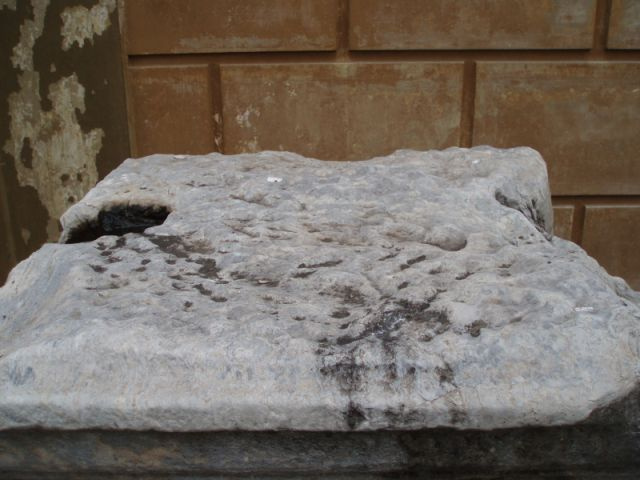
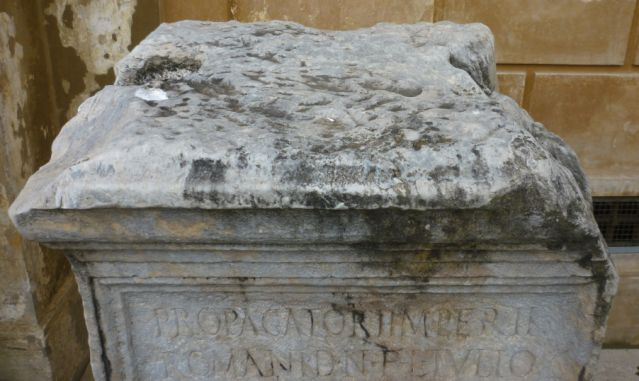
Large marble base, with prominent mouldings on three sides at both top and bottom: H 138.5, W 84, D 80 cm. The top right corner is broken and lost. The epigraphic field, which is 81 cm high and 63.5 cm wide, is contained within a frame and both deeply cut and rough, almost certainly because of the erasure of an earlier inscription. The top of the base is roughly finished, and it has two dowel holes towards each side.
PROVENANCE AND CURRENT LOCATION
The base was discovered in 1803 in the Roman Forum, by the arch of Septimius Severus. It was found close to LSA-1279. LSA-1360 was found in the same area, but at a later date. Our base is now in the Vatican Museums, in the Cortile della Pigna (inv. 5163).
HONORAND, AWARDER AND DATE
The statue honoured the emperor Constantius II (Augustus 337-61).
It was set up by Memmius Vitrasius Orfitus, while urban prefect for the second time (357-9). Chastagnol (1962, 144) suggests that he took office at the beginning of March 357, whereas PLRE (I, 652 Orfitus 3) suggests January of that same year. In any case, he was certainly already in charge when, during a very rare imperial visit, the emperor Constantius entered the city on 28 April 357 (Ammianus Marcellinus 16.10.4; Kienast 1996, 315).
The statue was almost certainly dedicated shortly before 28 April 357, when the emperor entered Rome, so that he could see the base in the forum.
FURTHER DISCUSSION
Constantius II was honoured with four statues in the Forum close to the Curia and arch of Septimius Severus. In 352-3, the then prefect of the City, Neratius Cerealis, had already dedicated here an equestrian monument in his honour (LSA-838), while our Orfitus set up, in the same area, three statues to the emperor with identical wording (our base, LSA-1279, and LSA-1360).
It is possible, as argued elsewhere (LSA-1099) that it was also here that Orfitus dedicated a statue to the then Caesar Julian, again during his second urban prefecture. Together with the equestrian monument dedicated to Constantine (LSA-1263), this part of the Forum was closely linked to the Constantinian dynasty by the middle of the 4th century. In the case of Constantius II, the prefects involved in these dedications were committed supporters of this emperor during the usurpation of Magnentius (Humphries 2003, 39).
Discussion references
- Chastagnol, A., Les fastes de la Préfecture de Rome au Bas-Empire, Paris 1962, 139-47
- Gordon, A. E., Album of Dated Latin Inscriptions, vol. 3, Berkeley 1965, 126-7
- Humphries, M., "Roman senators and absent emperors in Late Antiquity", Acta ad Acheologiam et Artium Historiam Pertinentia, (n.s. 3) 17, 2003, 39-40
- Jones, A. H. M. et al., The Prosopography of the Later Roman Empire. Vol. I 260-395, Cambridge et al. 1971 (1975), 651-3 (Orfitus 3)
- Kienast, D., Römische Kaisertabelle : Grundzüge einer römischen Kaiserchronologie, Darmstadt, 1996, 314-17
Cite: Last Statues of Antiquity, LSA-1278 (Carlos Machado).