
LSA-128
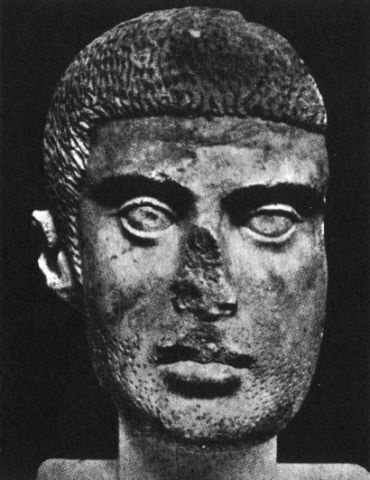
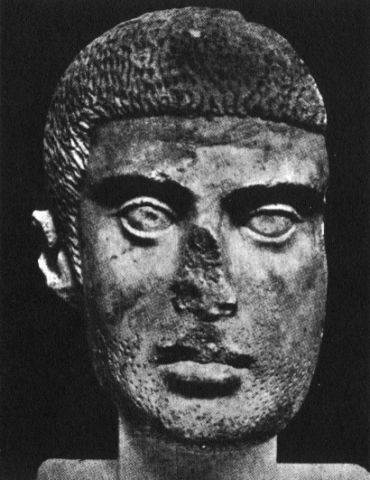
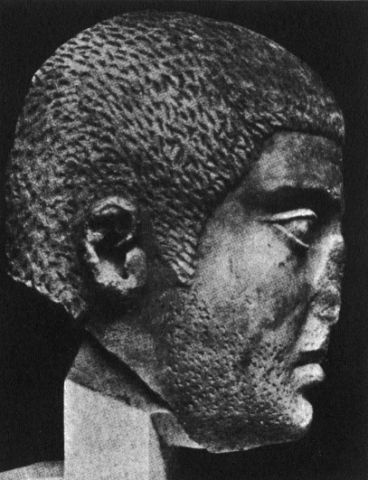
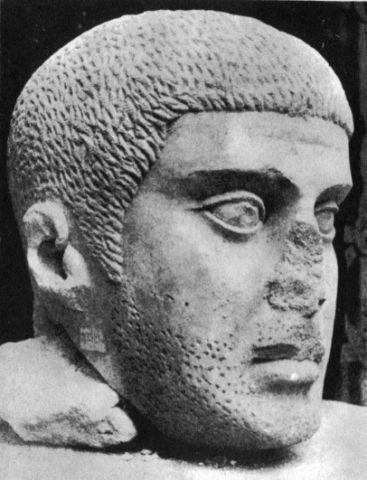
Portrait head of short-haired, stubble-bearded man, probably re-worked from earlier portrait. Athens. Early fourth century.
Record details
Photographs
Bibliography
- Datsoule-Satvride, A., Romaika Portraita sto Ethniko Archaiologiko Mouseio tes Athenas, Athens 1985, 85 no. 536 pl. 120-1
- L'Orange, H. P., Studien zur Geschichte des spätantiken Porträts, Oslo 1933, pp. 27-8, 113 no. 20 figs. 55-57
Discussion
DESCRIPTION (Object)
Portrait head of a male with stubble beard and short-cropped hair, neck broken off; marble (small-grained, probably pentelic, according to L'Orange 1933, 113). The only measurement published by L'Orange 1933 is the distance mouth-hairline (12.5 cm); this yields an approximately life-sized overall measurement (see below, 'Provenance/ Location'; see also LSA-129) . Nose, left ear with adjoining part of the head, and back are broken off (from L'Orange 1933, 113, not visible in the published photos); upper lip and right ear are chipped.
The short-cropped hair is a compact mass articulated by short chisel strokes. The hairline, reaching deep into the forehead, runs horizontally and forms sharp angles over the temples. The compact hair is tapering out into short fringes over the forehead with a symmetrically arranged 'fork' accentuating the centre. Different from the hair, the stubble beard is without plastic volume; it is marked by chisel strokes directly hewn into the flesh. This technique is an indicator that the head in its present state is the result of a late-antique re-working.
The eyes are protruding, marked by a shallow concavity. The low-arching eyebrows are a sharp rim without indication of hair. The marked eyebrows meet at the inner angle while at the outer side the upper lid overlaps.
The face is parsimoniously modelled without hard caesuras. Chin and cheekbones are pronounced, the (proper) right cheek is slightly risen giving the adumbration of a smile. The horizontal line furrowing the forehead is the only wrinkle in this face of striking smoothness and symmetry.
PROVENANCE AND CURRENT LOCATION
According to Kavvadias 1892, the head was found in Athens; no further detail is recorded. Calza's suggestion that the head was set up in a domestic lararium was based on its allegedly under-life-sized dimensions; it is without support by any evidence (Calza 1972, 147). The head is today in the storerooms of the National Museum in Athens, inv. no. 658.
DESCRIPTION (Subject)
The age of the portrayed is hard to determine. While the stubble beard indicates maturity, the wrinkleless smoothness of the face speaks against advanced age. The compact hair and the stubble beard assign our head to the 'military type' used in the imperial representation of the tetrarchs; the portrait type is not restricted, however, to emperors, but used for numerous representations of soldiers in the state relief of that period. In Athens, it contrasts markedly not only with the long-haired and long-bearded 'Holy man' (LSA-1083), but also with the 'citizen-type' usually represented with short (but not short-cropped) hair and trimmed (yet full) beard.
Epigraphic and literary evidence testifies to imperial honorific statuary in Athens in late antiquity (LSA-399, LSA-400, LSA-402); among the portrait sculpture from Athens, however, no imperial portrait has been convincingly identified so far. Calza 1972 counted our head as a representation of Galerius; she considered it a replica of another head of the same type in Athens (LSA-129).
While, in our view, on the one hand any attribution to a specific emperor is beyond our evidence, we would on the other hand not exclude that the head might represent an imperial office holder.
DATE
The head was dated to the tetrarchic period by L'Orange 1933, 27.
Hairstyle and beard identify the roughly tetrarchic date of the portrait; the symmetrical arrangement of the hair and the smooth, symmetrical, almost classicising overall appearance, however, dislodges this head from the anxiously agitated, asymetrically modelled portraits of the early tetrarchy represented in Athens by several items (LSA-123, LSA-124, LSA-125, LSA-127). These differences should be taken as an indicator of date rather than of typology. Laubscher ascertained a bias towards a 'new loftiness' ('neue Erhabenheit') in the imperial portraits of the later tetrarchic period, reached by means of symmetry, smoothness, 'classicising' forms (Laubscher 1999). Whether our head is an imperial portrait representing this late-tetrarchic style, or whether it is a subject following the contemporaneuos imperial portrait type, the head appears to belong into the context of asthetic sedation in the first decades of the fourth century.
If the portrayed was an emperor, the head belongs most probably to the years before 324 when Constantine I after his final victory against Licinius achieved sole rule, and shortly after introduced the diadem into imperial self-representation. Constantine, moreover, had for himself propagated a new imperial image, youthful, clean shaven, and with longer hair, already after his defeat of Maxentius in 312.
If, on the other hand, the portrayed was a non-imperial person, the date would have to be extended. The well dated portrait-head of Dogmatius (LSA-903) from 324/37 still displays the 'tetrarchic' military hair-style and stubble beard after the imperial image had been shifted to clean-shaven youthfulness. It must have been considered an appropriate representational pattern for men who took ascension in the militia until well into the 4th century.
Discussion references
- Calza, R., Iconografia Romana Imperiale. Da Carausio a Giuliano (287-363 d. C.), Rome 1972, p. 147 no. 58 pl. XXXIX 113-14
- Laubscher, H.-P., 'Beobachtungen zu tetrarchischen Kaiserbildern aus Porphyr', JdI, (1999) 207-252
- Καββαδίας, Π., Γλυπτά του Εθνικού Μουσείου, Περιγραφικός Κατάλογος, Athens 1890-1892, pp. 308-9 no. 658
Cite: Last Statues of Antiquity, LSA-128 (Ulrich Gehn).