
LSA-129
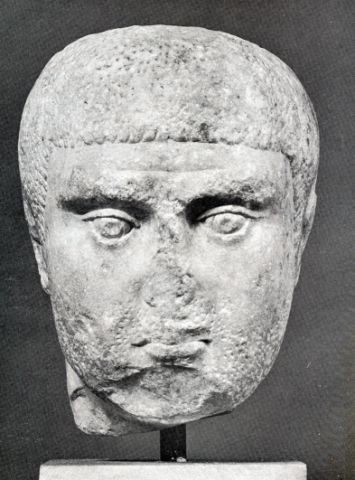
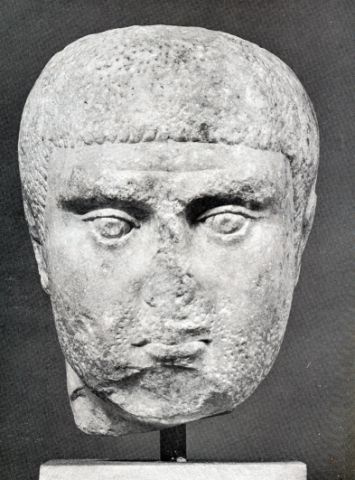
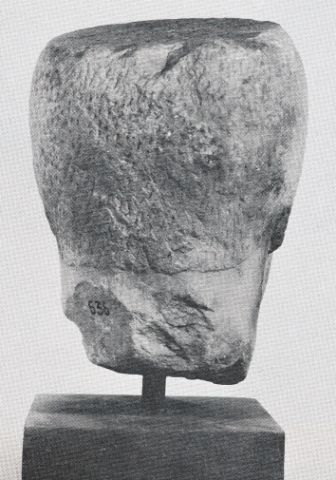
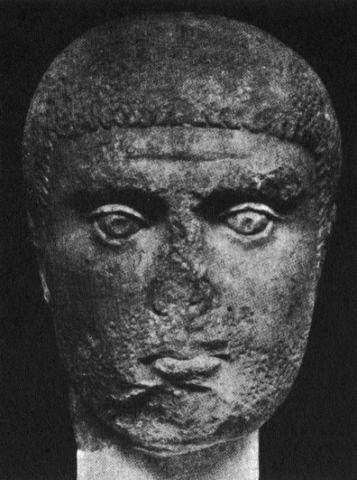
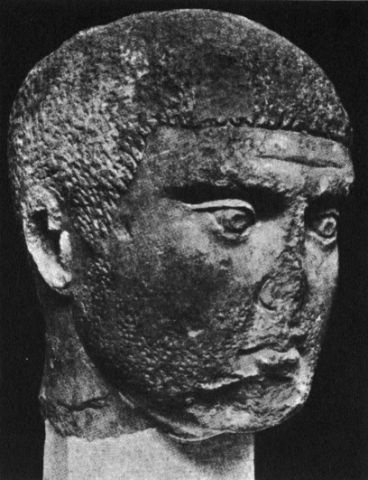
Portrait head of stubble-bearded man, probably re-worked from earlier portrait. Athens. Early to mid fourth century.
Record details
Photographs
Bibliography
- L'Orange, H. P., Studien zur Geschichte des spätantiken Porträts, Oslo 1933, pp. 27-8, 113 no. 19 figs. 53-4
Discussion
DESCRIPTION (Object)
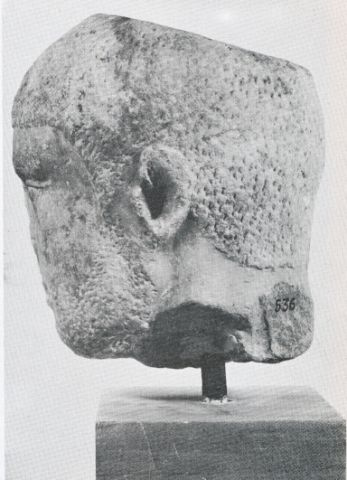
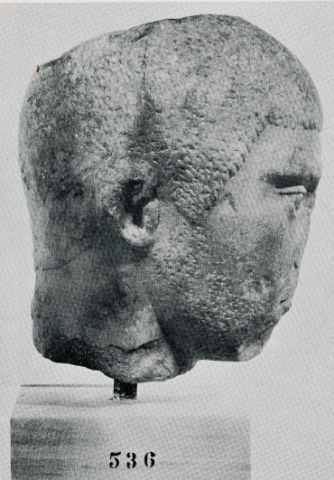
Life-sized portrait head of a man with stubble beard, the neck broken below te chin. Parian marble, H 25 cm, W 18.5 cm (Datsoule-Stavride 1985, 85. L'Orange 1933, 113 no. 19 measures 12 cm from mouth to hairline; this is about the same size as LSA-128). The uppermost part of the calvary is missing. It was worked separately and fixed with a dowel to the plain finished for that purpose. Nose and chin are broken off; eyebrows, upper lip, and earlaps are chipped; further chips scattered on the surface.
The short-cropped hair, spanning over the head like a tight-fitting cap, is articulated by short chisel strokes. The hairline, reaching deep into the forehead, runs horizontally and forms sharp angles over the temples. The compact hair is tapering out into short fringes over the forehead. A 'fork' accentuates the centre while the symmetrical arrangement of corresponding locks is maintained throughout the whole length of the forehead. Different from the hair, the stubble beard is without plastic volume; it is marked by chisel strokes directly hewn into the flesh. This technique is an indicator that the head in its present state is the result of a late-antique re-working.
The small eyes lie under flat-arching brows. The eyeballs are protruding, the iris is circumscribed by a coarsly incised line, the pupil marked by a shallow concavity. The upper lid is rigidly marked; it overlaps the lower lid on inner and outer sides.
A single, sharply incised horizontal line furrows the forehead; this is the only wrinkle in this otherwise stikingly smooth and symmetrical face.
PROVENANCE AND CURRENT LOCATION
The head was found in the Dionysus-theatre at the southern slope of the Acropolis (Kabbadias 1892). Calza's suggestion that the head was set up in a domestic lararium was based on its allegedly under-life-sized dimensions; it is without support by any evidence (Calza 1972, 147). It is today in the store-rooms of the National Archaeological Museum in Athens, inv. no. 536.
DESCRIPTION (Subject)
The age of the portrayed is hard to determine. While the stubble beard indicates maturity, the wrinkleless smoothness of the face speaks against advanced age. The compact hair and the stubble beard assign our head to the 'military type' used in the imperial representation of the tetrarchs. The portrait type is not restricted to emperors, but used for numerous representations of soldiers in the state relief of that period. However, in Athens it is almost unique except for one further head of the same type (LSA-128) and contrasts markedly with the longer hair and beard displayed by other Athenian heads of the period. It is well possible that this head (and its counterpiece LSA-128) represents an emperor of the earlier 4th century. Calza 1972 counted our head as a representation of Galerius; she considered it a replica of LSA-128.
Epigraphic and literary evidence testifies to imperial honorific statuary in Athens in the late 3rd/ earlier 4th century (LSA-97, LSA-98, LSA-399, LSA-400, LSA-402, LSA-430).
DATE
The head was dated to the tetrarchic period by L'Orange 1933, 27, followd by Datsoule-Stavride 1985.
Hairstyle and beard identify the roughly tetrarchic date of the portrait; the symmetrical arrangement of the hair and the smooth, symmetrical, almost classicising overall appearance, however, dislodges this head from the anxiously agitated, asymetrically modelled portraits of the early tetrarchy represented in Athens by several items (LSA-123, LSA-124, LSA-125, LSA-127). These differences should be taken as an indicator of date rather than of typology. Laubscher ascertained a bias towards a 'new loftiness' ('neue Erhabenheit'), reached by means of symmetry, smoothness, 'classicising' forms, in the imperial portraits of the later tetrarchies (Laubscher 1999). Whether our head is an imperial portrait representing this late-tetrarchic style, or whether it is a subject following the contemporaneuos imperial portrait type, the head appears to belong into the context of asthetic sedation in the first decades of the fourth century.
If the portrayed was an emperor, the head belongs most probably to the years before 324 when Constantine I after his final victory against Licinius achieved sole rule, and shortly after introduced the diadem into the imperial self-representation. Constantine, moreover, had for himself propagated a new imperial image, youthful, clean shaven, and with longer hair, already after his defeat of Maxentius in 312.
Discussion references
- Calza, R., Iconografia Romana Imperiale. Da Carausio a Giuliano (287-363 d. C.), Rome 1972, p. 147 no. 58 pl. XXXIX 111, 112
- Καββαδίας, Π., Γλυπτά του Εθνικού Μουσείου, Περιγραφικός Κατάλογος, Athens 1890-1892, p. 288 no. 536
- Ντατσούλη Σταυρίδι, Α., Ρωμαικά Πορτραίτα στο Εθνικό Αρχαιολογικό Μουσείο της Αθήνας, Athens 1985, p. 85 no. 536 pl. 120, 121 α-γ
Cite: Last Statues of Antiquity, LSA-129 (Ulrich Gehn).