
LSA-1296
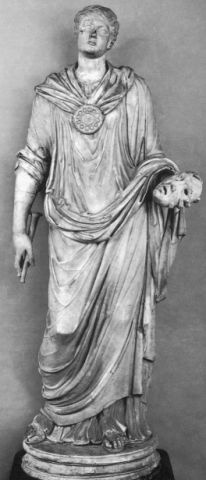
Statue of Coelia Concordia (on base LSA 1510). From Rome. 385
Record details
Photographs
Bibliography
- Amelung, W. 'Due sculture cnservate nel Palazzo Colonna', Dissertazioni della Pontificia Accademia Romana di Archeologia 8, Rome 1903, 67-76
- Carinci, F. et al., Catalogo della Galleria Colonna in Roma : sculture, Rome 1990, 157-63, no. 87
Discussion
DESCRIPTION (Object)
Headless statue with restored plinth and head. H: 1.72 cm.. Large-grained white marble (probably Asiatic).
The head, now on the statue, is ancient, but was added in the century and does not originally belong to the statue. The portrait head was probably worked separately. The ends of vittae which were depicted in a view (published by J. Graevius, 1732-37) around the base of the neck at the back of the statue have been removed, probably when the head was added. The feet and plinth are also restoration and are perhaps modern.
Other restorations include the right forearm which has been added in three parts with the hand holding the flute; the left hand with the mask; most of the folds behind the neck and on the chest on to which the large ancient pendant has been attached, probably not in its original position. The folds of the outer garment over the left shoulder and along the side of the figure have been reworked. In addition, many folds of the outer garment have been filled in.
The 16th century engravings also show the medallion higher on the chest and the drapery over the chest tighter around the neck. The medallion has perhaps been re-set.
PROVENANCE
Two original 16th century documents (engraving by J. Mermerlarius and drawing of Ciacconius) have allowed the statue to be identified as that found with its base in 1591. The headless statue and base (LSA-1510) were found in 1591 in the Vigna Cesi at the ‘Arco of S. Vito’ near Sta. Maria Maggiore. Water pipes bearing the name of Vettius Agrarius Praetextatus, husband of the dedicator, indicate that this was the location of Horti of Praetextatus and his wife, Fabia Aconia Paulina, the dedicator of the statue. It is documented as property of the Colonna family from the outset of the 1700s.
DESCRIPTION (Subject)
The headless statue shows a woman dressed in a sleeved undergarment (chiton) and a heavy outergarment (himation) which is wrapped around her legs. Its upper border crosses the waist in a loose roll of fabric. Significantly she wears a large circular medallion which once featured coloured stones. It is set between the breasts and hangs from a broad section of material which probably belonged to the suffibulum, a veil which covered the head and which was commonly worn by priests and priestess. A suffibulum with a similar medallion can be seen on a high-imperial period statue of a Vestal Virgin; Rome, Museo Nazionale, inv. no. 639, A. Giuliano, ed. Museo Nazionale Romano: Le Sculture I,1 (Rome 1979), 269-270, no.165. The head of this statue also seems to have worn vittae, fillets, again religious apparel and again visible in the above-cited statue of a Vestal. The ends of these fillets were visible on the shoulders when the statue was found.
The statue stands with weight over her left leg. Both upper arms are lowered and rest alongside the body. Both forearms probably projected away from the body. The right arm would have made a religious gesture (probably holding a patera), and the left would have supported the end of the heavy outer garment. The traditional gesture of sacrifice, just as the clothing, well suits a portrait statue of the Chief Vestal Virgin.
DATE AND IDENTIFICATION
The inscription of the base LSA-1510 dates the statue. For a full discussion of the honorand, dedicator, and husband of the dedicator, see LSA-1510 and for also LSA-777, LSA-839, LSA-1409, LSA-1472, and LSA-1473. Fabia Aconia Paulina (PLRE I, 675, Fabia Ancona Paulina 4) put this statue up because Cloelia Concordia had erected a statue to her husband, Vettius Agorius Praetextatus (PLRE I, 722-4, Vettius Agorius Praetextatus 1). The husband died in late 384, and Symmachus in a letter to his brother Flavianus (Letters, II.36.2-3) discusses the process of the erection of the statue by the Vestals to Praetextatus in 385.
It should, however, be noted that the statue was not made ex-novo for this monument. It has been adapted from a first or second century statue.
Cite: Last Statues of Antiquity, LSA-1296 (J. Lenaghan).