
LSA-130
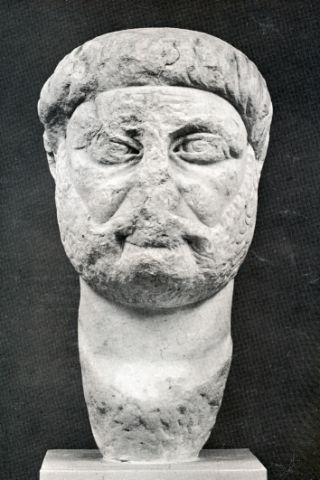
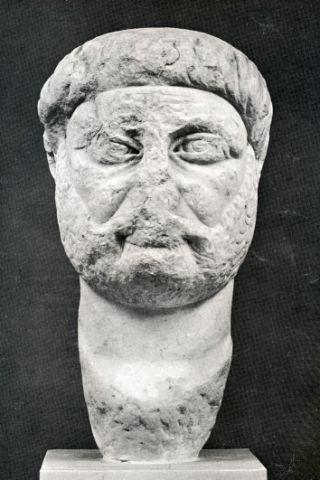
Portrait head of bearded man, re-worked from earlier portrait. Athens. Late fourth to fifth century.
Record details
Photographs
Bibliography
- Datsoule-Satvride, A., Romaika Portraita sto Ethniko Archaiologiko Mouseio tes Athenas, Athens 1985, pp. 86-7 no. E.582/735 pl. 126-7
Discussion
DESCRIPTION (Object)
Portrait head of a bearded man with brushed-forward hair, worked for insertion. Pentelic marble (Datsoule-Stavride), H 37.5 cm, W 19.6 cm. Head and neck are fully preserved. The nose is chipped off; chin,lips, both eyebrows, and the (proper) right temple with the adjoining part of forehead and hair are chipped.
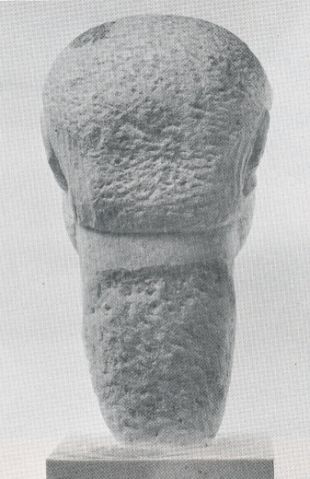
The tenon for the insertion is slightly irregular and roughly finished. At the back it has been worked back secondarily thereby taking away a layer of the neck; this was probably to adapt the head for its late-antique use.
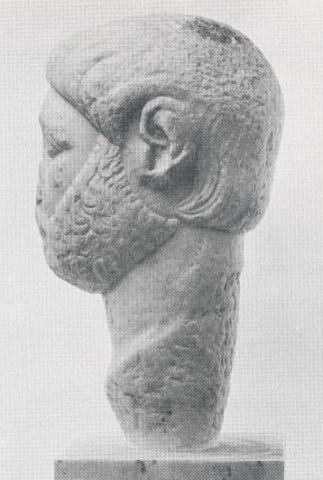
The hair is a compact mass, defined against the flesh by a continuous chisel-line, arching above the forehead. Around the face and behind the ears, the hair is arranged into lank, foreward-brushed strands, marked by superficially incised chisel lines. On top and at the back the surface is only roughly finished with a point. This technique assures that the hair was designed from an earlier, more voluminous, hairstyle. The beard, like the hair, is a compact mass defined against the surrounding flesh by continuous lines. Single strands are marked by short, superficially incised chisel strokes, parallel at the fringes, otherwise crescent-shaped and irregular.
The protruding eyes are emphasized through marked modellings. The arching brows are designed as a hard rim; the heavy upper lid is separated from the orbital by a thin drill line, the thick lower lid set against the zygomatic bone by a sharp caesura. The caruncles are drilled and marked against the eyeballs by deep incised lines; the iris is sketched by a circular incised line with the pupil in its centre marked by a small circular hole (Datsoule-Stavride 1981, 136). Fleshy bulges run from the inner angles of the eyes towards the cheeks.
Deeply incised naso-labial folds mark the caesura between upper the lip and the fat cheeks. The mouth is bent upwards forming a smile and creating deep pit-marks (Grübchen) in its corners. Two horizontally incised lines furrow the forehead.
The ears sit high, they are clumsily modelled and separated from the beard by a blank area. This design, in our view, is a further indicator that the head in its present shape is the result of a late-antique re-work.
PROVENANCE AND CURRENT LOCATION
There is no published record of the provenance of the head. The material (pentelic marble) suggests that it was made in a local workshop. Today it is in the store-rooms of the National Archaeological Museum in Athens, inv. no. E.582/735.
DESCRIPTION (Subject)
The portrait depicts an elderly man with heavy jaw-bones, a fat face, and a small smiling mouth. The heavy-faced type combined with the long neck and the expressive adjustments in the eyes, and notably the smiling mouth, resemble typological and individual features ascertained by Smith for the public image of Licinius (Smith 1997). It seems tempting to group the Athenian head together with the other portraits of Licinius, although it could hardly be considered as belonging to the Vienna-Izmir type (Smith 1997, 176-9; see also LSA-325, LSA-373, LSA-512, LSA-687; such an attribution would fit well with the Constantinian date of our head, as proposed by Datsoule-Stavride (see below, 'Date')).
Objections against the Constantinian date of our head - and thereby against its identification as Licinius - rise in first line from the hairstyle. The public image of Licinius adheres to the short-cropped tetrarchic hairstyle, combined with a stubble beard. In contrast, the lank, forward-brushed coiffure of our head is decidedly 'untetrarchic'. In the neck, the hair rolls into a small coil, a feature of portraits of high ranking state officials in the late 4th and the 5th centuries. Honorific epigrams on statue bases for state officials in the 4th and 5th centuries repeatedly praise the honorand's affability. A smile reappears on the face of the chlamydatus-bust in Thessaloniki (LSA-90), conventionally dated to around 400, and might be considered an appropriate visual code for this administrative virtue.
While the hairstyle appears appropriate for a state-official in the late 4th century or later, portrait types with trimmed beard and short hair, on the other hand, are used for local men representing as Athenian citizens. While we are making the case for a post-Constantinian date for our head (see below, 'Date'), this would, in consequence, exclude any imperial identification.
DATE
The head was dated to the 'Constantinian era' ('τῆς ἐποχῆς τοῦ Κωνσταντίνου') by Datsoule-Stavride 1981, 136 (here specified as '306-337') and again by Datsoule-Stavride 1985, 87 (here specified as '285-337').
In my view, both the typological and stylistic features of the head make a later date preferable. The modellings, if comparable in their intensity, do not display, however, the anxious asymmetries of the tetrarchic portraits represented in Athens by several heads (LSA-124, LSA-125, LSA-127); neither can they represent the stereometrical re-adjustment of forms conventionally reclaimed for Constantinian portraiture. The symmetrical web of lines emphasizing the eyes, together with the marked naso-labial folds, is much better comparable to some portrait heads which have usually been dated to the later 5th or even the 6th century (LSA-690, LSA-691, LSA-694). All these heads display the 'wreath-hairstyle' with a coil in the neck. This hairstyle appears prominently on the obelisk-base in Constantinople (390/2) where it is worn by high-ranking officials, and it remains a feature of magistrate's portraits in the 5th century (Oecumenius, governor of Caria, LSA-150 (statue with head), LSA-151 (inscribed base)).
While the Athenian heads claimed for the period period proposed by Datsoule-Stavride do, in my view, not offer stylistic and typological resemblances, I do see both in heads of the 5th - according to some scholars even the 6th - century.
Our very broad outer dates take into account the assessments of earlier scholarship.
Discussion references
- Datsoule-Stavride, A., Hysteroromaika Portraita 2ou - 4ou m(eta) Ch(ristou) Aiona sto Ethniko Archaiologiko Mouseio Athenon, Archaiologike Ephemeris 1981, 127-38, Athens 1983, p. 136 pl. 50 γ
- Smith, R.R.R.,'The public image of Licinius I: Portrait sculpture and imperial ideology in the early fourth century', JRS 87, 1997
Cite: Last Statues of Antiquity, LSA-130 (Ulrich Gehn).