
LSA-1300
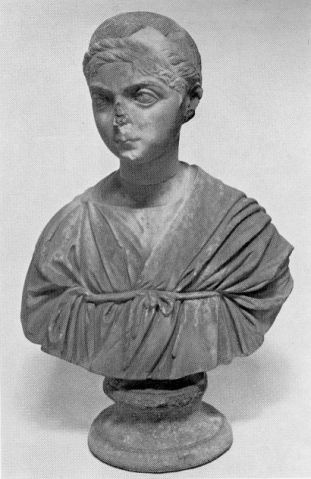
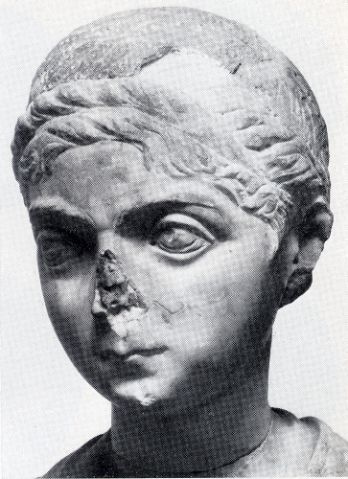
Portrait head of young girl (variation of 'Fausta' type) mounted on bust. Art Market. Early fourth century.
Record details
Photographs
Bibliography
- Bergmann, M., Studien zum römischen Porträt des 3. Jahrhunderts n. Chr., Bonn 1977, 198, pl. 61.2 (320s)
- Schade, K., Frauen in der Spätantike--Status und Repräsentation, Mainz 2003, 90 (late third to Constantinian)
- Sothebys London, Catalogue of Egyptian, Western Asiatic, Irish Bronze Age, Greek, Etruscan, Roman, and Anglo-Saxon Antiquities, on Monday 27th November 1967, London 1967, 32, no. 68
Discussion
DESCRIPTION (Object)
Life-size head set on bust. H: 47.6 cm. Marble.
The head has been mounted on a bust. The neck appears to be cut smoothly at the base so as to enable the attachment to the bust. The nose is broken and there appears to be damage in the hair over the left eye.
The hair is delineated with flat chisels. The irises are large and coarsely engraved, and the pupils are drilled,
PROVENANCE
Once the property of Countess Adelheid Lanckornska.
DESCRIPTION (Subject)
The head is over life-size if a child is intended and seems to have been mounted on the bust in the modern period. The hair is pulled off the face and arranged in two tiers of hair that are pulled back and upward. Some hair escapes on to the brow.
The round, full-cheeked face has a distinctive aspect. The smooth brow is punctuated by rope-like eyebrows. The eyes are large. The mouth is pursed with a pronounced dip at the centre of the upper lip. The lower lip projects over a rounded chin.
DATE AND HONORAND
The technique in which the eyes and eyebrows are rendered suggest a date no earlier than the end of the third century. Moreover, the portrait seems to follow the same model as LSA-573 and LSA-1541. Delbreuck identified LSA-573 as Fausta for which there is no strong evidence. Bergmann considers all three portraits to represent different girls of the same historic period, the late Tetrarchy or early Constantinian era . Fittschen has noted, with regard to LSA-573 that it follows the same model as a Severan portrait now in the Toledo Museum of Art in Ohio.
To this author and to De Kersauson, the coincidence of three essentially similar portraits of girls in the late Tetrarchic or early Constantinian period suggests that one honorand (rather than a ‘Zeittypus’) is intended. Moreover, the similarity of the eyes and mouth of this portrait with those of the so-called Fausta LSA-573 are striking and seem intended. Probability would favour an imperial identity.
Discussion references
- de Kersauson, K., Les portraits romains II; de l’année de la guerre civile (68-69 après J-C) à la fin de l’Empire , Paris 1996, 524-5
Cite: Last Statues of Antiquity, LSA-1300 (J. Lenaghan).