
LSA-1301
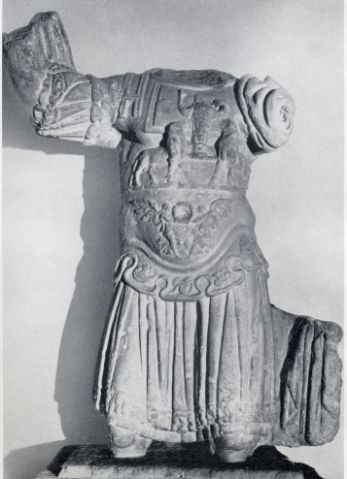
Headless statue of Emperor in cuirass. Carnuntum (Pannonia Prima). Late second to early fourth century.
Record details
Photographs
Bibliography
- Jobst, W. (ed.), Carnuntum : das Erbe Roms an der Donau : Katalog der Ausstellung des Archäologischen Museums Carnuntinum in Bad Deutsch Altenburg AMC, Vienna 1992, 60-61, no. 40 (Severan, possibly Alexander Severus)
- Krüger, M-L., Die Rundskulpturen des Stadtgebietes von Carnuntum. Corpus signorum imperii Romani. Österreich ; v.1, fasc.2 , Vienna 1967, 30-31, no. 83, pl. 30 (third to early fourth century)
Discussion
DESCRIPTION (Object)
The statue is made of a fine local freestone, H 98, W 65 cm. It is broken below the knees, the head, the left arm and the right hand and wrist are broken. The cloak at the left side is only preserved at the shoulder and hip where it was attached to the statue body. At the hips, a massive jag extends horizontally from the centre to the left side.
PROVENANCE AND CURRENT LOCATION
The statue was excavated in 1883 in the principia of the legionary camp at Carnuntum, together with the draped female statue LSA-1273. It is today in Deutsch-Altenburg, Museum Carnuntinum, inv. no. 3932.
DESCRIPTION (Subject)
The depicted stands over his left leg, the right arm is risen to shoulder height and bent in the elbow, the left arm was bent and holding the cloak. He is dressed in a languishly decorated cuirass over a short sleeved tunic showing thick wooly fringes at the sleeve. The costume is completed by the officer’s cloak (paludamentum) fixed at the left shoulder and hanging down the left side. At the lower right arm a conical (or rectangular) slightly bent object is visible which must be a portion of an attribute once held in the right hand.
The front side of the cuirass is lavishly depicted with reliefs: (i) on the breast, there is a statue of Jupiter Heliopolitanus standing elevated against two bulls set heraldically to both sides. The god has raised both arms. The attributes he held in his hands are today lost; it must have been a lightning and earbunch in the left (he is a weathergod responsible for growth), and a whip in his right hand (which characterizes him as charioteer, a solar divinity). He is dressed in an ankle long cloak decorated with reliefs (ependytes, Jobst 1992, 59. 61). The bulls are gazing upwards towards the god. (ii) On the belly there are two victories carrying a wreath between them. (iii) On the jags at the lower edge of the cuirass (pteryges), there were several motifs; a pelta and a sacrificial plate (patera) are still visible.
HONORAND AND DATE
The portrayed has been identified as an emperor almost unanimously so far; there is dissens however, about the dating of the statue (and hence the question which emperor). The statue was dated to the earlier 3rd century by Schober 1935 who suggested that the portrayed was Alexander Severus (and the pendant female statue statue LSA-1273 his mother Julia Mamaea). Jobst 1992 dated to the Severan period (193-235) arguing that this period was the heyday of the cult of Syrian deities in Carnuntum. Schade 2003 readopted an earlier proposal to identify Aurelian (and his mother) in the portrayed, relating this to the religious program of that emperor. Krüger 1967 considered a date in the earlier 3rd/early 4th century.
The gesture of the statue, as Vermeule 1959 pointed out, is characteristic of depictions of Jupiter Dolichenus. Vermeule's suggestion to see this as a statue of the god, not an emperor, is supported, as I think, by the attribute once held in the raised right hand, which might well be an axe (the characteristic attribute of that god). If so, a date in the Severan period (193-235) is most likely.
Cite: Last Statues of Antiquity, LSA-1301 (Ulrich Gehn).