
LSA-1308
Gate inscription recording statues to Honorius and Arcadius, emperors. Rome, Porta Tiburtina. 401-402.
Record details
Photographs
Inscription
S(enatus) p(opulus)q(ue) R(omanus) / impp(eratoribus) Caess(aribus), dd(ominis) nn(ostris), invictissimis principib(us) Arcadio et Honorio, victorib(us) ac triumfatorib(us), semper Augg(ustis), / ob instauratos urbi(s) aeternae muros, portas ac turres egestis [inmensis] ruderibus [[---]] / [[---]] ad perpetuitatem nominis eorum / simulacra constituit. /(5) [---] v(iro) c(larissimo), praef(ecto) urbi, d(evotus) n(uminni) m(aiestati)q(ue) eorum.
Inscription translation
The Senate and People of Rome set up these statues (simulacra) to the emperors [and] Caesars, our lords [and] most invincible rulers, Arcadius and Honorius, victorious and triumphant, forever Augusti, because of the restoration of the walls, gates, and towers of the Eternal City, with the removal of immense ruins ... for the perpetuation of their name. ... of clarissimus rank, prefect of the City, devoted to their divine spirit and majesty.
Bibliography
- Corpus Inscriptionum Latinarum; , VI, 1190 (+p.4334)
Discussion
INSCRIPTION
In five lines.
S(enatus) p(opulus)q(ue) R(omanus) / impp(eratoribus) Caess(aribus), dd(ominis) nn(ostris), invictissimis principib(us) Arcadio et Honorio, victorib(us) ac triumfatorib(us), semper Augg(ustis), / ob instauratos urbi(s) aeternae muros, portas ac turres egestis [inmensis] ruderibus [[---]] / [[---]] ad perpetuitatem nominis eorum simulacra constituit. /(5) [---] v(iro) c(larissimo), praef(ecto) urbi, d(evotus) n(uminni) m(aiestati)q(ue) eorum.
'The Senate and People of Rome set up these statues (simulacra) to the emperors [and] Caesars, our lords [and] most invincible rulers, Arcadius and Honorius, victorious and triumphant, forever Augusti, because of the restoration of the walls, gates, and towers of the Eternal City, with the removal of immense ruins ... for the perpetuation of their name. ... of clarissimus rank, prefect of the City, devoted to their divine spirit and majesty.'
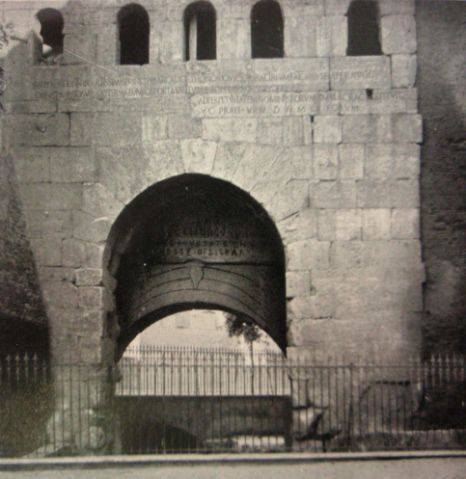
The inscription records the dedication of statues to the emperors, on the occasion of the completion of the Honorian works on the Aurelianic wall. The text was carved directly into the travertine curtain, and would not be readable unless the letters were painted.
Coates-Stephens 2001, 234 suggested that the reference to the immense ruins removed (l. 3) could be an allusion to the debris left by the demolitions carried out during the original construction of the wall, in the late third century. The material would have been incorporated into the Honorian heightening of the whole structure.
CIL VI, 1190 includes a line break in l. 4, between 'eorum' and 'simulacra'. This was corrected by Alföldy and Kruse, in CIL VI, p. 4344. The reference to the intervention of Stilicho (ll.3-4) and the involvement of the prefect Longinianus were erased, presumably after Stilicho fell from grace in 408. Longinianus, however, still had a successful career (PLRE II, 686-687 Longinianus).
Similar dedications survive from other gates of Rome, see LSA-1306 and LSA-1307).
DESCRIPTION
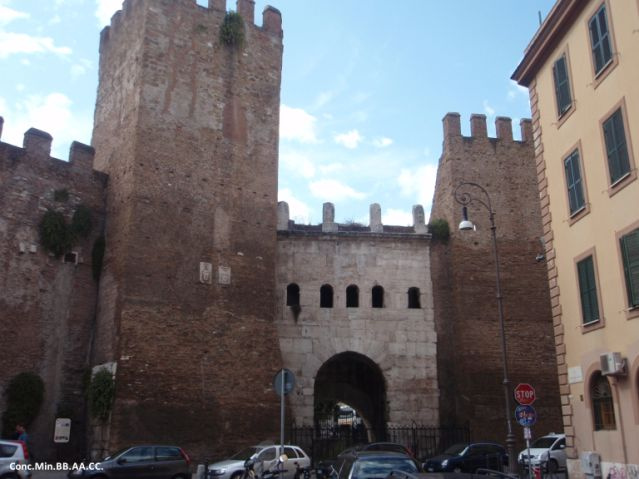
The gate still survives, and the outer façade is well preserved. Part of the interior of the gate was destroyed, most notably the inner court, removed in 1869 (Richmond 1930, 170). The Porta Tiburtina is a single-arched gate, flanked by two brick towers. It abutted an earlier aqueduct arch which carried the aquae Marcia, Tepula and Iulia across the Via Tiburtina. The early imperial inscriptions on this arch can still be seen. Our inscription is faded, but still legible. It was carved into the outer travertine curtain, between the archway and a row of five small arched windows. Richmond observes that the merlons on top of the gate were fragile and of little use as a defensive mechanism, and suggests that this would be the more likely place for the setting up of the statues (p. 178).
PROVENANCE AND CURRENT LOCATION
Our inscription can still be seen on the outer façade of the Porta Tiburtina.
HONORAND, AWARDER AND DATE
As the inscription tells us, the statues (simulacra, in the plural) were set up by the Senate and people of Rome, in honour of the emperors Arcadius and Honorius. The dedication as carried out by the prefect of the City, Flavius Macrobius Longinianus, who was in office in 401-402 (PLRE II, 686-687 Longinianus).
Discussion references
- Coates-Stephens, R., "Muri dei bassi secoli in Rome: observations on the re-use of statuary in walls found on the Esquiline and Caelian after 1870", Journal of Roman Archaeology 14, 2001, pp. 217-238
- Martindale, J. R., The Prosopography of the Later Roman Empire. Vol. II A.D. 395-527, Cambridge 1980, pp. 686-687 (Longinianus)
- Richmond, I. A., The city wall of imperial Rome: an account of its architectural development from Aurelian to Narses, Oxford 1930, pp. 170-181
Cite: Last Statues of Antiquity, LSA-1308 (Carlos Machado).