
LSA-131
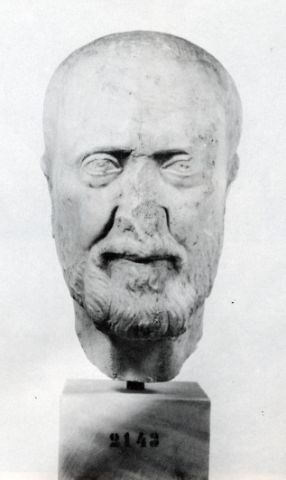
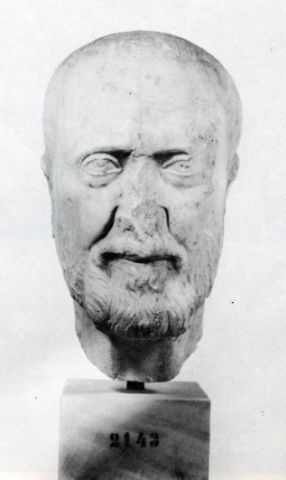
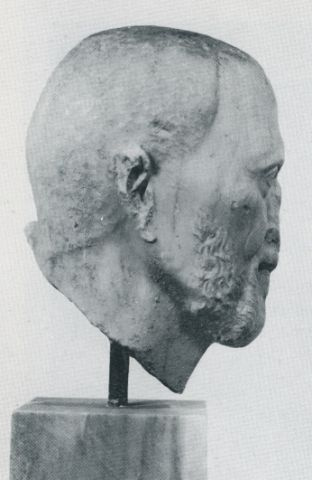
Portrait head of thin-faced bearded man, with short, balding hair. Athens. Late fourth to earlier fifth century?
Record details
Photographs
Bibliography
- Datsoule-Satvride, A., Romaika Portraita sto Ethniko Archaiologiko Mouseio tes Athenas, Athens 1985, pp. 89-90 pl. 133, 134 α-γ
Discussion
DESCRIPTION (Object)
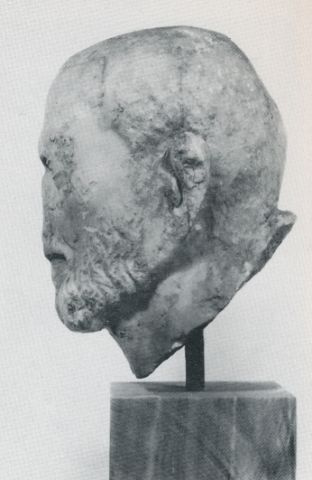
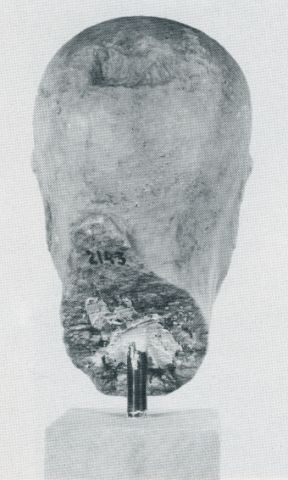
Marble portrait head of a bearded man with neck cut back in a sloping plain from the adam's apple to the hairline in the back. H (overall) 29 cm, H (head alone) 24.6 cm; W 17.7 cm, D 21.2 cm (all measurements from Datsoule-Stavride 1981, 137 n. 2. Deviant Datsoule-Stavride 1985 (H 26.5 cm)). The plain is roughly finished; possibly the head belonged to a relief or a clipeus. In the back, a piece of garment is standing proud of the neck; on the calvary, a rectangular piece of stone has been cut out, possibly an antique repair. The nose is broken, the left temple with the adjacent parts of eye and eyebrow, and the earlaps are chipped. There are some traces of sinter on forehead and cheeks; apart from that the head is in a good state of preservation.
The short hair covers the skull like a thin, tight-fitting cap. It is brushed forward, receding at the temples and forming a convex line above the high forehead. Single strands are articulated by short chisel strokes only along the edges around the face. On the skull and in the back the surface is just roughly finished, possibly to be completed with paint. The voluminous beard is laid in lank strands around the mouth and wavy at the jaws; under the lower lip a rectangular 'mouche' is singled out.
The eyes are emphasized by rich modelling. The sharp-edged brows are contracted, almost horizontal, and deeply overshadowing the eyes. The heavy upper lid is separated from the deep-hanging brow by a drill line; the bulgy lower lids are set against the articulated lacrimal sacs by a marked caesura. From the outer angles of the eyes, incised wrinkles spread radially. The iris is circumscribed by an incised line, the pupil drilled out crescent-shaped.
The high forehead is furrowed by numerous irregularly incised horizontal lines; the contracted eyebrows create a short vertical fold above the nose. The thin lips are tightly closed, forming a marked horizontal line. The deeply-cut naso-labial folds are lyra-shaped, as a result of the swelling nostrils. The flabby flesh of the cheeks hangs from the marked cheekbones.
PROVENANCE AND CURRENT LOCATION
The head was found in Athens at the southern slope of the Acropolis (Datsoule-Stavride 1985, 90; different Hekler 1934, 265: 'Gefunden in Vrachano am Hymettos': Hekler was followed by Sydow 1969, 107 n. 23, and by Bergmann 1977,159 n. 644). Today it is in the store-rooms of the National Archaeological Museum in Athens, inv. no. 2143.
DESCRIPTION (Subject)
The portrait depicts an elderly man with short cropped hair and voluminous beard. His advanced age is indicated by the receding hair, the heavy lacrimal sacs, the wrinkles in the eyes, the flabby cheeks. The contracted eyebrows, the furrowed forehead, and the swelling nostrils indicate intellectual effort and attentive vigilance.
The voluminous beard and some of our head's expressive characteristics connect it with the long-haired, long-bearded 'philosopher-type' (or 'Holy-man') attested in Athens through a head in the Acropolis Musuem (LSA-1083). Contracted eyebrows together with swelling nostrils re-appear on a head in the 'Iamblichus-type' from Delphi in the National Museum in Athens (LSA-110); the swelling nostrils feature prominently in the heads of the same type in Athens/ Paris (LSA-114) and in Epidaurus (LSA-115). Like the 'Iamblichus-type', our head was possibly designed to make reference to the intellectual capacities of the portrayed. The arrangement of the voluminous beard, with its marked 'mouche' below the lower lip, looks much like an individual feature of the portrayed. Resemblances to outstanding intellectual heroes of the 'great past' were possibly desired - the arrangement of the beard around the mouth is reminiscent of the portrait of Pindar.
The short-cropped hair, on the other hand, distinct from all heads of the 'philosopher-type', fits a man in the vita activa. Whereas Hekler 1934, 265 saw a scholar in the portrayed ('ungemein interessantes Gelehrtengesicht'), the hairstyle rather characterizes an imperial office-holder than a philosopher. Late-antique honorific epigrams on statue bases for high-ranking state officials repeatedly praise the familiarity of the honorand with the muses, a motive notably applied in Greece. The combination of semantic elements in our head can be read as a visual encoding of similar ideas.
DATE
The had was dated to the late 3rd century by Hekler 1934, and by v. Heintze 1963, 43 who still saw it in the tradition of the Gallienic portraiture. This date was challenged by v. Sydow 1969 who argued that the head was without relation to works of the third century. Sydow's view was supported by Bergmann 1977; she saw the 'rigid rectangularity and hard delineation of the facial areas' ('die (...) starre Rechteckform und die harte Begrenzung der Gesichtsglieder') at the earliest in the Valentinianic era, and possibly 'much later'.
In my view, stylistic resemblances connect our head to portraits conventionally dated to the 5th century. The sophisticated 'realisms' in the modelling of the face with its flabby flesh hanging from the cheekbones, the contracted eyebrows, even the 'mouche' below the lower lip, are shared by the Stratonikeia-head (LSA-447). This was dated as late as 460 by Özgan-Stutzinger 1985.; however, in our own view, the 'realisms' of the Stratonikeia-head are well comparable to the Thessalonica-head LSA-90 from the beginnings of the 5th century (Gehn 2012, 453-7 no. O 34 (Stratonikeia) and 457-60 (Thessalonica)). Both these heads display the moderate 'wreath-'hairstyle with a coil in the neck appropriate for office-holders in the late 4th and the 5th century. The missing of this typological feature at our head might speak in favour of a 4th century rather than a 5th century date; or the portrayed did for some reason not follow that fashion.
I assign broad outer dates in the 4th/5th centuries, but suggest a date in the late 4th - early 5th century.
Discussion references
- Bergmann, M., Studien zum römischen Porträt des 3. Jahrhunderts n. Chr., Bonn 1977, p. 159 n. 644
- Gehn, U., Ehrenstatuen in der Spätantike. Chlamydati und Togati, Wiesbaden 2012
- Hekler, A., Archäologische Gesellschaft zu Berlin. Sitzung am 9. Januar 1934, Archäologischer Anzeiger. Beiblatt zum Jahrbuch des Archäologischen Instituts 1934, 256-66, Berlin 1934, p. 265 no. 7 figs. 11, 12
- von Heintze, H. 'Vir sanctus et gravis. Bildniskopf eines spätantiken Philosophen', Jahrbuch für Antike und Christentum 6, Münster 1963, p. 43
- Von Sydow, W., Zur Kunstgeschichte des spätantike Porträts im 4. Jahrhundert. n. Chr, Bonn 1969, pp. 107-8
Cite: Last Statues of Antiquity, LSA-131 (Ulrich Gehn).