
LSA-1314
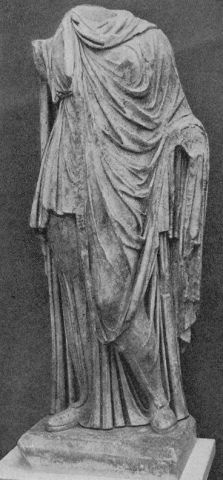
Under life-size statue of woman in chlamys. From Rome. Mid fourth to fifth century.
Record details
Photographs
Bibliography
- L'Orange, H.P. 'Statua tardo-antica di un' Imperatrice', Likeness and icon. Selected studies in classical and early mediaeval art, Odense 1973, 43-53, figs. 1-5
Discussion
DESCRIPTION (Object)
Under life-size head statue missing separately worked head. H: 1.23 cm. H (total estimated with head) 1.48 cm. Plinth: H: 9; W: 46; D: 33 cm. Marble.
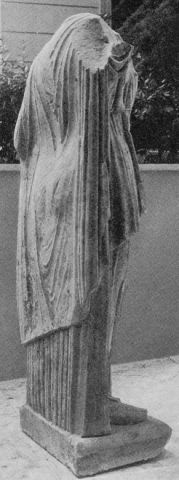
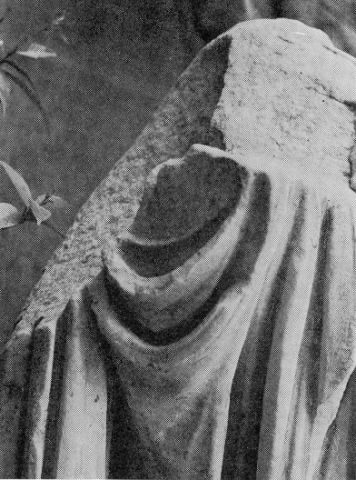
The statue is preserved from the plinth to the shoulders. The head was worked separately and inserted into a socket. It is now missing. The raised right arm and left wrist and hand have broken off.
The back is fully worked but flatly rendered, especially below the buttocks.
PROVENANCE
The statue was given as a gift to the Institute by Fritz Teschow for the inauguration of the Institute’s new building in October 1962.
DESCRIPTION (Subject)
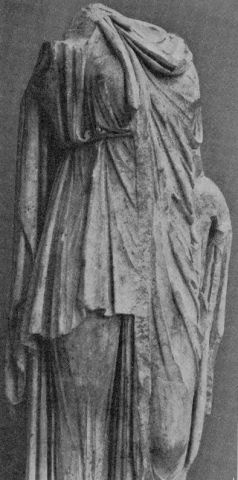
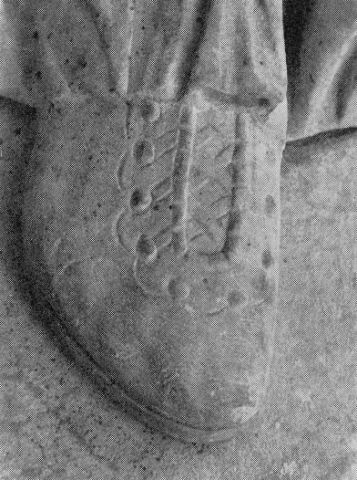
The statue is under life-size and depicts a female figure in a particular costume. The figure wears a cloak fastened by a fibula on the right shoulder; an inner garment which is belted below the breasts and has an overfold (apotygma); a sleeved inner garment; and closed shoes that are decorated with pearls. The belted garment resembles the classical “peplos” but it does not have an open seam on the right side. It may be intended to be a dalmatica.
The figure stands with its weight over the right leg and with the right arm raised.
DATE
The technical carving of the work provides no significant indication of its date, though the ???small-size??? is more common in later statues. The footwear suggests contemporary fashion of late antiquity. The clothing is unparalleled in a portrait statue of a woman of the high imperial period.
IDENTIFICATION
The fashionable footwear and the separately worked head both suggest that this statue was a portrait, rather than a representation of an ideal figure.
Cite: Last Statues of Antiquity, LSA-1314 (J. Lenaghan).