
LSA-1315
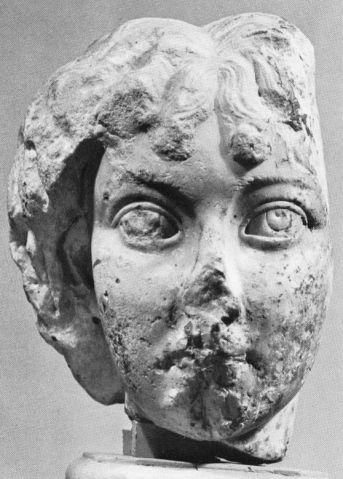
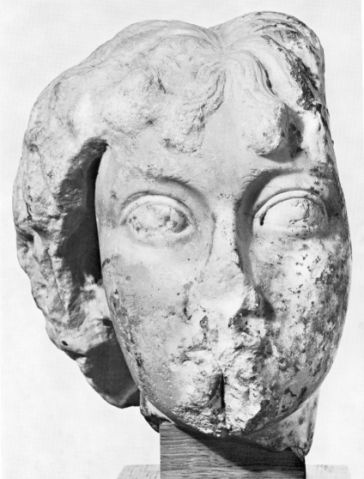
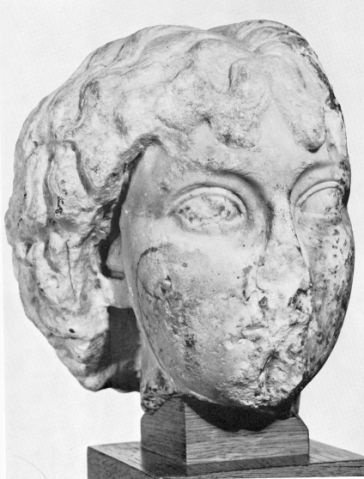
Portrait head of long-haired child. From Italy. Fifth century?
Record details
Photographs
Bibliography
- Heintze, H. von ‘Ein spätantikes Mädchenportät in Bonn. Zur stilitischen Entwicklung des Frauenbildnisses im 4. und 5. Jahrhundert’, Jahrbuch für Antike und Christentum 14, Münster 1971, 61-2, 83 no. VI 6, 85-6, pls. 1, 2, 17d, 18a, and 19c (late fourth to early fifth century)
Discussion
DESCRIPTION (Object)
Life-size head. H: 24, H (chin to crown) 21 cm. White Luni marble.
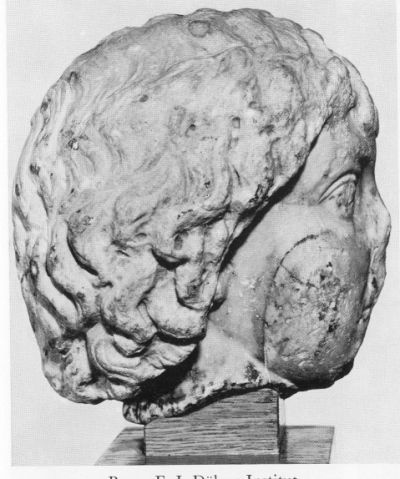
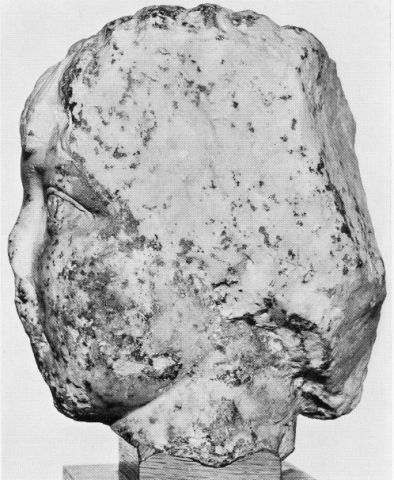
The head is broken irregularly through the neck, more of which is preserved on the proper left. The hair at the back and left side of the head has completely broken off. Along the right side of the head, the ends of the hair seem to be missing. The lower part of the nose, the mouth, and the middle of the chin are badly damaged. Only the corner of the mouth is preserved. The surface of the right eye is abraded. The right cheek is also chipped and scarred.
The drill has not been used in the thick hair which is rendered with a flat chisel. A fine flat chisel has also been used to engrave the eyebrows. The iris is more than semi-circular and is defined by an engraved line. The pupil seems to be indicated by ???a??? two drill points.
PROVENANCE
Supposedly purchased in Rome in second half of 19th century.
DESCRIPTION (Subject)
The head depicts a child with a smooth oval face and thick curly hair which is parted in the centre. The cheeks and nose are long. The corners of the mouth are widely spaced, and the chin rounded. The eyes are accentuated by fine arching brows, below which is a flat surface and then the upper lid. The eyes themselves are elegantly shaped. They are long; have pointed inner canthi; and seem larger at the inner corners because of the outer placement of the irises.
On either side of the part, the hair falls in two long locks that end in curls low on the brow. Behind these curls, the hair falls in a mass of long waves that cover the ears. The individual locks are not separated from each other but seem as a mass to have been drilled away from the face.
The hairstyle has given rise to speculation on the gender of the portrait. In its first publication (von Heintze) it was interpreted as a female coiffure. Later and probably more correctly it has been understood as a young boy and as the sort of image which would influence the iconography of Christian angels (Schade).
DATE
The head is difficult to date because it shows a hairstyle that stands outside the realm of fashion. The technical rendering of the eyes and eyebrows seems surely to indicate a date in the fourth century or later. The mop-like hairstyle, which is drilled off the face, might suggest a fifth century date.
Discussion references
- Schade, K., Frauen in der Spätantike--Status und Repräsentation, Mainz 2003, 91 (boy)
Cite: Last Statues of Antiquity, LSA-1315 (J. Lenaghan).