
LSA-132
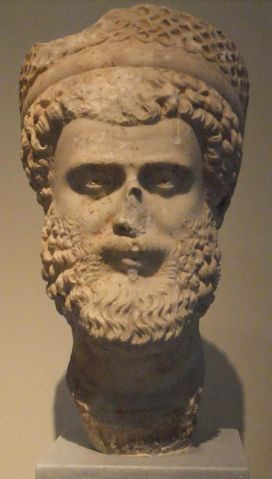
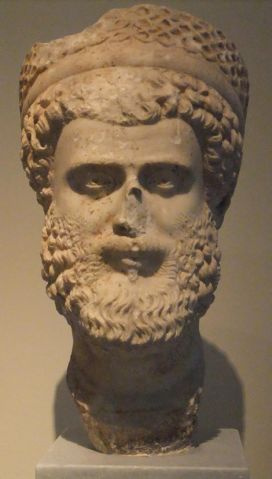
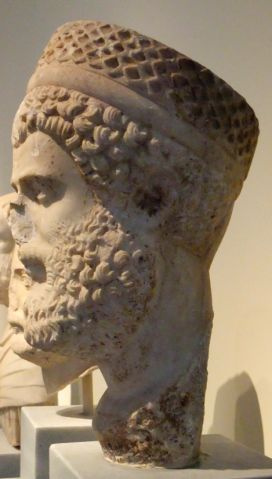
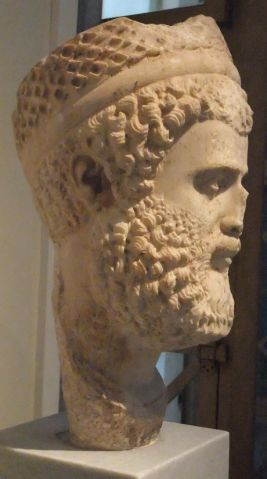
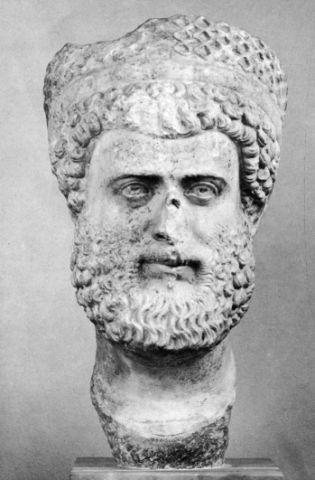
Portrait head of bearded man wearing wreath and crown, traditionally dated late antique. Athens. Late second to early third century
Record details
Photographs
Bibliography
- Datsoule-Satvride, A., Romaika Portraita sto Ethniko Archaiologiko Mouseio tes Athenas, Athens 1985, pp. 91-2 no. 2006 pl. 136
- Romiopoulou, K., Ellenoromaika Glypta tou Ethnikou Archaiologikou Mouseiou, Athens 1997, p. 131 no. 143
Discussion
DESCRIPTION (Object)
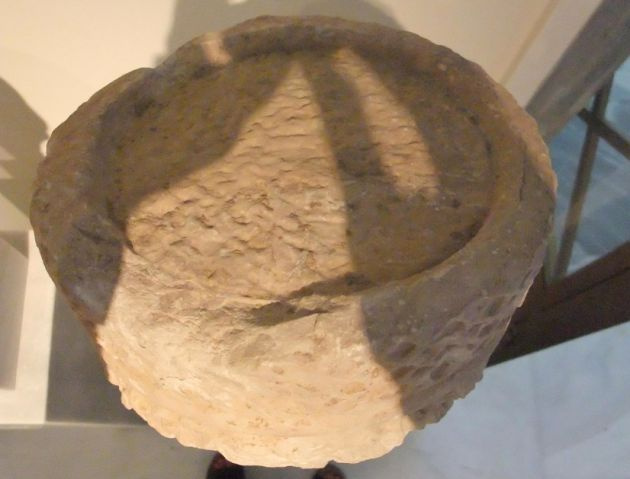
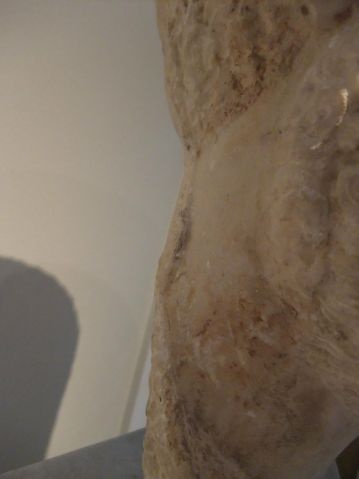
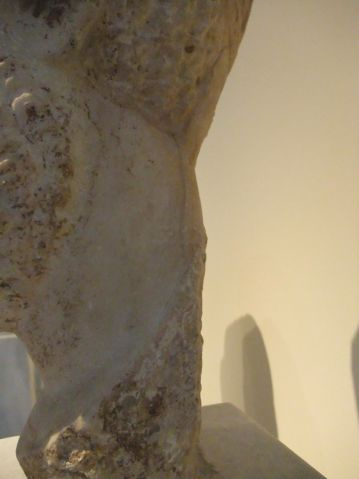
Portrait head of a bearded man wearing wreath and crown, preserved with part of the neck; worked for insertion. Pentelic marble, H 43.1 cm, W 21.6 cm (measurements from Datsoule-Stavride 1985). The left half of the nose and a piece of the wreath above the right side of the face are broken off; the hair in the forehead above the right eye is chipped. Minor chips are scattered on the surface; the overall state of preservation, however, is excellent. The cone for the insertion is irregular, bevelled at the right side.
The crown is a high polos, its surface a basket-like network of rhombs; at the back it has an undecorated rectangular area. The wreath, worn below the crown, is a bulge with smooth surface on the forehead to the ears; behind the ears it is a flat band. It is fixed in a double knot at the back, with the two ends hanging down the neck (descriptions of backside from Datsoule-Stavride 1985, 91).
The small eyes are almond-shaped, the burred eyebrows almost horizontal. The thin upper lid is separated from the orbital by an incised line. The caruncles are drawn out and with a drill point; at the outer angles the upper lid overlaps the lower. The iris is circumscribed by an incised line, the bean-shaped pupil marked by drill-work; this is the standard 2nd/ early 3rd-century way of treating the eyes (see below, 'Date').
The hair is reaching in a downward-arching line into the forehead, elaborately arranged into three rows of curly locks. The locks are separated from each other by drillwork, and subdivided by neat chisel-work. Behind the ear, it is worked back to a plain surface, just roughly finished. The voluminous beard is an artistic formation of various textures indicated by varying techniques. It grows from the cheeks, marked as short hatchings, soon to form little knots, separated by chiselwork, then to thick, wooly knots, separated by drillwork, on the jawbones. From the lower lip, it is combed in wavy streaks over the chin, symmetrically arranged, and executed again in chiselwork. The thick moustache is a hardly differentiated bulge, separated in its centre by an upward-pointing triangle to open the view at the filtrum.This motive is balanced by a conical little 'mouche' below the centre of the lower lip. At the corners of the mouth, the mass of hair is hatched by short horizontal chisel strokes.
The arrangement of hair and beard is of striking symmetry. The small and delicate mouth is framed by a semicircular beard: the downward-arching line is repeated by the bendings of the wavy streaks below the chin and by the delineation of the chin; it corresponds to the hairline in the forehead.
The voluminous and meticulously arranged hairgrowth in the face reduces the organs to a small triangular space. Axiality and symmetry in the arrangement of the lines create a 'classicising' impression which is enforced by the plane modelling. Two furrows on the forehead, repeating the arching hairline, are only just indicated by shallow incisions; the transition between upper lip and cheeks, as the transition between eyes and cheeks, are plastically rendered but without marked caesuras.
PROVENANCE AND CURRENT LOCATION
The head had been built into a wall above the door of the house of the family of Stavros Boulikes (Kastriotes 1923, 119; Kastriotes points out that this family is testified to in Athens already in inscriptions of the 16th century) beside the old turkish mosque at the Monastiraki-station at the northern side of the Acropolis, adjacent to the Library of Hadrian and the Roman Agora. From here it was transferred to the National Museum in the early 20th century (Kastriotes 1923, 119: 'πρὸ 20ετίας περίπου’- 'about 20 years ago') . It is recorded in Kastriotes' 1908 catalogue, p. 349 inv. no. 2006. Today in the National Archaeological Museum, inv. no. 2006.
DESCRIPTION (Subject)
The portrayed is a man of mature age, as indicated by the impressive beard, although no wrinkles disturb the smoothness of his face. Wreath and crown identiy him as a man with priestly functions. Both, beard and priestly crown led Kastriotes 1923 to identify the portrayed with the emperor Julian; he was followed by Vermeule 1968, and his view was supported by Datsoule-Stavride 1985 and again entertained by Kaltsas 2002. This identification was challenged, however, by Romiopoulou 1997; justly in our view. While there are no secured plastic portraits of that emperor, his coins throughoutly display the imperial diadem and the imperial hairstyle (βασιλικὸν σχῆμα) with the long strands of lank, forward-brushed hair. Both, imperial attribute and imperial hairstyle are missing on our head; this rules out any identification as late-antique imperial portrait.
Priestly functions were still administered in late-antique Athens by members of the local aristocracy. Late-antique portrait types possibly associated with such functions are a long-haired, wreathed head in the Acropolis museum (LSA-1083) and a wreathed head of the 'Iamblichus type in Eleusis (LSA-116). Our head with its meticulously cultivated appearance and calmness is markedly distinguished from the emphasized, staring glance and the indications of spiritual excitement or religious zeal notably of the Athenian head (see also below, 'Date').
DATE
The identification of our head with Julian by several scholars (see above, 'Description (Subject)') consecutively dated the head to the reign of that emperor, 361-3 (Kastriotes 1923, Datsoule-Stavride 1985, Kaltsas 2002). Meischner 1990, 320 assessed the head as 'a typical example of the early-theodosian Classicism' ('ein typisches Beispiel des frühtheodosanischen Klassizismus'). Romiopoulou 1997 proposed a date in the late 4th/ early 5th century and argued that this was a late-antique re-work made from a portrait of the late 2nd/ early 3rd century.
Stylistic, technical, and iconographic indicators assign a date in the 2nd or early 3rd century to this head. The eyes are shaped in the the usual way of that period (see above, 'Description (Object)', and the virtuously executed marble work with its variety in texture and high polishing, the artificially styled hair and beard provide further argument to assign this head to the sophisticated marble techniques of the 2nd to early 3rd century (Smith 1998). The self-orchestration of the portrayed as a priest with a tall headgear conforms to the promotion of Hellenic cultural values potent in that period.
FURTHER DISCUSSION
A similar headgear consisting of a strophion worn beneath a cylindrical polos is displayed by the portrait head of an aged from Corinth (LSA-74). The hair of the Corinthian head, like on ours, is worked out around the face and just roughly finished in the back.
A similar case of a head traditionally dated late and asociated with the 'Theodosian classicism', but dating to the late 2nd or early 3rd century in my view, is LSA-126.
Discussion references
- Kaltsas, N., Sculpture in the National Archaeological Museum, Athens, Athens 2002, p. 373 no. 800
- Kastriotes, P., Ioulianou tou Apostatou Kephale, Archaiologike Ephemeris 1923, 118-23, Athens 1923
- Meischner, J., 'Das Porträt der theodosianischen Epoche I (380 bis 405 n. Chr.),' , Jahrbuch des Deutschen Archäologischen Instituts 105, Berlin 1990
- Smith, R. R. R., Cultural choice and political identity in honorific portrait statues in the Greek East in the second century A.D., The Journal of Roman Studies 88, 56-93, 1998
- Vanderpool, C., Roman Portraiture, Williams, C. K. II & N. Bookidis, Corinth, the centenary, 1896-1996: Corinth XX, 369-384, Princeton 2003
- Vermeule, C. C., Roman imperial art in Greece and Asia Minor, Cambridge, Mass. 1968, p. 404 Julianus no. 2
Cite: Last Statues of Antiquity, LSA-132 (Ulrich Gehn).