
LSA-1321
Base for statue of Lucius Crepereius Rogatus signo Secundinus, senator and priest. Rome. Late third-early fourth century
Record details
Photographs
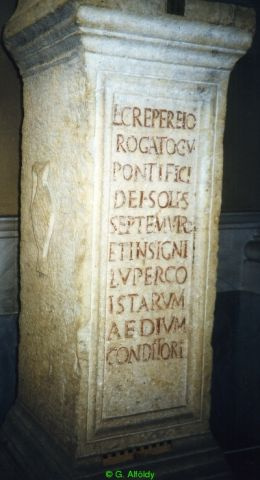
Inscription
Secundini. / L(ucio) Crepereio / Rogato, c(larissimo) v(iro), / pontifici /(5) dei Solis, / septemviro / et insigni / luperco, / istarum /(10) aedium / conditori.
Inscription translation
[Statue] of Secundinus. To Lucius Crepereius Rogatus, of clarissimus rank, priest (pontifex) of the Sun god, member of the college of the seven men (septemvir), and splendid lupercus, founder of this temple.
Bibliography
- Corpus Inscriptionum Latinarum; , VI, 1397 (+pp.4691-4692)
- Inscriptiones Latinae Selectae, , 1203
Discussion
INSCRIPTION
In eleven lines. Letter height 4-5 cm.
Secundini. / L(ucio) Crepereio / Rogato, c(larissimo) v(iro), / pontifici /(5) dei Solis, / septemviro / et insigni / luperco, / istarum /(10) aedium / conditori.
'[Statue] of Secundinus. To Lucius Crepereius Rogatus, of clarissimus rank, priest (pontifex) of the Sun god, member of the college of the seven men (septemvir), and splendid lupercus, founder of this temple.'
The inscription records a dedication to a pagan man, member of different religious associations, who was responsible for the building of an unnamed structure. The fact that the structure is not identified suggests that the base was originally inside or physically near it. Only religious offices are mentioned, and it is possible that the structure had a religious function (see below, Provenance and Location)
DESCRIPTION (CIL)
Marble base with crown, 137 x 44 x 44 cm. Left side is decorated with urceus, the right side with patera. There is a hole at the back, possibly to affix base against wall. This possibility is supported by the fact that the base is tall but not wide nor deep.
PROVENANCE AND CURRENT LOCATION
Our base is first recorded c. 1687, as part of the collection of antiquities of queen Cristina of Sweden (CIL). It was certainly dedicated with LSA-1322, honouring the wife of Rogatus and also seen in the collection of the queen. There is no record of their original findspot, but Lanciani plausibly suggested that these bases were found during the excavation of the mihtraeum of the vicus Patricius, a structure that belonged to a private domus and that was located in an area where the same queen is known to have been involved in excavations (Lanciani 1891, 341).
The base is now in the Vatican Museums, at the Museo Pio Clementino, Galleria dei Candelabri (inv. n. 2778).
HONORAND, AWARDER, AND DATE
Our monument was dedicated to Lucius Crepereius Rogatus, a pagan who founded an unknown structure. He was a priest of the Sun God, and therefore must be dated after 274, when the cult was instituted. He is probably to be dated between the late third and the early fourth century (PLRE I, 767 Rogatus 2).
The awarder of this statue is unknown.
Discussion references
- Jones, A. H. M. et al., The Prosopography of the Later Roman Empire. Vol. I 260-395, Cambridge et al. 1971 (1975), p. 767 (Rogatus 2)
- Lanciani, R., "Miscellanea Topografica", Bullettino della Commissione Archeologica Comunale di Roma, 1891, 305-329 and 341
Cite: Last Statues of Antiquity, LSA-1321 (Carlos Machado).