
LSA-133
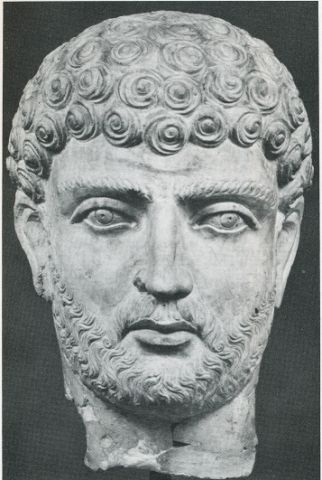
Portrait head of bearded male. From Thera (Insulae). First to third century, or possibly earlier fourth century.
Record details
Photographs
Bibliography
- Datsoule-Stavride, A., Hysteroromaika Portraita 2ou - 4ou m(eta) Ch(ristou) Aiona sto Ethniko Archaiologiko Mouseio Athenon, Archaiologike Ephemeris 1981, 127-38, Athens 1983, pp. 136-7 no. 1643
- Kastriotes, P., Katalogos Glypton tou Ethnikou Mouseiou, Athens 1908, p. 291 no. 1643
Discussion
DESCRIPTION (Object)
Portrait head of a bearded male preserved with a part of the neck. Hard limestone; H (overall) 35.5 cm, (head alone) 31 cm; W 22.5 cm. According to Datsoule-Stavride 1981, 136 n. 3, a piece of the left side of the head is missing; this is not visible on the published images. The neck is glued together from a number of pieces; it is broken below the adam's apple, a piece at the (proper) right side is missing. A crack splits the (proper) right earlobe; apart from that, the head (as visible in the front view on the published images) is without damages.
The hair is a compact mass symmetrically arranged in four rows of snail-shaped curls; no drill-work is applied. The hairline extends in an arching line into the forehead, the central curl set directly above the straight nose.The trimmed beard is made up of undulating strands curling up at their ends. Like the hair, it is arranged around the vertial axis of the face in strict symmetry.
The small eyes are overshadowed by flat-arching brows accentuated by sinus-shaped vertical chisel-strokes. The lids don't meet at the inner angles, at the outer angles the broad, fleshy upperlid overlaps the lower. The small iris is circumscribed by an circular incised line; despite the upper-lid covering half the eye, the circle is almost completely visible. The pupil is indicated by a small circular hole in the centre of the iris.
The heavy upper lid and the lips are edged by burred, almost metallic lines. The forehead is furrowed by one superficially inscribed line repeating the arch of the hairline. No futher wrinkles or folds disturb the smoothness of the face. The only marked caesura in the modelling of the flesh is between lower lip and chin. The (proper) right side of the face is slightly contracted as compared to the left.
Datsoule-Stavride 1981 pointed out that the head shows characteristics of Palmyrene art and was 'obviously imported from Palmyra' ('εἰσαγμένα προφανῶς ἀπὸ τὴν Παλμύρα'). We fully agree to this assessment (see below, 'Description' and 'Date').
PROVENANCE AND CURRENT LOCATION
The head was found in Thera ( Datsouli-Stavridi 1981, 136 n. 3; Kastriotes 1908). No information is provided about the exact circumstances. Today it is in the store rooms of the National Archaeological Museum in Athens, inv. no. 1643.
DESCRIPTION (Subject)
The ornamental arrangement of beard and hair may be attributed to the head's (or the sculptor's) origin, possibly from Palmyra. The portrayed is not a youth anymore, as indicated by his full beard. No further indications of age, status, or office are legible.
Kastriotes 1908 considered our head to be a likeness of a Roman emperor ('Εἰκονίζει πιθανῶς αὐτοκράτορα Ρωμαῖον'), without, however, daring an ascription. This attribution was not repeated by Datsoule-Stavride (see below, 'Date').
DATE
The head was considered of 'barbarian technique' ('Τέχνης μᾶλλον βαρβαρικῆς') by Kastriotes 1908. Datsoule-Stavride 1981 dated to the Constantinian period, without offering any argument to the reader; she did, however, point out that the head shows clear features of Palmyrene art and was 'obviously imported from Palmyra' ('εἰσαγμένα προφανῶς ἀπὸ τὴν Παλμύρα'). The short cut hair with the hairline arching into the brow, and the short beard could be taken as indicators for a Constantinian date. However, heads from Palmyra defy the usual dating criteria for Roman portraiture. In our view, there is no safe indicator assigning the head to the Constantinian period. Notably the marking of the eyes, elswhere the clearest indicator of late-antique nascency, is observable in Palmyrene likenesses long before late antiquity (see, for example, the male bust Ingholt 1928 33-4 pl. III fig. 9, dated 154/5; it has the same arrangement of hair and the same delineation of eyes as our head does). Portraits of this quality, moreover, would be highly exceptional in Palmyra after the city's destruction in 272.
Without being capable to propose a narrow dating, I consider the head a likeness of the earlier imperial period of the 1st/ 3rd centuries; it probably does not testify to a late-antique honorific statue in Thera.
Discussion references
- Ingholt, H. , Studier over palmyrensk Skulptur, København 1928
Cite: Last Statues of Antiquity, LSA-133 (Ulrich Gehn).