
LSA-134
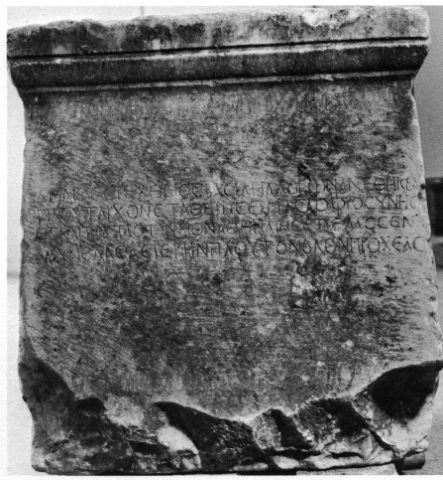
Base for statue of Plutarchus 'king of words'. Athens (Achaea). Late fourth to early fifth century
Record details
Photographs
Inscription
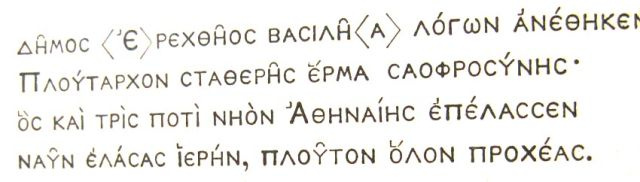
δῆμος [Ἐ]ρεχθῆος βασιλῆ[α] λόγων ἀνέθηκεν / Πλούταρχον σταθερῆς ἕρμα σαοφροσύνης· / ὃς καὶ τρὶς ποτὶ νηὸν Ἀθηναίης ἐπέλασσεν / ναῦν ἐλάσας ῾ϊερήν, πλοῦτον ὅλον προχέας.
Inscription translation
The people of Erechtheus (= the Athenians) set [this] up [to] Plutarchus, the king of words, the mainstay of firm prudence, who rowed the sacred ship three times in all near to the temple of Athena, spending all his wealth. (trans. E. Sironen)
Bibliography
- Inscriptiones Graecae, II/III 3818
- Inscriptiones Graecae, II/III(2) 13281
Discussion
INSCRIPTION
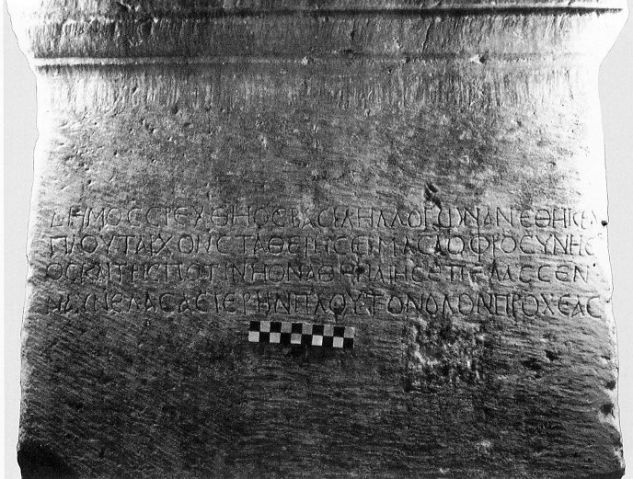
Verse inscription of two elegiac distichs laid out in four lines:
δῆμος [Ἐ]ρεχθῆος βασιλῆ[α] λόγων ἀνέθηκεν,
Πλούταρχον, σταθερῆς ἕρμα σαοφροσύνης;
ὃς καὶ τρὶς ποτὶ νηὸν Ἀθηναίης ἐπέλασσεν
ναῦν ἐλάσας ῾ϊερήν, πλοῦτον ὅλον προχέας.
'The people of Erechtheus (= the Athenians) set [this] up [to] Plutarchus, the king of words, the mainstay of firm prudence, who rowed the sacred ship three times in all near to the temple of Athena, spending all his wealth.' (trans. E. Sironen)
Letter height 1.5-2 cm.
DESCRIPTION (from Sironen 1997 and the published photos)
Rectangular base of white marble with mouldings at bottom and top, used for three dedications at different times: H 61, W 59, D 67 cm. The first use was for Marcus Ulpius Flavius Tisamenus (IG II/III 3701, before the middle of the 3rd century) and is associated with the imprints for the feet of a statue on the top. The second use (with the inscription set on the original left side) was for a dedication to Hegias (LSA-102). The third use (on the original right side) is our inscription to the sophist Plutarchus, of the late fourth or early fifth century. The epigraphic field for this inscription has been cut back with a claw.
PROVENANCE AND LOCATION
Found in 1848 in a wall of the church of Agia Kandeli in the Plaka. The church is now destroyed, and the base is in the Epigraphic Museum, inv. no. 10512.
HONORAND AND DATE
The name 'Plutarchus' appears on three late antique inscriptions in Athens: this one where he is the honorand; an inscription built into the Library of Hadrian where a sophistes Plutarchus is the dedicator of a statue to the praetorian prefect Herculius in 407/12 (LSA-137); and a second fragmentary base also set up to a Plutarchus (LSA-136). It is possible that all three inscriptions, which all contain references to intellectual brilliance, refer to the same Plutarchus, the famous head of the neo-platonist school (Frantz 1988, 64; PLRE I, 708 Plutarchus 5, recorded also as PLRE II, 893 Plutarchus 1). PLRE and Sironen however, have argued that the honorand of the base currently under discussion, while the same man as the sophistes Plutarchus of the Library of Hadrian, was different from the philosopher Plutarchus, to whom Sironen attributes the base LSA-136 (Sironen 1994, 47-8).
FURTHER DISCUSSION
The 'sacred ship' (ναῦν ...῾ϊερήν, line 4) is the ship carriage on which the peplos, the garment of the goddess Athena, was carried to the Acropolis on the festival of the Great Panathenaeans. The garment was hung over the T-shaped construction of mast and spreader. The ship was carried from the Pompeion to the Eleusinion at the foot of the Acropolis (ποτὶ νηὸν Ἀθηναίης -close to the temple of Athena, line 3) (Deubner 1966, 32-3).
ACKNOWLEDGEMENT
We are very greatful to Erkki Sironen for help with the translation and interpretation of this inscription.
Discussion references
- Deubner, L., Attische Feste, Berlin (2)1966
- Frantz, A., Late Antiquity A. D. 267 - 700: The Athenian Agora XXIV, Princeton 1988, 63-4
- Jones, A. H. M. et al., The Prosopography of the Later Roman Empire. Vol. I 260-395, Cambridge et al. 1971 (1975)
- Martindale, J. R., The Prosopography of the Later Roman Empire. Vol. II A.D. 395-527, Cambridge 1980
- Sironen, E., The late Roman and early Byzantine inscriptions of Athens and Attica, Dissertation - University of Helsinki 1997, 77-8 no. 20
- Sironen, E. , 'Life and administration of late Roman Attica in the light of public inscriptions'
P. Castrén, Post-Herulian Athens : aspects of life and culture in Athens, A.D. 267-529 , Helsiniki 1994, 15-62, 46-8 no. 29
Cite: Last Statues of Antiquity, LSA-134 (Ulrich Gehn).