
LSA-135
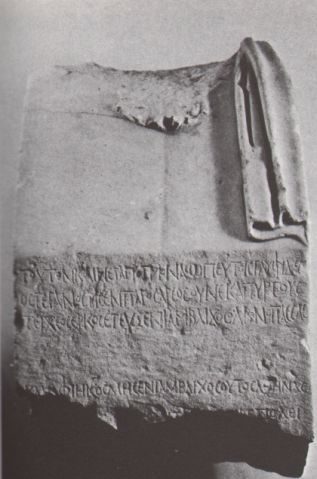
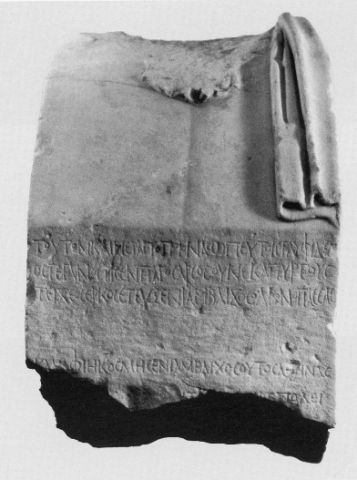
Inscribed re-used herm honouring Iamblichus. Athens (Achaea), Agora. Late fourth century
Record details
Photographs
Inscription
τοῦτον καὶ μετὰ πότμον ἀθ̣ωπεύτοις γλυφίδεσσ̣ι[ν]
ὁ στεγανὸς τῖσεν πάγος Ἄρεος, οὕνεκα πύργους,
τείχος ἕρκος ἔτευξεν, Ἰάμβλιχος ὄλβον ὀπάσσας.
καὶ σ̣ο̣φίῃ κόσμησεν Ἰάμβλιχος οὗτος Αθηνας,
[καὶ Κρανα]<b>ῇ κρα̣τερὸ</b>ν̣ τε̣ῖχος ἐπ]ῇ̣ρ̣ε πόλει.
[---?]
[---?]
Inscription translation
The silent hill of Areopagus honoured this man even after his death with carvings which cannot flatter him, Iamblichus, because he built the towers, the defence wall, giving it for the common weal.
This Iamblichus adorned Athens through his wisdom and raised a mighty wall for the city of Cranaus (= Athens). [...?] (trans. E. Sironen)
Bibliography
- Inscriptiones Graecae, II/III(2) 13277
Discussion
INSCRIPTION
In five lines of verse, separated by a space between lines 3 and 4:
τοῦτον καὶ μετὰ πότμον ἀθ̣ωπεύτοις γλυφίδεσσ̣ι[ν]
ὁ στεγανὸς τῖσεν πάγος Ἄρεος, οὕνεκα πύργους,
τείχος ἕρκος ἔτευξεν, Ἰάμβλιχος ὄλβον ὀπάσσας.
καὶ σ̣ο̣φίῃ κόσμησεν Ἰάμβλιχος οὗτος Αθηνας,
[καὶ Κρανα]ῇ κρα̣τερὸν̣ τε̣ῖχος ἐπ]ῇ̣ρ̣ε πόλει.
[---?]
'The silent hill of Areopagus honoured this man even after his death with carvings which cannot flatter him, Iamblichus, because he built the towers, the defence wall, giving it for the common weal.'
'This Iamblichus adorned Athens through his wisdom and raised a mighty wall for the city of Cranaus (= Athens). [...?]'
(trans. E. Sironen).
Letter height 1-2 cm.The letters underlined were legible when the herm was first found, but are already recorded as lost by Raubitschek 1964, 64.
The two poems are in different verse forms (three hexameters the first, a distich the second) and are, as Sironen (1997, 72) points out, in different hands. The herm is broken and lost at the bottom; the second poem could therefore once have had at least one more distich.
DESCRIPTION (from Sironen and the published photo)
Inscribed portrait herm of white marble (Pentelic according to Sironen 1997, 72): H 50, W 29, D 24 cm. The present inscription is clearly carved over an earlier one chiseled out. The head and lower part of the shaft are broken away, the bottom of a long beard on the breast is still visible. On the left shoulder, a philosopher's cloak (himation). On both sides of the herm there are cuttings for 'armstubs'. The bust and head presumably date from the first use of the herm, though not enough of them survive to be able to tell whether there was any late antique reworking.
PROVENANCE AND LOCATION
The herm was found in 1936 in the Agora, close to the stoa of Attalus; it is now in the Agora-Museum, inv. no. I-3542.
HONORAND AND DATE
The honorand was a philosopher of high distinction active in Athens in the second half of the fourth century (PLRE I, 451-2 Iamblichus 2; on his influence on contemporary philosophical thought see Cameron 1967, 149-53). He was born in Apamea, but must not be confused with the philosopher and theurg of the late 3rd/ early 4th century, likewise a native of Syria (PLRE I, 450-1 Iamblichus 1). He first came to Athens in the late 350s and settled there permanently in 362/5 (Raubitschek 1964, 66-7). Both epigrams praise his contributions to the fortifications of Athens, which were reconstructed in the later 4th century, perhaps in the face of the Visigothic invasion of Greece in 390 (Frantz 1988, 51). Iamblichus is known to have been still alive in 391. While the lower poem possibly still dates to his lifetime, but probably not much earlier than ca. 390, the upper one alludes to his death and was therefore probably executed in the 390s, after 391.
Discussion references
- Cameron, Al., Iamblichus at Athens, Athenaeum (nuova serie) 45, 1967, 143-53
- Frantz, A., Late Antiquity A. D. 267 - 700: The Athenian Agora XXIV, Princeton 1988, p. 51 n. 214-15 pl. 45 a
- Raubitschek, A. E., Iamblichos at Athens, Hesperia 33, 1964, 63-8
- Sironen, E., The late Roman and early Byzantine inscriptions of Athens and Attica, Dissertation - University of Helsinki 1997, 72-4 no. 15
- Sironen, E. , 'Life and administration of late Roman Attica in the light of public inscriptions'
P. Castrén, Post-Herulian Athens : aspects of life and culture in Athens, A.D. 267-529 , Helsiniki 1994, 15-62, 32-3 no. 15
Cite: Last Statues of Antiquity, LSA-135 (Ulrich Gehn).