
LSA-136
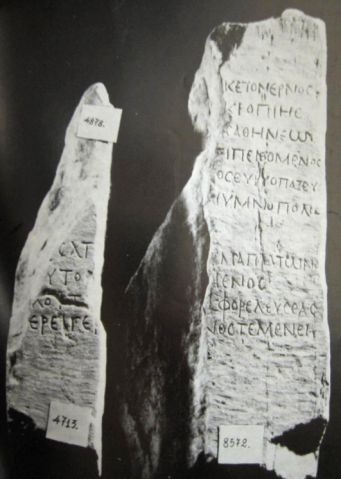
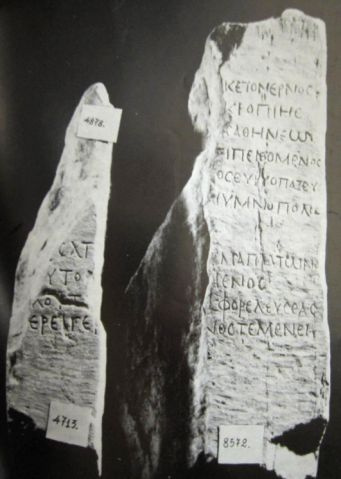
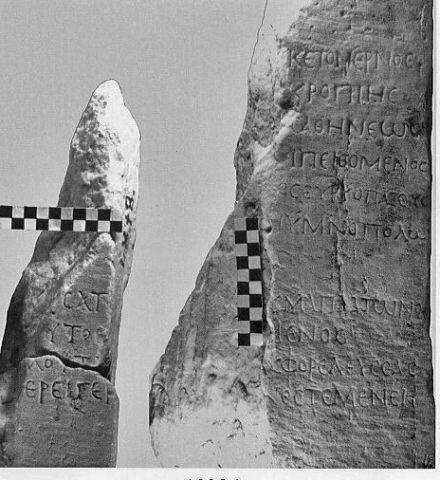
Three fragments of base for statue of Plutarchus. Athens (Achaea). Late fourth to early fifth century
Record details
Photographs
Inscription
[-------ἀριδε]ίִ̣κετον ἔρνος / [------- Κε]κροπίης / [--------δῆμο]ς Ἀθηνέων / -------Ι̣ πειθόμενος / (5) ----------ος εὐρύοπα Ζεὺς / -------Ι ὑμνοπόλῳ
[..]Υ̣ΣΑΠ̣ -------σμα Πλάτωνο[ς]
[πλο]ῦτος -------μενος
(3) [Π]λουτα̣[ρχ ------ Τελε]σφόρε, λεύσσας
[ἦ] ἱ̣¨ερεῖ γερ[α --- με]νος τεμένει
Inscription translation
... famous offspring ... of Cecropian ... of Athens ... complying with ... the far-seeing Zeus ... minstrel.
... of Plato ... the wealth ... Plutarchus ... having seen, o Telesphorus ... indeed, a gift of honour ... to the precincts of a temple. (trans. E. Sironen)
Bibliography
- Inscriptiones Graecae, II/III 12767a
- Inscriptiones Graecae, II/III(2) 13286
Discussion
INSCRIPTION
In verse. Parts of six lines, and then four lines, survive:
[-------ἀριδε]ίִ̣κετον ἔρνος / [------- Κε]κροπίης / [--------δῆμο]ς Ἀθηνέων / -------Ι̣ πειθόμενος / (5) ----------ος εὐρύοπα Ζεὺς / -------Ι ὑμνοπόλῳ
Space of 4 cm
[..]Υ̣ΣΑΠ̣ -------σμα Πλάτωνο[ς] / [πλο]ῦτος -------μενος / (3)[Π]λουτα̣[ρχ ------ Τελε]σφόρε, λεύσσας / [ἦ] ἱ̣¨ερεῖ γερ[α --- με]νος τεμένει
'... famous offspring ... of Cecropian ... of Athens ... complying with ... the far-seeing Zeus ... minstrel.' (trans. E. Sironen)
Space
'... of Plato ... the wealth ... Plutarchus ... having seen, o Telesphorus ... indeed, a gift of honour ... to the precincts of a temple.' (trans. E. Sironen)
Letter height 0.3 - 2 cm.
DESCRIPTION (from the published photos)
The inscription, of white marble, is preserved in three fragments, which were linked for the first time by Mitsos 1971. They come from a rectangular base. All fragments are broken on all sides. H 46 cm (a+b), 54 cm (c); W 10 cm (a, b), 23 cm (c); D 15 cm (a, b), 14 cm (c). The largest fragment, c (National Museum inv. no. 8572), preserves the right end of the epigraphic field with about one third of the inscription. Although broken on the right edge, the final letters are still legible. The inscription consisted of two epigrams separated by a space of 4 cm; the first is in six verses (three distichs), the second in four verses (two distichs).The smaller fragments, b (National Museum inv. no. 4878) and c (National Museum inv. no.4713), join horizontally. They preserve a part of the second epigram, the break cutting the third line of the epigram. The surface of the epigraphic field appears only roughly finished with a claw, which suggests that an earlier inscription was erased to make way for the present one. In the final line of the second epigram, with some probability the word γέρας - 'reward' can be reconstructed, which is widely used to refer to statues in late antique honorific epigrams.
PROVENANCE AND LOCATION
Fragment c was found in 1839 in the National Garden in Athens during the Lyceum Excavation (Sironen 1997, 85); nothing is known about the provenance of the other two fragments. All three are now preserved in the Epigraphic Museum in Athens, inv. no. 4713 (frgmt. a), 4878 (frgmt. b), 8572 (frgmt. c).
HONORAND AND DATE
E. Sironen attributed this honorific monument to Plutarchus, the head of the neo-platonist school in Athens in the late fourth and early fifth century (PLRE I, 708 Plutarchus 5, recorded also as PLRE II, 893 Plutarchus 1), because of the references to Plato and to the cult of Asclepius (Telesphorus (lit.: the one carrying the aim), line 3, referring to the genius who protects those recovering from disease, often depicted along with Asclepius, as small figure clad in a hood), both in the second epigram, the family of Plutarchus having been linked for generations with the priesthood of Asclepius (Sironen 1994, 49). The allusion to the Athenian origin of the honorand in the first epigram strengthens Sironen's attribution. Plutarchus died at a great age in 431/4. His honorific monument must therefore have been erected in the early 5th or late 4th century.
FURTHER DISCUSSION
The name Plutarchus is recorded on three honorific monuments in late antique Athens. The present one as an honorand, the second as the awarder of a statue for the praetorian prefect Herculius (where he is styled sophistes, LSA-137), and finally again as the honorand on a base set up by the people of Athens (LSA-134). Sironen attributes the latter two to a single individual, distinguishing him from the neo-platonist philosopher honoured by the present monument. It remains however possible that all three inscriptions refer to the same man, the head of the neo-platonist school (cf. Frantz 1988, 64).
Discussion references
- Frantz, A., Late Antiquity A. D. 267 - 700: The Athenian Agora XXIV, Princeton 1988, 63-4
- Sironen, E., The late Roman and early Byzantine inscriptions of Athens and Attica, Dissertation - University of Helsinki 1997, 85-7 no. 25
- Sironen, E. , 'Life and administration of late Roman Attica in the light of public inscriptions'
P. Castrén, Post-Herulian Athens : aspects of life and culture in Athens, A.D. 267-529 , Helsiniki 1994, 15-62, 48 no. 30 - Μιτσός, Μ. Θ., Ἀπὸ τοὺς καταλόγους Ἀθηναίων Ἐφήβων κλπ. (ΙΙΙ)
, Ἀρχαιολογικὴ Ἐφημερίς
, 1971, 56-65, 64-5 no. 7 pl. 7
Cite: Last Statues of Antiquity, LSA-136 (Ulrich Gehn).