
LSA-1363
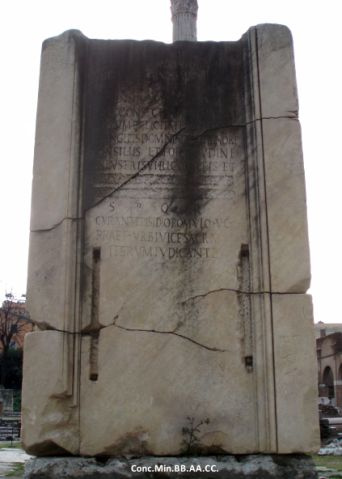
Base for statue dedicated to the 'Fides' and 'Virtus' of the emperor's soldiers. Rome, Forum. 406.
Record details
Photographs
Inscription
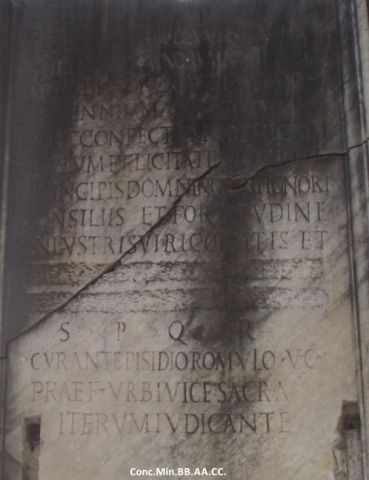
Fidei virtutiq(ue) devotissimorum / militum dom(i)norum nostrorum / Arcadi, Honori et Theodosi, / perennium Augustorum, /(5) post confectum Gothicum / bellum, felicitate aeterni / principis dom(i)ni nostri Honori, / consiliis et fortitudine / inlustris viri, comitis et /(10) [[[magistri utriusq(ue) militiae]]] / [[[Fl(avi) Stilichonis, bis co(n)s(ulis) ord(inarii)]]], / s(enatus) p(opulus)q(ue) R(omanus), / curante Pisidio Romulo, v(iro) c(larissimo), / praef(ecto) urbi, vice sacra /(15) iterum iudicante.
Inscription translation
To the loyalty and valour of the most devoted soldiers of our lords Arcadius, Honorius and Theodosius, eternal Augusti, after the war against the Goths was finished by the good fortune of our eternal emperor our lord Honorius, [and] the counsels and bravery of the count and master of both soldieries (magister utriusque militiae), Flavius Stilicho, of illustris rank, twice consul. The Senate and People of Rome [set this up], under the supervision of Pisidius Romulus, of clarissimus rank, prefect of the City, judge representing the emperor for the second time.
Bibliography
- Corpus Inscriptionum Latinarum; , VI, 31987 (+p. 4800)
Discussion
INSCRIPTION
In 15 lines.
Fidei virtutiq(ue) devotissimorum / militum dom(i)norum nostrorum / Arcadi, Honori et Theodosi, / perennium Augustorum, /(5) post confectum Gothicum / bellum, felicitate aeterni / principis dom(i)ni nostri Honori, / consiliis et fortitudine / inlustris viri, comitis et /(10) [[[magistri utriusq(ue) militiae]]] / [[[Fl(avi) Stilichonis, bis co(n)s(ulis) ord(inarii)]]], / s(enatus) p(opulus)q(ue) R(omanus), / curante Pisidio Romulo, v(iro) c(larissimo), / praef(ecto) urbi, vice sacra /(15) iterum iudicante.
'To the loyalty and valour of the most devoted soldiers of our lords Arcadius, Honorius and Theodosius, eternal Augusti, after the war against the Goths was finished by the good fortune of our eternal emperor our lord Honorius, [and] the counsels and bravery of the count and master of both soldieries (magister utriusque militiae), Flavius Stilicho, of illustris rank, twice consul. The Senate and People of Rome [set this up], under the supervision of Pisidius Romulus, of clarissimus rank, prefect of the City, judge representing the emperor for the second time.'
The name and titles of Stilicho (in lines 10-11) were erased, certainly after his downfall in 408.
The inscription records a dedication to the Fides and Virtus of the soldiers (ll. 1-3), but later associates the successes of the imperial armies against the Goths to the good fortune (felicitas) of Honorius, and the actions of the magister militum Flavius Stilicho. It is not clear whether the statue itself was of a virtue, of the emperor Honorius himself, or of Stilicho.
DESCRIPTION:
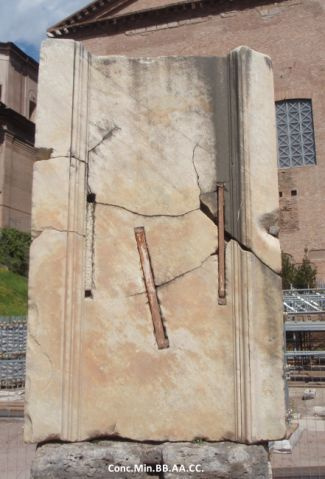
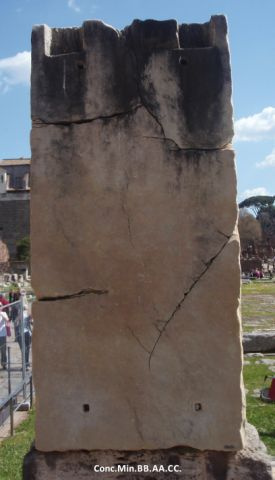
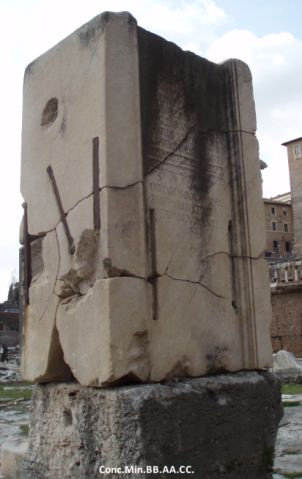
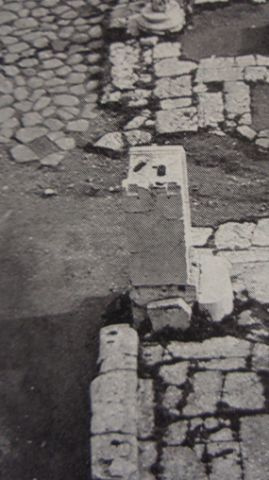
Large marble base, originally for an equestrian statue, turned on end when re-used for our dedication: H 230, W 148, D 100 cm. The base sits on top of a travertine block, 72 cm high, in its original position. The base is cracked in several places, and was held together by metal clamps already in Antiquity, some of which are still in situ, others testified to by their sunken settings (Giuliani and Verduchi 1987, 78). When made for an equestrian statue, the base had mouldings, top and bottom, on all sides; in its re-used form, the mouldings were cut back from what is now the bottom. The 'front', into which our dedication is carved, is framed by mouldings on its sides, is cracked in several places, and has the settings for two ancient metal clamps (which the inscription avoids). The right side is smoothly finished, though cracked; it has four small square dowel holes, and two roughly rectangular cuttings of uncertain date and function towards the top. The back is smoothly finished, and cracked, with three clamps (or settings for clamps). The left side, the original top face (when it was for an equestrian statue), is also cracked and has three clamps (or settings for clamps); it has four large, deep round holes, the fixings for a bronze horse. The present top (which bore the statue related to our dedication) has the clear imprints of a pair of feet; curiously, these do not face the inscribed front face of the base (and the Curia), but the right side (and the arch of Severus). There are also a small round dowel hole and a channel for pouring lead.
PROVENANCE AND CURRENT LOCATION
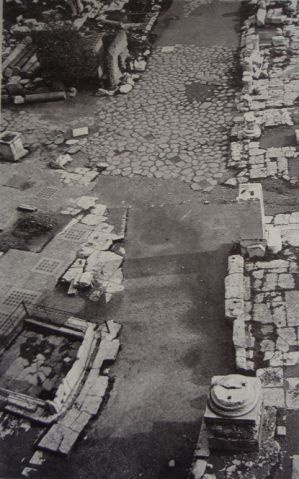
Our base, which stands in its original location in front of the Curia near the arch of Septimius Severus, was first excavated in 1583, but soon reburied. It was re-excavated in 1880, and remains in situ, Sopr. For-Pal. Inv. n. 12436.
HONORAND, AWARDER AND DATE
The identity of the statue that stood on this base is controversial and uncertain. Most scholars consider it to be a dedication to the powerful general and courtier Flavius Stilicho, as the inscription emphasizes his role in recent imperial victories over the Goths (Giuliani and Verduchi 1987, 77; PLRE I, 853-858 Stilicho). However, the text of the inscription, read literally, is a dedication to the Virtus and Fides of the soldiers of Arcadius, Honorius, and Theodosius II, and also celebrates the good fortune (felicitas) of Honorius' reign. The statue itself may therefore have been of a personification of the virtues celebrated (Chastagnol 1962, 263), or even perhaps an image of the emperor himself (Messerschmidt 2004, 559). It is also possible that Stilcho was represented, as himself the living personification of military Fides and Virtus.
Our monument was dedicated by the Senate and People of Rome, under the supervision of Flavius Pisidius Romulus, prefect of the City in 406.
FURTHER DISCUSSION
This is a strange monument in a number of ways. The identity of the statue it once bore is uncertain; and there is no apparent reason why this statue should have faced to the right, and not the front. The block of marble used is also of strikingly poor quality, perhaps from its very origins (so that it may never have been used for an equestrian statue), and is set on a block of travertine that was only roughly finished. Possibly these defects were originally masked by plaster (though no evidence of this survives); but what we see today contrasts markedly with the still high quality of other monuments of this same period, or even later, in Rome, and is particulalrly odd for such a prominent base set up in such a prime position.
Discussion references
- Chastagnol, A., Les fastes de la Préfecture de Rome au Bas-Empire, Paris 1962
- Giuliani, C. F, Verduchi, P., L'area centrale del Foro romano , Firenze 1987, pp. 77-78
- Jones, A. H. M. et al., The Prosopography of the Later Roman Empire. Vol. I 260-395, Cambridge et al. 1971 (1975), pp. 853-858 (Stilicho)
- Messerschmidt, W., "Die statuarische Repräsentation des theodosianischen Kaiserhauses in Rom", Römische Mitteilungen 111, 2004, pp. 555-567
Cite: Last Statues of Antiquity, LSA-1363 (Carlos Machado).